
About This Book
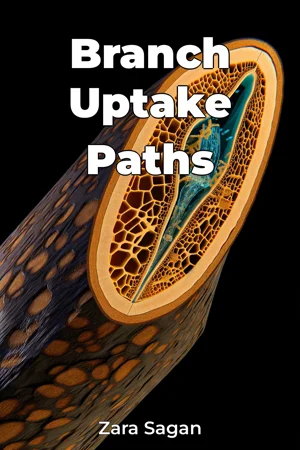
"Branch Uptake Paths" unravels the sophisticated mechanisms through which tree branches transport essential nutrients, revealing the hidden hydraulic networks that sustain forest ecosystems. Through detailed analysis of vascular architecture and nutrient flow dynamics, this comprehensive work examines how branches function as both conduits and processors in the tree's metabolic system. The book presents three core areas of investigation: the structural anatomy of branch vascular systems, real-time nutrient transport measurements, and the integration of branch networks within whole-tree physiology. These topics build upon decades of research in plant biology while incorporating recent technological advances in flow monitoring and 3D imaging techniques. Drawing from extensive field studies and laboratory research, the text establishes how branch architecture evolved to optimize nutrient distribution. The first section examines the fundamental structure of xylem and phloem tissues, utilizing advanced microscopy and tissue sampling to detail their organization. This foundation supports subsequent chapters on flow dynamics, where precise measurements reveal how branches actively modify their internal conditions to regulate nutrient movement. Central to the book's thesis is the demonstration that branches are not passive conduits but dynamic systems that respond to environmental conditions and tree metabolic demands. Through examination of pressure gradients, chemical signaling, and mechanical stress responses, the text shows how branches actively participate in resource allocation decisions. The research presented combines traditional botanical techniques with modern analytical methods, including: - Magnetic resonance imaging of live branches - Radioactive tracer studies of nutrient movement - Computational modeling of flow dynamics - Long-term monitoring of seasonal variations The work connects to multiple scientific disciplines, including fluid dynamics, materials science, and evolutionary biology. These interdisciplinary links help explain how physical principles constrain biological design and how trees have evolved solutions to transport challenges. Written in a technical yet accessible style, the book provides detailed explanations supported by extensive data visualization. While maintaining scientific rigor, it ensures key concepts are comprehensible to readers with basic biological knowledge. The target audience includes plant scientists, forestry professionals, and advanced students in related fields. The book addresses several current debates in plant biology, including the role of active transport versus passive flow, the importance of branch architecture in drought resistance, and the extent of communication between different parts of the tree through vascular networks. Practical applications of this research extend to: - Forest management and tree care - Agricultural practices for woody crops - Urban planning for tree health - Climate change adaptation strategies While focusing primarily on woody plants, the book acknowledges that similar principles may apply to other vascular plant systems. It maintains a specific scope centered on nutrient transport, deliberately limiting coverage of other aspects of tree biology except where directly relevant to vascular function. The work concludes by examining implications for forest health in changing climates, offering evidence-based perspectives on how branch systems may adapt to environmental stress. This research provides valuable insights for both theoretical understanding and practical application in plant science and forest management.
"Branch Uptake Paths" unravels the sophisticated mechanisms through which tree branches transport essential nutrients, revealing the hidden hydraulic networks that sustain forest ecosystems. Through detailed analysis of vascular architecture and nutrient flow dynamics, this comprehensive work examines how branches function as both conduits and processors in the tree's metabolic system. The book presents three core areas of investigation: the structural anatomy of branch vascular systems, real-time nutrient transport measurements, and the integration of branch networks within whole-tree physiology. These topics build upon decades of research in plant biology while incorporating recent technological advances in flow monitoring and 3D imaging techniques. Drawing from extensive field studies and laboratory research, the text establishes how branch architecture evolved to optimize nutrient distribution. The first section examines the fundamental structure of xylem and phloem tissues, utilizing advanced microscopy and tissue sampling to detail their organization. This foundation supports subsequent chapters on flow dynamics, where precise measurements reveal how branches actively modify their internal conditions to regulate nutrient movement. Central to the book's thesis is the demonstration that branches are not passive conduits but dynamic systems that respond to environmental conditions and tree metabolic demands. Through examination of pressure gradients, chemical signaling, and mechanical stress responses, the text shows how branches actively participate in resource allocation decisions. The research presented combines traditional botanical techniques with modern analytical methods, including: - Magnetic resonance imaging of live branches - Radioactive tracer studies of nutrient movement - Computational modeling of flow dynamics - Long-term monitoring of seasonal variations The work connects to multiple scientific disciplines, including fluid dynamics, materials science, and evolutionary biology. These interdisciplinary links help explain how physical principles constrain biological design and how trees have evolved solutions to transport challenges. Written in a technical yet accessible style, the book provides detailed explanations supported by extensive data visualization. While maintaining scientific rigor, it ensures key concepts are comprehensible to readers with basic biological knowledge. The target audience includes plant scientists, forestry professionals, and advanced students in related fields. The book addresses several current debates in plant biology, including the role of active transport versus passive flow, the importance of branch architecture in drought resistance, and the extent of communication between different parts of the tree through vascular networks. Practical applications of this research extend to: - Forest management and tree care - Agricultural practices for woody crops - Urban planning for tree health - Climate change adaptation strategies While focusing primarily on woody plants, the book acknowledges that similar principles may apply to other vascular plant systems. It maintains a specific scope centered on nutrient transport, deliberately limiting coverage of other aspects of tree biology except where directly relevant to vascular function. The work concludes by examining implications for forest health in changing climates, offering evidence-based perspectives on how branch systems may adapt to environmental stress. This research provides valuable insights for both theoretical understanding and practical application in plant science and forest management.
"Branch Uptake Paths" offers a fascinating exploration of how trees transport and process nutrients through their intricate branch networks, revealing these structures as dynamic, responsive systems rather than simple passive pipes. The book masterfully combines traditional botanical research with cutting-edge technology, including magnetic resonance imaging and radioactive tracers, to illuminate the sophisticated mechanisms that sustain forest ecosystems. Through a carefully structured progression, the text first establishes the fundamental anatomy of branch vascular systems, focusing on the complex organization of xylem and phloem tissues. It then delves into the real-time dynamics of nutrient transport, demonstrating how branches actively modify their internal conditions to regulate resource distribution. The investigation reveals remarkable adaptations in branch architecture that have evolved to optimize nutrient flow, supported by detailed analysis of pressure gradients and chemical signaling patterns. The book's approach bridges multiple scientific disciplines, making complex botanical concepts accessible while maintaining scientific rigor. By combining traditional research methods with modern analytical techniques, it provides valuable insights for both theoretical understanding and practical applications in forest management and tree care. The work is particularly relevant for those interested in how trees might adapt to environmental stress and changing climates, offering evidence-based perspectives that connect fundamental plant biology to urgent environmental challenges.
Book Details
ISBN
9788233945855
Publisher
Publifye AS
Your Licenses
You don't own any licenses for this book
Purchase a license below to unlock this book and download the EPUB.
Purchase License
Select a tier to unlock this book
Need bulk licensing?
Contact us for enterprise agreements.