
About This Book
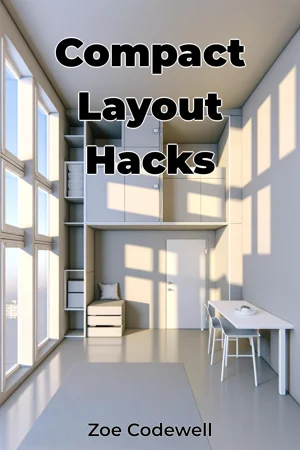
"Compact Layout Hacks" addresses the pressing challenge of maximizing living space in an era where urban housing continues to shrink, offering research-based solutions for transforming small spaces into highly functional environments. The book centers on three fundamental principles: spatial optimization through modular design, psychological aspects of space perception, and sustainable approaches to compact living. These concepts are particularly relevant as global urbanization trends show that by 2050, 68% of the world's population will live in cities, making efficient space utilization a critical skill. Drawing from architectural history, the text traces the evolution of space-saving design from traditional Japanese homes to modern micro-apartments, providing context for contemporary solutions. The book establishes that effective small-space design requires understanding both architectural principles and human behavioral patterns in confined spaces. The central thesis argues that successful compact living depends not on minimal possession, but on intelligent space organization through integrated design systems. This approach challenges conventional thinking about small spaces, presenting them as opportunities for innovation rather than limitations. The content progresses through three major sections: First, it examines the science of spatial perception and how design elements influence space functionality. Second, it presents a comprehensive system of modular furniture solutions, including detailed technical specifications and implementation guidelines. Third, it explores storage integration techniques based on anthropometric data and usage patterns. Research support comes from multiple sources, including case studies of award-winning micro-apartments, environmental psychology studies on space perception, and quantitative analysis of movement patterns in compact spaces. The book incorporates data from the International Standards Organization (ISO) regarding human dimensions and spatial requirements. The work connects architecture with psychology, engineering, and environmental science, demonstrating how materials science influences furniture design and how cognitive psychology affects space perception. These interdisciplinary links provide a comprehensive framework for understanding compact living solutions. The book's unique contribution lies in its systematic approach to space optimization, presenting a modular design framework that can be adapted to various living situations. It includes specialized measuring tools and planning matrices developed through extensive research. Written in a technical yet accessible style, the text balances theoretical concepts with practical applications, using clear diagrams, photographs, and step-by-step instructions. Each chapter includes implementation examples and troubleshooting guides. The primary audience includes urban dwellers, interior designers, architects, and space planning professionals seeking evidence-based solutions for compact living challenges. The content is particularly relevant for those working with spaces under 800 square feet. Following design and architecture genre conventions, the book includes technical drawings, spatial analysis diagrams, and detailed specifications while maintaining readability for non-specialists. The scope focuses specifically on residential spaces under 800 square feet, addressing both renovation and new construction scenarios. While commercial applications are mentioned, they are not the primary focus. Practical applications include detailed guides for furniture selection, room layout optimization, and storage system implementation, supported by downloadable planning tools and calculation sheets. The book addresses ongoing debates about minimal square footage requirements in urban housing and the balance between density and livability in modern cities, presenting research-based perspectives on these issues. Throughout, the focus remains on measurable outcomes and practical solutions, providing readers with tools and methods to implement efficient design strategies in their own spaces.
"Compact Layout Hacks" addresses the pressing challenge of maximizing living space in an era where urban housing continues to shrink, offering research-based solutions for transforming small spaces into highly functional environments. The book centers on three fundamental principles: spatial optimization through modular design, psychological aspects of space perception, and sustainable approaches to compact living. These concepts are particularly relevant as global urbanization trends show that by 2050, 68% of the world's population will live in cities, making efficient space utilization a critical skill. Drawing from architectural history, the text traces the evolution of space-saving design from traditional Japanese homes to modern micro-apartments, providing context for contemporary solutions. The book establishes that effective small-space design requires understanding both architectural principles and human behavioral patterns in confined spaces. The central thesis argues that successful compact living depends not on minimal possession, but on intelligent space organization through integrated design systems. This approach challenges conventional thinking about small spaces, presenting them as opportunities for innovation rather than limitations. The content progresses through three major sections: First, it examines the science of spatial perception and how design elements influence space functionality. Second, it presents a comprehensive system of modular furniture solutions, including detailed technical specifications and implementation guidelines. Third, it explores storage integration techniques based on anthropometric data and usage patterns. Research support comes from multiple sources, including case studies of award-winning micro-apartments, environmental psychology studies on space perception, and quantitative analysis of movement patterns in compact spaces. The book incorporates data from the International Standards Organization (ISO) regarding human dimensions and spatial requirements. The work connects architecture with psychology, engineering, and environmental science, demonstrating how materials science influences furniture design and how cognitive psychology affects space perception. These interdisciplinary links provide a comprehensive framework for understanding compact living solutions. The book's unique contribution lies in its systematic approach to space optimization, presenting a modular design framework that can be adapted to various living situations. It includes specialized measuring tools and planning matrices developed through extensive research. Written in a technical yet accessible style, the text balances theoretical concepts with practical applications, using clear diagrams, photographs, and step-by-step instructions. Each chapter includes implementation examples and troubleshooting guides. The primary audience includes urban dwellers, interior designers, architects, and space planning professionals seeking evidence-based solutions for compact living challenges. The content is particularly relevant for those working with spaces under 800 square feet. Following design and architecture genre conventions, the book includes technical drawings, spatial analysis diagrams, and detailed specifications while maintaining readability for non-specialists. The scope focuses specifically on residential spaces under 800 square feet, addressing both renovation and new construction scenarios. While commercial applications are mentioned, they are not the primary focus. Practical applications include detailed guides for furniture selection, room layout optimization, and storage system implementation, supported by downloadable planning tools and calculation sheets. The book addresses ongoing debates about minimal square footage requirements in urban housing and the balance between density and livability in modern cities, presenting research-based perspectives on these issues. Throughout, the focus remains on measurable outcomes and practical solutions, providing readers with tools and methods to implement efficient design strategies in their own spaces.
"Compact Layout Hacks" offers a groundbreaking approach to maximizing small living spaces through a fusion of scientific research and practical design solutions. At its core, the book addresses the growing challenge of urban housing density by presenting innovative strategies for transforming compact spaces into highly functional environments. Through three main principles—modular design, psychological space perception, and sustainable living—the book provides a comprehensive framework for understanding and implementing effective space optimization. The book uniquely bridges the gap between theoretical concepts and practical applications, drawing from diverse fields including architectural history, environmental psychology, and anthropometric studies. Readers journey through the evolution of space-saving design, from traditional Japanese architecture to contemporary micro-apartments, while learning how design elements influence both spatial functionality and human behavior in confined spaces. Rather than advocating minimalism, the book emphasizes intelligent space organization through integrated design systems. Progressing through three distinct sections, the work first explores the science of spatial perception, then presents detailed modular furniture solutions, and finally delves into storage integration techniques. What sets this resource apart is its systematic approach, featuring specialized measuring tools and planning matrices developed through extensive research. For urban dwellers, designers, and architects working with spaces under 800 square feet, the book provides evidence-based solutions supported by clear diagrams, technical specifications, and practical implementation guidelines, making complex design principles accessible to both professionals and enthusiasts.
Book Details
ISBN
9788233945756
Publisher
Publifye AS
Your Licenses
You don't own any licenses for this book
Purchase a license below to unlock this book and download the EPUB.
Purchase License
Select a tier to unlock this book
Need bulk licensing?
Contact us for enterprise agreements.