
About This Book
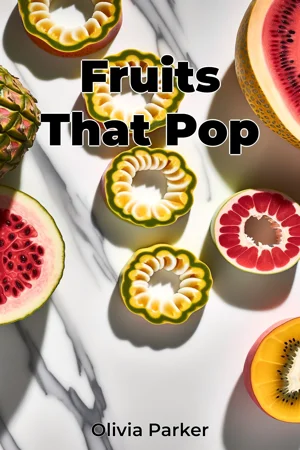
"Fruits That Pop" challenges conventional perspectives on familiar fruits by presenting a comprehensive exploration of their nutritional profiles, cultural significance, and historical evolution. The book opens with a provocative question: "What if the fruits in your kitchen held secrets that could reshape your understanding of human history and health?" This research-based guide interweaves three primary threads: the biochemical composition of fruits and their impact on human health, the anthropological significance of fruit cultivation across civilizations, and practical applications for optimal fruit consumption in modern diets. Drawing from peer-reviewed dietetic journals and WHO nutritional guidelines, the book establishes clear connections between fruit consumption patterns and health outcomes. The narrative is structured in three distinct sections. The first examines the science behind fruit nutrition, detailing specific compounds like flavonoids, anthocyanins, and their roles in human metabolism. The second section traces the agricultural and cultural evolution of key fruits, from ancient wild varieties to modern cultivars. The final section provides practical frameworks for incorporating fruits strategically into daily nutrition plans. Supporting evidence comes from multiple sources, including archaeological findings, botanical research, and contemporary nutritional studies. The book references the Harvard School of Public Health's longitudinal studies on fruit consumption, alongside data from global agricultural databases and ethnobotanical research. The work makes notable connections across disciplines, linking biochemistry with anthropology, and agricultural science with preventive medicine. This interdisciplinary approach provides readers with a multi-faceted understanding of how fruits have shaped human development and continue to influence health outcomes. What distinguishes this book is its integration of historical context with practical application. Rather than simply listing health benefits, it explains the evolutionary adaptations that led to specific nutrient profiles in different fruits, making the information both memorable and applicable. Written in an accessible academic style, the text balances scientific precision with engaging narrative elements. Technical concepts are explained through relatable analogies and real-world examples, making complex biochemical processes understandable to general readers. The target audience includes health-conscious individuals, nutrition professionals, and anyone interested in the intersection of food science and history. The book particularly appeals to readers seeking evidence-based information about optimal fruit consumption and its impact on health. The content adheres to health and fitness genre conventions by providing actionable advice while maintaining scientific rigor. Each chapter includes practical tips, serving suggestions, and storage recommendations based on current food science research. While the book covers major fruit varieties and their properties, it acknowledges limitations in discussing every known variety. Instead, it focuses on principles that readers can apply to any fruit they encounter. The work addresses ongoing debates in nutrition science, including discussions about fructose consumption, organic versus conventional farming methods, and the impact of modern agricultural practices on nutrient density. These topics are presented objectively, with evidence from multiple perspectives. Throughout the text, readers gain practical knowledge about selecting, storing, and consuming fruits for maximum nutritional benefit. The information is grounded in current research while remaining accessible to readers without scientific backgrounds, creating a valuable resource for anyone seeking to optimize their fruit consumption through informed choices.
"Fruits That Pop" challenges conventional perspectives on familiar fruits by presenting a comprehensive exploration of their nutritional profiles, cultural significance, and historical evolution. The book opens with a provocative question: "What if the fruits in your kitchen held secrets that could reshape your understanding of human history and health?" This research-based guide interweaves three primary threads: the biochemical composition of fruits and their impact on human health, the anthropological significance of fruit cultivation across civilizations, and practical applications for optimal fruit consumption in modern diets. Drawing from peer-reviewed dietetic journals and WHO nutritional guidelines, the book establishes clear connections between fruit consumption patterns and health outcomes. The narrative is structured in three distinct sections. The first examines the science behind fruit nutrition, detailing specific compounds like flavonoids, anthocyanins, and their roles in human metabolism. The second section traces the agricultural and cultural evolution of key fruits, from ancient wild varieties to modern cultivars. The final section provides practical frameworks for incorporating fruits strategically into daily nutrition plans. Supporting evidence comes from multiple sources, including archaeological findings, botanical research, and contemporary nutritional studies. The book references the Harvard School of Public Health's longitudinal studies on fruit consumption, alongside data from global agricultural databases and ethnobotanical research. The work makes notable connections across disciplines, linking biochemistry with anthropology, and agricultural science with preventive medicine. This interdisciplinary approach provides readers with a multi-faceted understanding of how fruits have shaped human development and continue to influence health outcomes. What distinguishes this book is its integration of historical context with practical application. Rather than simply listing health benefits, it explains the evolutionary adaptations that led to specific nutrient profiles in different fruits, making the information both memorable and applicable. Written in an accessible academic style, the text balances scientific precision with engaging narrative elements. Technical concepts are explained through relatable analogies and real-world examples, making complex biochemical processes understandable to general readers. The target audience includes health-conscious individuals, nutrition professionals, and anyone interested in the intersection of food science and history. The book particularly appeals to readers seeking evidence-based information about optimal fruit consumption and its impact on health. The content adheres to health and fitness genre conventions by providing actionable advice while maintaining scientific rigor. Each chapter includes practical tips, serving suggestions, and storage recommendations based on current food science research. While the book covers major fruit varieties and their properties, it acknowledges limitations in discussing every known variety. Instead, it focuses on principles that readers can apply to any fruit they encounter. The work addresses ongoing debates in nutrition science, including discussions about fructose consumption, organic versus conventional farming methods, and the impact of modern agricultural practices on nutrient density. These topics are presented objectively, with evidence from multiple perspectives. Throughout the text, readers gain practical knowledge about selecting, storing, and consuming fruits for maximum nutritional benefit. The information is grounded in current research while remaining accessible to readers without scientific backgrounds, creating a valuable resource for anyone seeking to optimize their fruit consumption through informed choices.
"Fruits That Pop" presents a fascinating exploration of fruits through the lenses of science, history, and nutrition, offering readers a revolutionary perspective on these everyday foods. This comprehensive guide masterfully weaves together biochemical analysis, anthropological insights, and practical dietary advice to demonstrate how fruits have shaped human development and continue to influence our health. Through meticulous research drawing from peer-reviewed journals and WHO guidelines, the book reveals the intricate connections between fruit consumption patterns and wellness outcomes. The book's unique three-part structure begins with an in-depth examination of fruit biochemistry, detailing the roles of compounds like flavonoids and anthocyanins in human metabolism. The narrative then transitions to an engaging exploration of fruit cultivation throughout human history, tracing the evolution from ancient wild varieties to modern cultivars. The final section provides practical frameworks for incorporating fruits into daily nutrition plans, making the scientific insights immediately applicable to readers' lives. What sets this work apart is its interdisciplinary approach, combining elements of biochemistry, anthropology, and preventive medicine to create a comprehensive understanding of fruit's role in human health. Written in an accessible style that balances scientific accuracy with engaging storytelling, the book transforms complex nutritional concepts into digestible information through relevant examples and analogies. For health-conscious readers and nutrition professionals alike, it serves as both an educational resource and a practical guide for optimal fruit consumption.
Book Details
ISBN
9788233945633
Publisher
Publifye AS
Your Licenses
You don't own any licenses for this book
Purchase a license below to unlock this book and download the EPUB.
Purchase License
Select a tier to unlock this book
Need bulk licensing?
Contact us for enterprise agreements.