
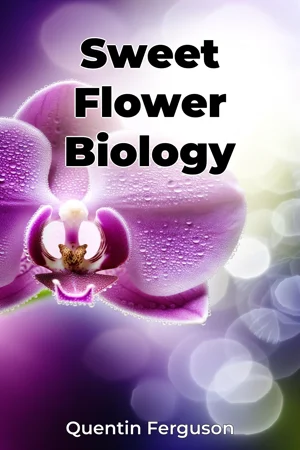
About This Book
"Sweet Flower Biology" opens by posing a fundamental question: How do flowering plants, which comprise over 80% of all known living plant species, maintain their dominance in Earth's ecosystems while simultaneously supporting human civilization? This comprehensive exploration of flowering plants combines current botanical research with ecological insights to reveal the sophisticated mechanisms that make angiosperms central to life on Earth. The book examines three core areas: the intricate architecture of flowers, from cellular structures to visible anatomy; the complex processes of pollination and reproduction; and the vital ecological relationships between flowering plants and other organisms. These topics are presented through the lens of recent scientific discoveries, including breakthrough research on the genetic basis of petal development and the biochemical pathways responsible for scent production. Drawing from extensive botanical studies and field research, the text provides detailed analyses of flower evolution, demonstrating how simple reproductive structures developed into the diverse array of flowering plants present today. The book incorporates findings from molecular biology, genetics, and environmental science to explain how flowers have adapted to various ecosystems and climate conditions. The central thesis argues that flowering plants represent one of the most successful evolutionary innovations in Earth's history, achieving this status through their ability to form complex relationships with pollinators, adapt to diverse environments, and support extensive ecological networks. This argument is supported by data from long-term studies of plant-pollinator interactions, fossil records, and DNA analysis. The content is structured in three main sections. The first examines flower anatomy and development, including cellular mechanisms controlling growth and specialization. The second focuses on reproduction, featuring detailed coverage of pollination strategies and seed dispersal methods. The final section explores ecological relationships, emphasizing the role of flowering plants in food webs and ecosystem stability. The book connects biology with chemistry, discussing the biochemical processes behind flower pigmentation and fragrance production. It also links to environmental science through examination of plant responses to climate change, and to agricultural science through analyses of crop breeding and food security. What distinguishes this work is its integration of traditional botanical knowledge with modern research techniques, including electron microscopy images of flower development and molecular studies of scent production. The writing maintains an academic rigor while remaining accessible to readers with basic scientific knowledge. The target audience includes biology students, botanists, ecologists, and educated general readers interested in plant science. The text provides practical applications for gardeners, conservationists, and those involved in habitat restoration, including specific information about plant-pollinator relationships and ecosystem maintenance. The book addresses current debates in the field, such as the impact of climate change on flowering timing and the effects of agricultural practices on plant-pollinator relationships. It examines these issues through evidence-based analysis rather than advocacy. While the scope encompasses flowering plants globally, it focuses primarily on well-studied species and ecosystems where research data is extensive. This approach allows for detailed examination of key principles while acknowledging gaps in current knowledge about many tropical and rare species. The work concludes by examining practical applications of flower biology in agriculture, conservation, and ecosystem restoration, providing readers with tools to apply scientific understanding to real-world challenges in plant conservation and ecosystem management.
"Sweet Flower Biology" opens by posing a fundamental question: How do flowering plants, which comprise over 80% of all known living plant species, maintain their dominance in Earth's ecosystems while simultaneously supporting human civilization? This comprehensive exploration of flowering plants combines current botanical research with ecological insights to reveal the sophisticated mechanisms that make angiosperms central to life on Earth. The book examines three core areas: the intricate architecture of flowers, from cellular structures to visible anatomy; the complex processes of pollination and reproduction; and the vital ecological relationships between flowering plants and other organisms. These topics are presented through the lens of recent scientific discoveries, including breakthrough research on the genetic basis of petal development and the biochemical pathways responsible for scent production. Drawing from extensive botanical studies and field research, the text provides detailed analyses of flower evolution, demonstrating how simple reproductive structures developed into the diverse array of flowering plants present today. The book incorporates findings from molecular biology, genetics, and environmental science to explain how flowers have adapted to various ecosystems and climate conditions. The central thesis argues that flowering plants represent one of the most successful evolutionary innovations in Earth's history, achieving this status through their ability to form complex relationships with pollinators, adapt to diverse environments, and support extensive ecological networks. This argument is supported by data from long-term studies of plant-pollinator interactions, fossil records, and DNA analysis. The content is structured in three main sections. The first examines flower anatomy and development, including cellular mechanisms controlling growth and specialization. The second focuses on reproduction, featuring detailed coverage of pollination strategies and seed dispersal methods. The final section explores ecological relationships, emphasizing the role of flowering plants in food webs and ecosystem stability. The book connects biology with chemistry, discussing the biochemical processes behind flower pigmentation and fragrance production. It also links to environmental science through examination of plant responses to climate change, and to agricultural science through analyses of crop breeding and food security. What distinguishes this work is its integration of traditional botanical knowledge with modern research techniques, including electron microscopy images of flower development and molecular studies of scent production. The writing maintains an academic rigor while remaining accessible to readers with basic scientific knowledge. The target audience includes biology students, botanists, ecologists, and educated general readers interested in plant science. The text provides practical applications for gardeners, conservationists, and those involved in habitat restoration, including specific information about plant-pollinator relationships and ecosystem maintenance. The book addresses current debates in the field, such as the impact of climate change on flowering timing and the effects of agricultural practices on plant-pollinator relationships. It examines these issues through evidence-based analysis rather than advocacy. While the scope encompasses flowering plants globally, it focuses primarily on well-studied species and ecosystems where research data is extensive. This approach allows for detailed examination of key principles while acknowledging gaps in current knowledge about many tropical and rare species. The work concludes by examining practical applications of flower biology in agriculture, conservation, and ecosystem restoration, providing readers with tools to apply scientific understanding to real-world challenges in plant conservation and ecosystem management.
"Sweet Flower Biology" presents a fascinating exploration of flowering plants' remarkable dominance in Earth's ecosystems, examining how these species—which make up more than 80% of known plants—have become fundamental to both natural systems and human civilization. Through a carefully structured approach, the book weaves together current botanical research, ecological insights, and evolutionary history to reveal the sophisticated mechanisms that make angiosperms essential to life on Earth. The text progresses logically through three main sections, beginning with an in-depth look at flower anatomy and cellular development, then moving to the intricacies of pollination and reproduction, and culminating in an examination of crucial ecological relationships. Notable insights include breakthrough research on genetic foundations of petal development and the complex biochemical pathways behind scent production. The book particularly shines in its integration of traditional botanical knowledge with cutting-edge research techniques, including electron microscopy and molecular studies. What sets this work apart is its comprehensive yet accessible treatment of complex biological concepts, making it valuable for both academic audiences and informed general readers. The book bridges multiple scientific disciplines, connecting biology with chemistry and environmental science, while maintaining a focus on practical applications for conservation and ecosystem management. Through evidence-based analysis, it addresses current challenges in plant conservation and climate change impacts, offering readers both theoretical understanding and practical tools for addressing real-world ecological challenges.
Book Details
ISBN
9788233945572
Publisher
Publifye AS
Your Licenses
You don't own any licenses for this book
Purchase a license below to unlock this book and download the EPUB.
Purchase License
Select a tier to unlock this book
Need bulk licensing?
Contact us for enterprise agreements.