
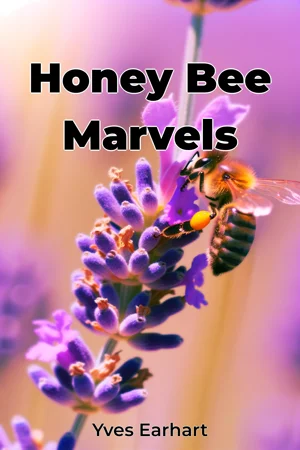
About This Book
"Honey Bee Marvels" delves into the intricate social structure and biological systems of honey bees, presenting new research that illuminates their critical role in global ecosystems and agriculture. Through detailed field observations and current scientific data, this comprehensive guide examines how these insects maintain complex societies while contributing to worldwide food security through pollination. The book begins by exploring the sophisticated architecture of bee colonies, where thousands of individuals work in precise coordination. Drawing from recent studies in behavioral biology, it reveals how bees communicate through dance languages, maintain thermal regulation within their hives, and organize labor divisions with remarkable efficiency. This section incorporates findings from leading apiaries and research institutions, providing readers with current understanding of hive dynamics. Central to the work is an analysis of honey production biochemistry and its relationship to pollination. The text examines how bees convert nectar into honey through enzymatic processes, while simultaneously facilitating plant reproduction across vast agricultural regions. This dual process represents one of nature's most refined examples of species interdependence and energy transfer within ecosystems. The book presents evidence through multiple research methodologies, including thermal imaging of hives, chemical analysis of honey varieties, and long-term population studies. These data sources combine to create a comprehensive picture of bee biology and behavior, supported by contributions from international researchers and agricultural scientists. Interdisciplinary connections link bee behavior to principles of engineering, particularly in studies of hive construction and temperature regulation. The text also explores connections to chemistry through the analysis of honey composition and agricultural science through examination of crop pollination efficiency. The writing maintains an accessible academic tone, presenting complex scientific concepts through clear explanations and relevant examples. Technical terms are carefully introduced and explained, making the content approachable for both science students and interested general readers. Practical applications receive significant attention, with detailed sections on beekeeping practices, crop pollination management, and conservation strategies. The book addresses current challenges facing bee populations, including colony collapse disorder, pesticide impacts, and habitat loss, providing evidence-based solutions for these issues. The scope encompasses both micro and macro perspectives, from individual bee anatomy to global pollination patterns. While focused primarily on honey bees, the text acknowledges their relationship with other pollinator species and their collective impact on ecosystem stability. This work serves multiple audiences, including biology students, agricultural professionals, and conservation practitioners. The content provides both theoretical understanding and practical applications, making it valuable for academic study and field implementation. The book addresses ongoing debates in the field, particularly regarding the impacts of modern agricultural practices on bee populations and the development of sustainable pollination strategies. It presents current research on these topics while acknowledging areas where scientific consensus is still developing. Through this structured approach, "Honey Bee Marvels" provides readers with a robust understanding of honey bee biology, behavior, and ecological significance, while maintaining scientific accuracy and practical relevance. The work contributes to both theoretical knowledge and applied sciences, serving as a comprehensive resource for understanding these essential insects.
"Honey Bee Marvels" delves into the intricate social structure and biological systems of honey bees, presenting new research that illuminates their critical role in global ecosystems and agriculture. Through detailed field observations and current scientific data, this comprehensive guide examines how these insects maintain complex societies while contributing to worldwide food security through pollination. The book begins by exploring the sophisticated architecture of bee colonies, where thousands of individuals work in precise coordination. Drawing from recent studies in behavioral biology, it reveals how bees communicate through dance languages, maintain thermal regulation within their hives, and organize labor divisions with remarkable efficiency. This section incorporates findings from leading apiaries and research institutions, providing readers with current understanding of hive dynamics. Central to the work is an analysis of honey production biochemistry and its relationship to pollination. The text examines how bees convert nectar into honey through enzymatic processes, while simultaneously facilitating plant reproduction across vast agricultural regions. This dual process represents one of nature's most refined examples of species interdependence and energy transfer within ecosystems. The book presents evidence through multiple research methodologies, including thermal imaging of hives, chemical analysis of honey varieties, and long-term population studies. These data sources combine to create a comprehensive picture of bee biology and behavior, supported by contributions from international researchers and agricultural scientists. Interdisciplinary connections link bee behavior to principles of engineering, particularly in studies of hive construction and temperature regulation. The text also explores connections to chemistry through the analysis of honey composition and agricultural science through examination of crop pollination efficiency. The writing maintains an accessible academic tone, presenting complex scientific concepts through clear explanations and relevant examples. Technical terms are carefully introduced and explained, making the content approachable for both science students and interested general readers. Practical applications receive significant attention, with detailed sections on beekeeping practices, crop pollination management, and conservation strategies. The book addresses current challenges facing bee populations, including colony collapse disorder, pesticide impacts, and habitat loss, providing evidence-based solutions for these issues. The scope encompasses both micro and macro perspectives, from individual bee anatomy to global pollination patterns. While focused primarily on honey bees, the text acknowledges their relationship with other pollinator species and their collective impact on ecosystem stability. This work serves multiple audiences, including biology students, agricultural professionals, and conservation practitioners. The content provides both theoretical understanding and practical applications, making it valuable for academic study and field implementation. The book addresses ongoing debates in the field, particularly regarding the impacts of modern agricultural practices on bee populations and the development of sustainable pollination strategies. It presents current research on these topics while acknowledging areas where scientific consensus is still developing. Through this structured approach, "Honey Bee Marvels" provides readers with a robust understanding of honey bee biology, behavior, and ecological significance, while maintaining scientific accuracy and practical relevance. The work contributes to both theoretical knowledge and applied sciences, serving as a comprehensive resource for understanding these essential insects.
"Honey Bee Marvels" offers a fascinating exploration of these remarkable insects, weaving together cutting-edge research and practical insights about their crucial role in global ecosystems. The book masterfully reveals how honey bees maintain intricate social structures while performing their vital role in worldwide food security through pollination. From their sophisticated dance-based communication to their precise thermal regulation abilities, these tiny creatures demonstrate remarkable complexity in their colony operations. The text progresses from microscopic details of bee biology to broader ecological impacts, examining how bees convert nectar into honey while facilitating plant reproduction across agricultural landscapes. Through detailed field observations and scientific data, readers discover the impressive engineering behind hive construction and the biochemistry of honey production. The book's approach combines thermal imaging studies, chemical analysis, and long-term population research to present a comprehensive understanding of these industrious insects. What sets this work apart is its accessible presentation of complex scientific concepts, making it valuable for both academic and general audiences interested in biology and environmental science. While addressing critical issues like colony collapse disorder and habitat loss, the book provides evidence-based solutions for bee conservation. The integration of multiple disciplines – from engineering to agricultural science – offers readers a holistic view of how these remarkable insects maintain their colonies while playing an irreplaceable role in global ecosystem health.
Book Details
ISBN
9788233945527
Publisher
Publifye AS
Your Licenses
You don't own any licenses for this book
Purchase a license below to unlock this book and download the EPUB.
Purchase License
Select a tier to unlock this book
Need bulk licensing?
Contact us for enterprise agreements.