
About This Book
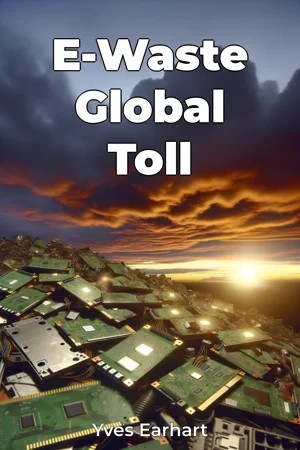
"E-Waste Global Toll" opens with a stark revelation: every year, the world generates over 50 million metric tons of electronic waste, equivalent to throwing away 800 laptops per second. This comprehensive examination of the global electronic waste crisis presents a detailed analysis of how discarded electronics reshape environments, communities, and human health across continents. The book structures its investigation around three primary themes: the lifecycle of electronic devices from production to disposal, the environmental and health consequences of improper e-waste management, and the complex international networks of formal and informal recycling systems. Through documented case studies from major e-waste processing regions, including Ghana's Agbogbloshie and China's Guiyu region, readers gain insight into the real-world implications of digital consumption. Drawing from research by the United Nations Environment Programme, World Health Organization, and independent environmental agencies, the book presents evidence-based analyses of soil contamination, water pollution, and atmospheric degradation caused by improper e-waste disposal. Statistical data tracks the movement of hazardous materials across borders, while medical studies reveal the impact of toxic exposure on workers and nearby communities. The central argument posits that current e-waste management practices create an unsustainable burden on developing nations while posing global environmental risks that transcend geographical boundaries. The book demonstrates how this challenge intersects with international trade, public health, environmental justice, and technological innovation. Each chapter builds upon this framework, examining specific aspects such as: - Chemical composition of common electronic devices and their environmental persistence - Documentation of recycling practices across formal and informal sectors - Economic drivers behind transboundary e-waste movement - Public health impacts, supported by epidemiological studies - Emerging solutions in sustainable electronics design and circular economy approaches The research synthesizes technical reports from environmental protection agencies, peer-reviewed scientific studies, and field investigations by environmental organizations. It features original interviews with recycling facility operators, public health officials, and environmental scientists, providing multiple perspectives on this complex issue. The book connects electronics manufacturing, environmental science, public health, and international development, demonstrating how e-waste management affects climate change, resource depletion, and global inequality. These interdisciplinary connections help readers understand the far-reaching implications of consumer electronics disposal. Written in an accessible academic style, the text balances technical information with clear explanations suitable for policymakers, environmental professionals, and concerned citizens. It includes detailed diagrams, chemical analyses, and case studies while maintaining readability for non-specialist audiences. The scope encompasses both current practices and future projections, though it focuses primarily on consumer electronics rather than industrial equipment. It addresses ongoing debates about producer responsibility, international waste trade regulations, and the effectiveness of various recycling approaches. Practical solutions are presented throughout, including: - Guidelines for responsible electronics disposal - Evaluation tools for recycling programs - Policy frameworks for improved e-waste management - Consumer strategies for reducing electronic waste The book serves as a crucial resource for environmental professionals, policy makers, researchers, and engaged citizens seeking to understand and address the global challenge of electronic waste management. It provides a foundation for informed decision-making while acknowledging the complexity of implementing sustainable solutions across diverse economic and social contexts.
"E-Waste Global Toll" opens with a stark revelation: every year, the world generates over 50 million metric tons of electronic waste, equivalent to throwing away 800 laptops per second. This comprehensive examination of the global electronic waste crisis presents a detailed analysis of how discarded electronics reshape environments, communities, and human health across continents. The book structures its investigation around three primary themes: the lifecycle of electronic devices from production to disposal, the environmental and health consequences of improper e-waste management, and the complex international networks of formal and informal recycling systems. Through documented case studies from major e-waste processing regions, including Ghana's Agbogbloshie and China's Guiyu region, readers gain insight into the real-world implications of digital consumption. Drawing from research by the United Nations Environment Programme, World Health Organization, and independent environmental agencies, the book presents evidence-based analyses of soil contamination, water pollution, and atmospheric degradation caused by improper e-waste disposal. Statistical data tracks the movement of hazardous materials across borders, while medical studies reveal the impact of toxic exposure on workers and nearby communities. The central argument posits that current e-waste management practices create an unsustainable burden on developing nations while posing global environmental risks that transcend geographical boundaries. The book demonstrates how this challenge intersects with international trade, public health, environmental justice, and technological innovation. Each chapter builds upon this framework, examining specific aspects such as: - Chemical composition of common electronic devices and their environmental persistence - Documentation of recycling practices across formal and informal sectors - Economic drivers behind transboundary e-waste movement - Public health impacts, supported by epidemiological studies - Emerging solutions in sustainable electronics design and circular economy approaches The research synthesizes technical reports from environmental protection agencies, peer-reviewed scientific studies, and field investigations by environmental organizations. It features original interviews with recycling facility operators, public health officials, and environmental scientists, providing multiple perspectives on this complex issue. The book connects electronics manufacturing, environmental science, public health, and international development, demonstrating how e-waste management affects climate change, resource depletion, and global inequality. These interdisciplinary connections help readers understand the far-reaching implications of consumer electronics disposal. Written in an accessible academic style, the text balances technical information with clear explanations suitable for policymakers, environmental professionals, and concerned citizens. It includes detailed diagrams, chemical analyses, and case studies while maintaining readability for non-specialist audiences. The scope encompasses both current practices and future projections, though it focuses primarily on consumer electronics rather than industrial equipment. It addresses ongoing debates about producer responsibility, international waste trade regulations, and the effectiveness of various recycling approaches. Practical solutions are presented throughout, including: - Guidelines for responsible electronics disposal - Evaluation tools for recycling programs - Policy frameworks for improved e-waste management - Consumer strategies for reducing electronic waste The book serves as a crucial resource for environmental professionals, policy makers, researchers, and engaged citizens seeking to understand and address the global challenge of electronic waste management. It provides a foundation for informed decision-making while acknowledging the complexity of implementing sustainable solutions across diverse economic and social contexts.
"E-Waste Global Toll" presents an alarming examination of our world's electronic waste crisis, revealing that we discard the equivalent of 800 laptops every second, totaling over 50 million metric tons annually. This comprehensive analysis explores the journey of electronic devices from creation to disposal, illuminating the devastating environmental and health impacts of improper e-waste management across the globe. Through detailed case studies of major processing regions like Ghana's Agbogbloshie and China's Guiyu, the book offers readers a ground-level view of how digital consumption patterns affect communities and ecosystems worldwide. The narrative weaves together extensive research from leading organizations, including the United Nations Environment Programme and World Health Organization, to document the movement of hazardous materials across borders and their effects on public health. The book uniquely combines technical analysis of chemical contamination with real-world implications, featuring original interviews with recycling facility operators and environmental scientists. This approach makes complex scientific concepts accessible while maintaining academic rigor, making it valuable for both specialists and general readers interested in environmental sustainability. Moving from problem identification to solution-finding, the text progresses through chapters examining the chemical composition of electronics, current recycling practices, and emerging approaches in sustainable design. The book concludes by offering practical guidelines for responsible electronics disposal and policy frameworks for improved waste management, emphasizing the crucial role of circular economy principles in addressing this global challenge. Throughout, readers gain a clear understanding of how e-waste management intersects with international trade, environmental justice, and public health, making this an essential resource for anyone concerned about the environmental impact of our digital age.
Book Details
ISBN
9788233945206
Publisher
Publifye AS
Your Licenses
You don't own any licenses for this book
Purchase a license below to unlock this book and download the EPUB.
Purchase License
Select a tier to unlock this book
Need bulk licensing?
Contact us for enterprise agreements.