
About This Book
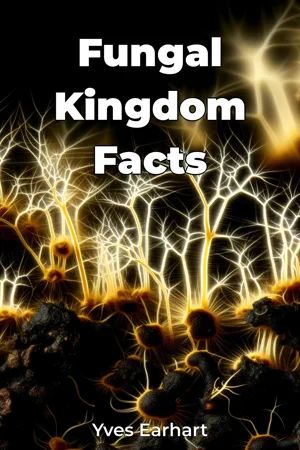
"Fungal Kingdom Facts" delves into the often-overlooked realm of fungi, organisms that form one of life's fundamental kingdoms and influence every ecological system on Earth. From the microscopic networks beneath our feet to the controlled environments of laboratories and food production facilities, this comprehensive examination reveals how fungi shape both natural processes and human industry. The book begins by establishing fungi's position as neither plant nor animal, explaining their unique cellular structures and evolutionary history spanning over 900 million years. This foundation helps readers understand why fungi developed their distinct characteristics and how these features enable their diverse roles in modern ecosystems. Three main sections structure the work: First, the book explores fungi's role in decomposition and nutrient cycling, explaining how mycelial networks break down organic matter and facilitate essential chemical processes in soil systems. Second, it examines the symbiotic relationships between fungi and other organisms, including the critical mycorrhizal associations that support 90% of plant species. Third, it investigates human applications of fungi, from traditional fermentation practices to modern biotechnology and pharmaceutical development. The text incorporates recent research from leading mycological institutions worldwide, including breakthrough studies on underground fungal communication networks and newly discovered species that expand our understanding of fungal diversity. These findings are presented alongside established scientific knowledge, creating a comprehensive view of current mycological understanding. Practical applications receive significant attention, with detailed explanations of how fungi contribute to food production through fermentation, their use in developing sustainable materials, and their potential in addressing environmental challenges such as pollution remediation and sustainable agriculture. The book includes specific examples from industrial applications, agricultural practices, and ecological restoration projects. Interdisciplinary connections link mycology with ecology, chemistry, and anthropology, demonstrating how fungal studies inform multiple scientific fields. The book examines fungi's influence on soil science, plant pathology, and human health, showing how these intersections drive research and innovation across disciplines. Written in a clear, methodical style, the text balances technical accuracy with accessibility, making complex concepts understandable to readers with basic scientific literacy. While primarily targeted at students, researchers, and professionals in life sciences, the book remains accessible to interested general readers who wish to deepen their understanding of natural systems. The work addresses current debates in the field, including discussions about fungi's classification, their role in emerging environmental technologies, and their potential in developing new antibiotics. It presents various scientific perspectives while maintaining focus on established research and verified findings. Each chapter includes detailed diagrams, microscopy images, and field photographs that illustrate key concepts and species. The book's scope encompasses both macro-fungi (mushrooms) and micro-fungi (molds, yeasts), providing a complete picture of fungal diversity and function. The conclusion examines future research directions and emerging applications, from using fungi in sustainable building materials to their potential role in space exploration. This forward-looking perspective helps readers understand both current knowledge and future possibilities in fungal science and application.
"Fungal Kingdom Facts" delves into the often-overlooked realm of fungi, organisms that form one of life's fundamental kingdoms and influence every ecological system on Earth. From the microscopic networks beneath our feet to the controlled environments of laboratories and food production facilities, this comprehensive examination reveals how fungi shape both natural processes and human industry. The book begins by establishing fungi's position as neither plant nor animal, explaining their unique cellular structures and evolutionary history spanning over 900 million years. This foundation helps readers understand why fungi developed their distinct characteristics and how these features enable their diverse roles in modern ecosystems. Three main sections structure the work: First, the book explores fungi's role in decomposition and nutrient cycling, explaining how mycelial networks break down organic matter and facilitate essential chemical processes in soil systems. Second, it examines the symbiotic relationships between fungi and other organisms, including the critical mycorrhizal associations that support 90% of plant species. Third, it investigates human applications of fungi, from traditional fermentation practices to modern biotechnology and pharmaceutical development. The text incorporates recent research from leading mycological institutions worldwide, including breakthrough studies on underground fungal communication networks and newly discovered species that expand our understanding of fungal diversity. These findings are presented alongside established scientific knowledge, creating a comprehensive view of current mycological understanding. Practical applications receive significant attention, with detailed explanations of how fungi contribute to food production through fermentation, their use in developing sustainable materials, and their potential in addressing environmental challenges such as pollution remediation and sustainable agriculture. The book includes specific examples from industrial applications, agricultural practices, and ecological restoration projects. Interdisciplinary connections link mycology with ecology, chemistry, and anthropology, demonstrating how fungal studies inform multiple scientific fields. The book examines fungi's influence on soil science, plant pathology, and human health, showing how these intersections drive research and innovation across disciplines. Written in a clear, methodical style, the text balances technical accuracy with accessibility, making complex concepts understandable to readers with basic scientific literacy. While primarily targeted at students, researchers, and professionals in life sciences, the book remains accessible to interested general readers who wish to deepen their understanding of natural systems. The work addresses current debates in the field, including discussions about fungi's classification, their role in emerging environmental technologies, and their potential in developing new antibiotics. It presents various scientific perspectives while maintaining focus on established research and verified findings. Each chapter includes detailed diagrams, microscopy images, and field photographs that illustrate key concepts and species. The book's scope encompasses both macro-fungi (mushrooms) and micro-fungi (molds, yeasts), providing a complete picture of fungal diversity and function. The conclusion examines future research directions and emerging applications, from using fungi in sustainable building materials to their potential role in space exploration. This forward-looking perspective helps readers understand both current knowledge and future possibilities in fungal science and application.
"Fungal Kingdom Facts" offers a captivating exploration of Earth's often-misunderstood fungal realm, revealing how these remarkable organisms shape every aspect of our world's ecosystems. This comprehensive guide illuminates fungi's unique position as neither plant nor animal, tracing their fascinating 900-million-year evolutionary journey and their crucial roles in maintaining life on Earth. Through clear, methodical explanations, the book demonstrates how fungal networks orchestrate essential processes from decomposition to plant survival. The text progresses logically through three main sections, beginning with fungi's fundamental role in decomposition and nutrient cycling, where mycelial networks break down organic matter in soil systems. It then explores the intricate symbiotic relationships fungi form with other organisms, notably the mycorrhizal associations supporting 90% of plant species. The final section examines human applications, from traditional fermentation practices to cutting-edge biotechnology and environmental solutions. What sets this book apart is its balanced approach to complex scientific concepts, making them accessible while maintaining academic rigor. It incorporates recent breakthrough research on underground fungal communication networks alongside established knowledge, illustrating these concepts with detailed diagrams and microscopy images. The work's interdisciplinary perspective connects mycology with ecology, chemistry, and anthropology, demonstrating fungi's far-reaching influence on natural systems and human innovation, from sustainable agriculture to potential space exploration applications.
Book Details
ISBN
9788233945145
Publisher
Publifye AS
Your Licenses
You don't own any licenses for this book
Purchase a license below to unlock this book and download the EPUB.
Purchase License
Select a tier to unlock this book
Need bulk licensing?
Contact us for enterprise agreements.