
About This Book
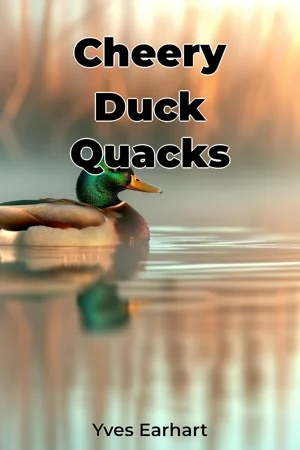
"Cheery Duck Quacks" unravels the intricate communication systems and adaptive behaviors of waterfowl in wetland ecosystems, presenting groundbreaking research that challenges our understanding of avian intelligence and social organization. The book examines two primary areas: the complex vocal communication patterns of various duck species and their behavioral adaptations to changing wetland environments. Through detailed acoustical analysis and long-term observational studies, readers discover how different duck species utilize more than twenty distinct vocalizations, each serving specific social, territorial, or survival functions. The research demonstrates how these vocalizations vary by species, season, and environmental conditions. Building on decades of ornithological research and recent technological advances in bioacoustics, the book provides context through historical studies dating back to the 1950s, when the first systematic analyses of waterfowl communications were conducted. Modern digital recording techniques and spectrographic analysis now reveal subtle variations in duck calls that were previously undetectable. The central thesis argues that ducks possess more sophisticated communication systems than previously recognized, enabling them to maintain complex social structures and adapt rapidly to environmental changes. This understanding proves crucial for both wildlife conservation and our broader comprehension of animal intelligence. The content progresses through three major sections: First, it explores the physical mechanisms of duck vocalization and sound production. Second, it examines the social context of different calls, including mating rituals, warning signals, and group coordination. Finally, it analyzes how these communication systems enable ducks to adapt to various wetland conditions, from natural marshes to urban water features. Supporting evidence comes from multiple sources, including field recordings, behavioral observations, and comparative studies across different duck species. The research incorporates data from wetland sites across North America, Europe, and Asia, providing a comprehensive global perspective. The book connects biology with environmental science, behavioral psychology, and acoustics. These interdisciplinary links help explain how duck communication influences wetland ecosystem dynamics and how environmental changes affect vocal behavior patterns. Written in an accessible academic style, the text balances scientific rigor with clear explanations suitable for both researchers and informed general readers. Technical concepts are carefully explained through diagrams, sonograms, and case studies. The target audience includes ornithologists, wildlife biologists, conservation specialists, and educated readers interested in animal behavior and wetland ecology. The book serves as both a scientific reference and an informative guide for wildlife enthusiasts. While focusing primarily on duck species found in major wetland habitats, the book acknowledges its limitations in covering all waterfowl species. It addresses current debates in behavioral ecology, particularly regarding the degree of intentionality in animal communication and the impact of habitat fragmentation on social behavior. Practical applications include improved wetland management strategies, more effective wildlife monitoring techniques, and enhanced methods for duck population surveys. The research also contributes to urban planning considerations for maintaining healthy waterfowl populations in human-modified environments. The book maintains scientific objectivity while addressing ongoing controversies about anthropogenic effects on wetland habitats and their impact on waterfowl communication patterns. It presents evidence-based discussions of climate change effects on duck behavior and adaptation strategies, offering insights for conservation planning and habitat protection.
"Cheery Duck Quacks" unravels the intricate communication systems and adaptive behaviors of waterfowl in wetland ecosystems, presenting groundbreaking research that challenges our understanding of avian intelligence and social organization. The book examines two primary areas: the complex vocal communication patterns of various duck species and their behavioral adaptations to changing wetland environments. Through detailed acoustical analysis and long-term observational studies, readers discover how different duck species utilize more than twenty distinct vocalizations, each serving specific social, territorial, or survival functions. The research demonstrates how these vocalizations vary by species, season, and environmental conditions. Building on decades of ornithological research and recent technological advances in bioacoustics, the book provides context through historical studies dating back to the 1950s, when the first systematic analyses of waterfowl communications were conducted. Modern digital recording techniques and spectrographic analysis now reveal subtle variations in duck calls that were previously undetectable. The central thesis argues that ducks possess more sophisticated communication systems than previously recognized, enabling them to maintain complex social structures and adapt rapidly to environmental changes. This understanding proves crucial for both wildlife conservation and our broader comprehension of animal intelligence. The content progresses through three major sections: First, it explores the physical mechanisms of duck vocalization and sound production. Second, it examines the social context of different calls, including mating rituals, warning signals, and group coordination. Finally, it analyzes how these communication systems enable ducks to adapt to various wetland conditions, from natural marshes to urban water features. Supporting evidence comes from multiple sources, including field recordings, behavioral observations, and comparative studies across different duck species. The research incorporates data from wetland sites across North America, Europe, and Asia, providing a comprehensive global perspective. The book connects biology with environmental science, behavioral psychology, and acoustics. These interdisciplinary links help explain how duck communication influences wetland ecosystem dynamics and how environmental changes affect vocal behavior patterns. Written in an accessible academic style, the text balances scientific rigor with clear explanations suitable for both researchers and informed general readers. Technical concepts are carefully explained through diagrams, sonograms, and case studies. The target audience includes ornithologists, wildlife biologists, conservation specialists, and educated readers interested in animal behavior and wetland ecology. The book serves as both a scientific reference and an informative guide for wildlife enthusiasts. While focusing primarily on duck species found in major wetland habitats, the book acknowledges its limitations in covering all waterfowl species. It addresses current debates in behavioral ecology, particularly regarding the degree of intentionality in animal communication and the impact of habitat fragmentation on social behavior. Practical applications include improved wetland management strategies, more effective wildlife monitoring techniques, and enhanced methods for duck population surveys. The research also contributes to urban planning considerations for maintaining healthy waterfowl populations in human-modified environments. The book maintains scientific objectivity while addressing ongoing controversies about anthropogenic effects on wetland habitats and their impact on waterfowl communication patterns. It presents evidence-based discussions of climate change effects on duck behavior and adaptation strategies, offering insights for conservation planning and habitat protection.
"Cheery Duck Quacks" reveals the fascinating world of waterfowl communication and behavior, presenting groundbreaking insights into the sophisticated vocal repertoire and social dynamics of ducks in wetland ecosystems. Through comprehensive research combining historical studies with modern bioacoustic technology, the book uncovers how different duck species utilize more than twenty distinct vocalizations for social interaction, territorial defense, and survival. These complex communication patterns demonstrate a level of avian intelligence previously underestimated in waterfowl species. The book progresses logically from the physical mechanics of duck vocalization to the social context of different calls, culminating in an analysis of how these communication systems enable environmental adaptation. Drawing from field recordings and behavioral observations across North America, Europe, and Asia, it offers compelling evidence of ducks' remarkable ability to modify their communication patterns in response to changing wetland conditions. The research particularly emphasizes how these adaptations play a crucial role in their survival across diverse habitats, from natural marshes to urban water features. This interdisciplinary work bridges biology, environmental science, and behavioral ecology, making it valuable for both researchers and wildlife enthusiasts. By examining the intersection of waterfowl communication and wetland ecosystem dynamics, the book provides essential insights for conservation efforts and wildlife management strategies. The accessible academic style, enhanced by detailed sonograms and case studies, ensures that complex concepts remain comprehensible while maintaining scientific rigor.
Book Details
ISBN
9788233944322
Publisher
Publifye AS
Your Licenses
You don't own any licenses for this book
Purchase a license below to unlock this book and download the EPUB.
Purchase License
Select a tier to unlock this book
Need bulk licensing?
Contact us for enterprise agreements.