
About This Book
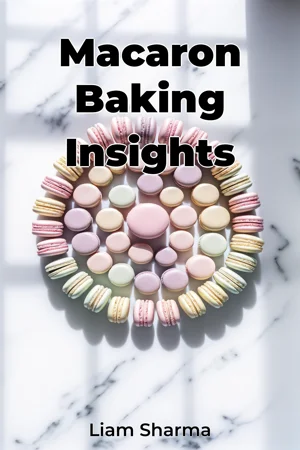
"Macaron Baking Insights" delves into the precise science and artistry behind one of French pâtisserie's most challenging creations, examining why these delicate cookies demand such exactitude in their preparation and how understanding their underlying chemistry leads to consistent success. The book addresses three core areas: the structural mechanics of macaron shells, the chemistry of flavor integration, and the mathematical precision required for successful execution. These elements are crucial for both professional pastry chefs and dedicated home bakers seeking to master this sophisticated confection. Drawing from centuries of French pâtisserie tradition and modern food science research, the text bridges historical techniques with contemporary understanding of ingredient interactions. Readers receive foundational knowledge in protein structures, sugar crystallization, and humidity effects on meringue formation—essential concepts for macaron mastery. The central thesis demonstrates how successful macaron production relies on the intersection of precise chemical reactions and careful technique, rather than chance or purely artistic skill. This argument challenges common misconceptions about macaron difficulty while providing evidence-based solutions to frequent preparation challenges. The content progresses through systematic chapters examining: protein behavior in egg whites and its impact on shell structure; the role of sugar crystallization in achieving proper "feet" formation; and the science of flavor compound integration. The book culminates in a comprehensive troubleshooting guide based on empirical testing and laboratory analysis. Research presented includes thermal imaging studies of optimal baking temperatures, electron microscope examination of shell structures, and extensive data on ingredient ratio variations and their outcomes. The methodology combines traditional French pâtisserie documentation with modern food science laboratory findings. The work connects chemistry, physics, and culinary arts, while incorporating elements of materials science in examining texture development. These interdisciplinary approaches provide readers with a comprehensive understanding of the macaron-making process. Written in a technical yet accessible style, the book maintains a methodical approach to information presentation, using clear explanations supported by diagrams, chemical equations, and practical examples. The tone remains professional and instructional, avoiding casual language while ensuring comprehensibility for non-scientists. The target audience includes professional pastry chefs, serious home bakers, culinary students, and food science enthusiasts who seek detailed understanding of confectionery principles. The content serves both educational and practical purposes, suitable for both classroom use and professional kitchen reference. The scope encompasses all aspects of macaron production, from ingredient selection to storage conditions, while intentionally limiting coverage of non-macaron confections to relevant comparative examples only. Practical applications include detailed troubleshooting guides, temperature and humidity control methods, and scaling techniques for both small and large batch production. The text addresses ongoing debates in the field, including the impact of aging egg whites, optimal macaronage techniques, and the scientific validity of traditional practices. The book deliberately avoids simplified "quick solutions," instead focusing on building comprehensive understanding through systematic examination of each variable in the production process. This approach enables readers to develop genuine expertise rather than merely following recipes.
"Macaron Baking Insights" delves into the precise science and artistry behind one of French pâtisserie's most challenging creations, examining why these delicate cookies demand such exactitude in their preparation and how understanding their underlying chemistry leads to consistent success. The book addresses three core areas: the structural mechanics of macaron shells, the chemistry of flavor integration, and the mathematical precision required for successful execution. These elements are crucial for both professional pastry chefs and dedicated home bakers seeking to master this sophisticated confection. Drawing from centuries of French pâtisserie tradition and modern food science research, the text bridges historical techniques with contemporary understanding of ingredient interactions. Readers receive foundational knowledge in protein structures, sugar crystallization, and humidity effects on meringue formation—essential concepts for macaron mastery. The central thesis demonstrates how successful macaron production relies on the intersection of precise chemical reactions and careful technique, rather than chance or purely artistic skill. This argument challenges common misconceptions about macaron difficulty while providing evidence-based solutions to frequent preparation challenges. The content progresses through systematic chapters examining: protein behavior in egg whites and its impact on shell structure; the role of sugar crystallization in achieving proper "feet" formation; and the science of flavor compound integration. The book culminates in a comprehensive troubleshooting guide based on empirical testing and laboratory analysis. Research presented includes thermal imaging studies of optimal baking temperatures, electron microscope examination of shell structures, and extensive data on ingredient ratio variations and their outcomes. The methodology combines traditional French pâtisserie documentation with modern food science laboratory findings. The work connects chemistry, physics, and culinary arts, while incorporating elements of materials science in examining texture development. These interdisciplinary approaches provide readers with a comprehensive understanding of the macaron-making process. Written in a technical yet accessible style, the book maintains a methodical approach to information presentation, using clear explanations supported by diagrams, chemical equations, and practical examples. The tone remains professional and instructional, avoiding casual language while ensuring comprehensibility for non-scientists. The target audience includes professional pastry chefs, serious home bakers, culinary students, and food science enthusiasts who seek detailed understanding of confectionery principles. The content serves both educational and practical purposes, suitable for both classroom use and professional kitchen reference. The scope encompasses all aspects of macaron production, from ingredient selection to storage conditions, while intentionally limiting coverage of non-macaron confections to relevant comparative examples only. Practical applications include detailed troubleshooting guides, temperature and humidity control methods, and scaling techniques for both small and large batch production. The text addresses ongoing debates in the field, including the impact of aging egg whites, optimal macaronage techniques, and the scientific validity of traditional practices. The book deliberately avoids simplified "quick solutions," instead focusing on building comprehensive understanding through systematic examination of each variable in the production process. This approach enables readers to develop genuine expertise rather than merely following recipes.
"Macaron Baking Insights" offers a groundbreaking exploration of the science and precision behind creating perfect French macarons, bridging traditional pastry techniques with modern food science understanding. This comprehensive guide delves into the three fundamental aspects of macaron making: shell structure mechanics, flavor chemistry, and mathematical precision, making it an invaluable resource for both professional pastry chefs and dedicated home bakers. The book uniquely combines centuries-old French pâtisserie wisdom with cutting-edge research, including thermal imaging studies and electron microscope examinations of shell structures. Through systematic chapters, readers gain deep insights into crucial concepts like protein behavior in egg whites, sugar crystallization's role in proper "feet" formation, and the science of flavor compound integration. Rather than offering quick fixes, the text builds a thorough understanding of how chemical reactions and precise technique intersect to create these delicate confections. Moving from foundational concepts to practical applications, the book culminates in an extensive troubleshooting guide based on empirical testing. Written in a technical yet accessible style, it provides clear explanations supported by diagrams and practical examples, making complex food science principles comprehensible for non-scientists. This methodical approach helps readers develop genuine expertise while challenging common misconceptions about macaron difficulty, offering evidence-based solutions to frequent preparation challenges.
Book Details
ISBN
9788233944148
Publisher
Publifye AS
Your Licenses
You don't own any licenses for this book
Purchase a license below to unlock this book and download the EPUB.
Purchase License
Select a tier to unlock this book
Need bulk licensing?
Contact us for enterprise agreements.