
About This Book
"Witty Parrot Words" investigates the intricate mechanisms behind parrots' ability to mimic human speech, revealing how these remarkable birds process, reproduce, and even comprehend human language patterns. By examining decades of scientific research and contemporary studies, this book unravels the biological and cognitive foundations of avian vocal learning. The work presents three core areas of investigation: the specialized neural pathways in parrot brains that enable vocal learning, the physical adaptations of their vocal apparatus, and the cognitive processes that allow them to associate sounds with meanings. These topics build upon recent breakthroughs in neuroscience and behavioral studies, offering readers insight into both avian intelligence and the broader implications for understanding language acquisition. Drawing from extensive research conducted across multiple continents, the book synthesizes findings from leading ornithological institutes and behavioral laboratories. It presents detailed analyses of various parrot species, from African Grey Parrots to Amazon Parrots, examining their different capacities for vocal mimicry and language processing. The central thesis argues that parrot vocalization represents more than mere mimicry—it demonstrates a sophisticated interplay between cognitive ability, social behavior, and neurological adaptation. This understanding challenges traditional views of animal communication and suggests new perspectives on the evolution of language. The book's structure progresses from basic anatomical foundations through increasingly complex aspects of vocal learning. It begins with detailed explanations of parrot brain structure and vocal apparatus, advances to examining learning mechanisms, and culminates in exploring the social and cognitive implications of their abilities. Supporting evidence includes neuroimaging studies, behavioral experiments, and long-term observational data from both wild and captive populations. The research incorporates cutting-edge techniques in bioacoustics and cognitive testing, providing readers with current scientific understanding of avian vocal abilities. The work connects multiple disciplines, including neurobiology, evolutionary biology, and cognitive science. These intersections help readers understand how studying parrot vocalizations contributes to fields beyond ornithology, including human speech development and artificial intelligence applications in language processing. Written in an accessible academic style, the book maintains scientific rigor while engaging readers through clear explanations and relevant examples. It serves both professional researchers and educated general readers interested in animal behavior, cognition, and communication. The target audience includes ornithologists, cognitive scientists, veterinarians, and informed bird enthusiasts. The book provides practical insights for parrot owners while maintaining sufficient technical depth for academic readers. The scope encompasses both wild and captive parrot populations, focusing on species with documented vocal learning abilities. While primarily centered on speech mimicry, the book also addresses related aspects of parrot cognition and social behavior. Current debates addressed include the extent of parrots' language comprehension versus pure mimicry, the role of social bonding in vocal learning, and implications for understanding the evolution of human language. The book presents multiple viewpoints on these ongoing scientific discussions while maintaining objective analysis. The work concludes with practical applications for parrot care, conservation efforts, and potential implications for understanding human speech disorders. It provides evidence-based recommendations for optimizing learning conditions in both research and domestic settings. This comprehensive examination of parrot vocal abilities combines rigorous scientific analysis with accessible presentation, offering readers a thorough understanding of current research while suggesting future directions for study in this dynamic field.
"Witty Parrot Words" investigates the intricate mechanisms behind parrots' ability to mimic human speech, revealing how these remarkable birds process, reproduce, and even comprehend human language patterns. By examining decades of scientific research and contemporary studies, this book unravels the biological and cognitive foundations of avian vocal learning. The work presents three core areas of investigation: the specialized neural pathways in parrot brains that enable vocal learning, the physical adaptations of their vocal apparatus, and the cognitive processes that allow them to associate sounds with meanings. These topics build upon recent breakthroughs in neuroscience and behavioral studies, offering readers insight into both avian intelligence and the broader implications for understanding language acquisition. Drawing from extensive research conducted across multiple continents, the book synthesizes findings from leading ornithological institutes and behavioral laboratories. It presents detailed analyses of various parrot species, from African Grey Parrots to Amazon Parrots, examining their different capacities for vocal mimicry and language processing. The central thesis argues that parrot vocalization represents more than mere mimicry—it demonstrates a sophisticated interplay between cognitive ability, social behavior, and neurological adaptation. This understanding challenges traditional views of animal communication and suggests new perspectives on the evolution of language. The book's structure progresses from basic anatomical foundations through increasingly complex aspects of vocal learning. It begins with detailed explanations of parrot brain structure and vocal apparatus, advances to examining learning mechanisms, and culminates in exploring the social and cognitive implications of their abilities. Supporting evidence includes neuroimaging studies, behavioral experiments, and long-term observational data from both wild and captive populations. The research incorporates cutting-edge techniques in bioacoustics and cognitive testing, providing readers with current scientific understanding of avian vocal abilities. The work connects multiple disciplines, including neurobiology, evolutionary biology, and cognitive science. These intersections help readers understand how studying parrot vocalizations contributes to fields beyond ornithology, including human speech development and artificial intelligence applications in language processing. Written in an accessible academic style, the book maintains scientific rigor while engaging readers through clear explanations and relevant examples. It serves both professional researchers and educated general readers interested in animal behavior, cognition, and communication. The target audience includes ornithologists, cognitive scientists, veterinarians, and informed bird enthusiasts. The book provides practical insights for parrot owners while maintaining sufficient technical depth for academic readers. The scope encompasses both wild and captive parrot populations, focusing on species with documented vocal learning abilities. While primarily centered on speech mimicry, the book also addresses related aspects of parrot cognition and social behavior. Current debates addressed include the extent of parrots' language comprehension versus pure mimicry, the role of social bonding in vocal learning, and implications for understanding the evolution of human language. The book presents multiple viewpoints on these ongoing scientific discussions while maintaining objective analysis. The work concludes with practical applications for parrot care, conservation efforts, and potential implications for understanding human speech disorders. It provides evidence-based recommendations for optimizing learning conditions in both research and domestic settings. This comprehensive examination of parrot vocal abilities combines rigorous scientific analysis with accessible presentation, offering readers a thorough understanding of current research while suggesting future directions for study in this dynamic field.
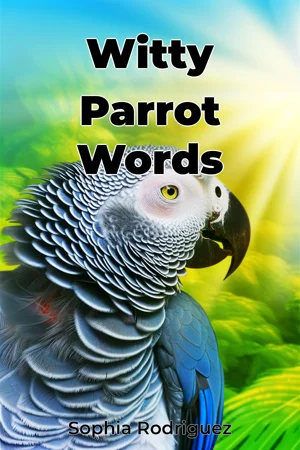
"Witty Parrot Words" delves into the fascinating world of parrot vocalization, exploring how these intelligent birds master human speech through a complex interplay of biological adaptation and cognitive processing. This comprehensive exploration goes beyond simple mimicry, revealing how parrots' specialized neural pathways and uniquely adapted vocal apparatus enable them to not only reproduce but potentially comprehend human language patterns. The book presents a carefully structured journey through the science of avian vocal abilities, beginning with the fundamental anatomy of parrot brains and vocal organs before progressing to more complex aspects of learning and social behavior. Through extensive research spanning multiple continents and species, from African Greys to Amazon Parrots, readers discover how these birds process and reproduce human speech. The integration of cutting-edge neuroimaging studies and behavioral experiments provides compelling evidence for the sophisticated nature of parrot communication. Drawing from neurobiology, evolutionary biology, and cognitive science, this work challenges traditional views of animal communication while maintaining accessibility for both scientific and general audiences. The book's examination of vocal learning mechanisms and their implications for understanding human language evolution makes it particularly valuable for researchers, veterinarians, and bird enthusiasts alike. By connecting findings from leading ornithological institutes with practical applications for parrot care, it offers a unique blend of scientific rigor and practical insight into these remarkable creatures' capabilities.
Book Details
ISBN
9788233944063
Publisher
Publifye AS
Your Licenses
You don't own any licenses for this book
Purchase a license below to unlock this book and download the EPUB.
Purchase License
Select a tier to unlock this book
Need bulk licensing?
Contact us for enterprise agreements.