
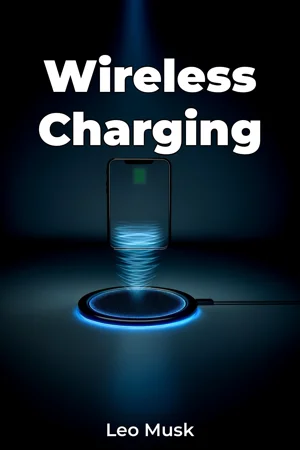
About This Book
"Wireless Charging" explores the technological revolution that is reshaping how we power our electronic devices, examining the fundamental principles, current innovations, and future implications of cordless power transfer systems. The book begins by addressing a critical question facing modern device users: How can we eliminate the last physical tether in our increasingly wireless world? Through systematic analysis, it demonstrates how wireless charging technology provides this solution while introducing new possibilities for device design and functionality. Three core sections form the book's foundation. The first examines electromagnetic induction principles and resonant coupling, explaining how energy transfers wirelessly between devices. The second section analyzes current implementation in consumer electronics, automotive applications, and industrial systems. The final section investigates emerging technologies, including long-range wireless power transmission and multi-device charging environments. The central thesis argues that wireless charging represents more than a convenience—it's a transformative technology that will fundamentally alter device design, user behavior, and energy distribution systems. This argument is supported by extensive technical data, case studies from major manufacturers, and research from leading laboratories worldwide. Technical content is presented through detailed diagrams, mathematical models, and practical examples, making complex concepts accessible to both engineering professionals and informed general readers. The book incorporates findings from peer-reviewed journals, industry white papers, and patent documentation to provide comprehensive coverage of current developments. Interdisciplinary connections link wireless charging to sustainable energy practices, showing how this technology reduces electronic waste through standardized charging solutions. The book also explores implications for urban planning and architecture, as wireless charging infrastructure becomes integrated into public spaces and buildings. The text maintains a balanced technical depth, suitable for electrical engineers while remaining accessible to technology professionals, designers, and decision-makers in related fields. Each chapter includes practical applications, engineering challenges, and solutions, supported by real-world implementation examples. Particular attention is given to standardization efforts, safety considerations, and efficiency improvements. The book addresses ongoing debates about competing wireless charging standards and the challenge of achieving higher power transfer rates while maintaining safety and efficiency. The scope encompasses both current commercial applications and emerging technologies, though it acknowledges limitations in areas still under development. Readers will understand system design principles, component selection criteria, and implementation strategies for various applications. For technical professionals, the book serves as a comprehensive reference for wireless charging system design and implementation. For industry decision-makers, it provides crucial insights into technology trends and market developments. Students and researchers will find it valuable for understanding both theoretical foundations and practical applications. The writing style maintains technical precision while presenting information in a structured, logical progression. Rather than relying on hyperbole, it emphasizes factual analysis and practical implications, supported by quantitative data and technical specifications. The book concludes by examining future developments, including resonant beam charging, quantum wireless power transfer, and integration with smart grid systems. It provides a roadmap for understanding how wireless charging will evolve and impact future electronic devices and power distribution systems.
"Wireless Charging" explores the technological revolution that is reshaping how we power our electronic devices, examining the fundamental principles, current innovations, and future implications of cordless power transfer systems. The book begins by addressing a critical question facing modern device users: How can we eliminate the last physical tether in our increasingly wireless world? Through systematic analysis, it demonstrates how wireless charging technology provides this solution while introducing new possibilities for device design and functionality. Three core sections form the book's foundation. The first examines electromagnetic induction principles and resonant coupling, explaining how energy transfers wirelessly between devices. The second section analyzes current implementation in consumer electronics, automotive applications, and industrial systems. The final section investigates emerging technologies, including long-range wireless power transmission and multi-device charging environments. The central thesis argues that wireless charging represents more than a convenience—it's a transformative technology that will fundamentally alter device design, user behavior, and energy distribution systems. This argument is supported by extensive technical data, case studies from major manufacturers, and research from leading laboratories worldwide. Technical content is presented through detailed diagrams, mathematical models, and practical examples, making complex concepts accessible to both engineering professionals and informed general readers. The book incorporates findings from peer-reviewed journals, industry white papers, and patent documentation to provide comprehensive coverage of current developments. Interdisciplinary connections link wireless charging to sustainable energy practices, showing how this technology reduces electronic waste through standardized charging solutions. The book also explores implications for urban planning and architecture, as wireless charging infrastructure becomes integrated into public spaces and buildings. The text maintains a balanced technical depth, suitable for electrical engineers while remaining accessible to technology professionals, designers, and decision-makers in related fields. Each chapter includes practical applications, engineering challenges, and solutions, supported by real-world implementation examples. Particular attention is given to standardization efforts, safety considerations, and efficiency improvements. The book addresses ongoing debates about competing wireless charging standards and the challenge of achieving higher power transfer rates while maintaining safety and efficiency. The scope encompasses both current commercial applications and emerging technologies, though it acknowledges limitations in areas still under development. Readers will understand system design principles, component selection criteria, and implementation strategies for various applications. For technical professionals, the book serves as a comprehensive reference for wireless charging system design and implementation. For industry decision-makers, it provides crucial insights into technology trends and market developments. Students and researchers will find it valuable for understanding both theoretical foundations and practical applications. The writing style maintains technical precision while presenting information in a structured, logical progression. Rather than relying on hyperbole, it emphasizes factual analysis and practical implications, supported by quantitative data and technical specifications. The book concludes by examining future developments, including resonant beam charging, quantum wireless power transfer, and integration with smart grid systems. It provides a roadmap for understanding how wireless charging will evolve and impact future electronic devices and power distribution systems.
"Wireless Charging" presents a comprehensive exploration of cordless power transfer technology, examining how this revolutionary approach is eliminating the last physical tether in our increasingly wireless world. The book skillfully navigates through the fundamental principles of electromagnetic induction and resonant coupling, demonstrating how energy can be efficiently transferred between devices without physical connections. Through a well-structured progression, the text moves from theoretical foundations to practical applications, covering everything from consumer electronics to automotive implementations. Notable insights include the technology's role in reducing electronic waste through standardized charging solutions and its potential impact on urban infrastructure as wireless charging becomes integrated into public spaces. The book balances technical depth with accessibility, using detailed diagrams and real-world examples to illuminate complex concepts for both engineering professionals and informed readers. The narrative extends beyond mere technical specifications to explore broader implications, including standardization efforts, safety considerations, and future developments like quantum wireless power transfer and smart grid integration. What sets this book apart is its comprehensive approach to the subject matter, combining theoretical knowledge with practical implementation strategies while maintaining a focus on real-world applications. This makes it an invaluable resource for engineers, industry professionals, and anyone seeking to understand the future of power distribution systems.
Book Details
ISBN
9788233943479
Publisher
Publifye AS
Your Licenses
You don't own any licenses for this book
Purchase a license below to unlock this book and download the EPUB.
Purchase License
Select a tier to unlock this book
Need bulk licensing?
Contact us for enterprise agreements.