
About This Book
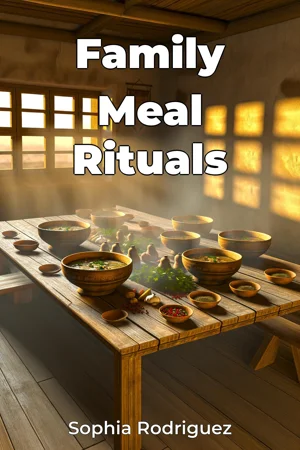
"Family Meal Rituals" examines how shared meals serve as a fundamental cornerstone of human social bonds across cultures, revealing how dining practices reflect and shape societal values, family dynamics, and cultural identity. Drawing from anthropological research spanning six continents and fifty cultures, this comprehensive study demonstrates how mealtime traditions create lasting social connections and transmit cultural values across generations. The book presents three core themes: the universal structure of family meals, the role of food-sharing in building community bonds, and the impact of modern life on traditional dining practices. The work builds on decades of cross-cultural research, incorporating data from longitudinal studies in social anthropology, nutrition science, and sociology. Historical records dating back to ancient civilizations provide context for understanding how meal rituals evolved alongside human society, while contemporary case studies illustrate current transformations in dining customs. Central to the book's thesis is the argument that structured family meals serve as critical vehicles for cultural transmission, social learning, and emotional bonding—functions that remain vital despite rapid societal changes. The text systematically examines this premise through three main sections: "The Architecture of Meal Rituals," "Cultural Variations in Dining Customs," and "Preserving Traditional Practices in Modern Times." The research methodology combines ethnographic observations, statistical analysis of dining patterns, and interviews with families across diverse socioeconomic backgrounds. Unique to this study is its integration of video analysis of over 1,000 family meals, providing detailed insights into non-verbal communication and social dynamics during shared meals. The book connects multiple disciplines, linking nutritional anthropology with child development studies and social psychology. These intersections help explain how meal rituals influence everything from language acquisition in children to the maintenance of cultural identity in immigrant communities. Written in an academic yet accessible style, the text balances scholarly rigor with practical insights, making it valuable for both researchers and general readers interested in food culture and family dynamics. The target audience includes sociologists, nutritionists, family therapists, and educated readers seeking to understand the significance of dining traditions. The work addresses several current debates, including the impact of technology on family meals, the role of traditional dining customs in maintaining cultural identity, and strategies for preserving meaningful meal rituals in time-pressured modern societies. While the book acknowledges regional variations in dining customs, it focuses primarily on recurring patterns that transcend cultural boundaries. Practical applications include guidelines for establishing meaningful family meal routines, strategies for incorporating traditional practices into contemporary lifestyles, and methods for using shared meals to strengthen family bonds. The text provides specific recommendations while remaining sensitive to diverse cultural contexts and practical constraints. The book's scope encompasses both urban and rural settings across different socioeconomic levels, though it primarily focuses on family units rather than institutional or commercial dining. This focused approach allows for detailed examination of interpersonal dynamics and cultural transmission within household settings. Research limitations are clearly addressed, including the challenges of studying rapidly changing customs and the complexity of separating cultural influences from economic factors. The work maintains objectivity while acknowledging the ongoing debate between preserving traditional practices and adapting to modern lifestyles.
"Family Meal Rituals" examines how shared meals serve as a fundamental cornerstone of human social bonds across cultures, revealing how dining practices reflect and shape societal values, family dynamics, and cultural identity. Drawing from anthropological research spanning six continents and fifty cultures, this comprehensive study demonstrates how mealtime traditions create lasting social connections and transmit cultural values across generations. The book presents three core themes: the universal structure of family meals, the role of food-sharing in building community bonds, and the impact of modern life on traditional dining practices. The work builds on decades of cross-cultural research, incorporating data from longitudinal studies in social anthropology, nutrition science, and sociology. Historical records dating back to ancient civilizations provide context for understanding how meal rituals evolved alongside human society, while contemporary case studies illustrate current transformations in dining customs. Central to the book's thesis is the argument that structured family meals serve as critical vehicles for cultural transmission, social learning, and emotional bonding—functions that remain vital despite rapid societal changes. The text systematically examines this premise through three main sections: "The Architecture of Meal Rituals," "Cultural Variations in Dining Customs," and "Preserving Traditional Practices in Modern Times." The research methodology combines ethnographic observations, statistical analysis of dining patterns, and interviews with families across diverse socioeconomic backgrounds. Unique to this study is its integration of video analysis of over 1,000 family meals, providing detailed insights into non-verbal communication and social dynamics during shared meals. The book connects multiple disciplines, linking nutritional anthropology with child development studies and social psychology. These intersections help explain how meal rituals influence everything from language acquisition in children to the maintenance of cultural identity in immigrant communities. Written in an academic yet accessible style, the text balances scholarly rigor with practical insights, making it valuable for both researchers and general readers interested in food culture and family dynamics. The target audience includes sociologists, nutritionists, family therapists, and educated readers seeking to understand the significance of dining traditions. The work addresses several current debates, including the impact of technology on family meals, the role of traditional dining customs in maintaining cultural identity, and strategies for preserving meaningful meal rituals in time-pressured modern societies. While the book acknowledges regional variations in dining customs, it focuses primarily on recurring patterns that transcend cultural boundaries. Practical applications include guidelines for establishing meaningful family meal routines, strategies for incorporating traditional practices into contemporary lifestyles, and methods for using shared meals to strengthen family bonds. The text provides specific recommendations while remaining sensitive to diverse cultural contexts and practical constraints. The book's scope encompasses both urban and rural settings across different socioeconomic levels, though it primarily focuses on family units rather than institutional or commercial dining. This focused approach allows for detailed examination of interpersonal dynamics and cultural transmission within household settings. Research limitations are clearly addressed, including the challenges of studying rapidly changing customs and the complexity of separating cultural influences from economic factors. The work maintains objectivity while acknowledging the ongoing debate between preserving traditional practices and adapting to modern lifestyles.
"Family Meal Rituals" presents a fascinating exploration of how shared meals function as a universal cornerstone of human social connections across cultures. Drawing from extensive anthropological research spanning fifty cultures across six continents, the book reveals how dining practices simultaneously reflect and shape our social values, family bonds, and cultural identity. Through comprehensive analysis of over 1,000 recorded family meals and extensive interviews, the study illuminates the intricate ways mealtime traditions create lasting social connections and transmit cultural values between generations. The book progresses through three main sections, examining the universal structure of family meals, exploring cultural variations in dining customs, and addressing the challenges of maintaining traditional practices in modern times. What makes this work particularly valuable is its unique integration of video analysis with traditional research methods, providing unprecedented insights into non-verbal communication and social dynamics during shared meals. The study bridges multiple disciplines, connecting nutritional anthropology with child development and social psychology, while maintaining an accessible writing style that appeals to both academic and general readers. The research reveals compelling findings about how meal rituals influence everything from children's language acquisition to the preservation of cultural identity in immigrant communities. While acknowledging regional variations, the book focuses on identifying universal patterns in dining customs that transcend cultural boundaries, offering practical guidelines for establishing meaningful family meal routines in contemporary society. This balanced approach between scholarly analysis and practical application makes it an invaluable resource for understanding the crucial role of shared meals in human social development.
Book Details
ISBN
9788233943219
Publisher
Publifye AS
Your Licenses
You don't own any licenses for this book
Purchase a license below to unlock this book and download the EPUB.
Purchase License
Select a tier to unlock this book
Need bulk licensing?
Contact us for enterprise agreements.