
About This Book
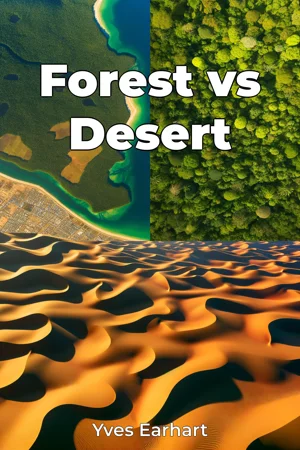
"Forest vs Desert" presents a detailed scientific comparison of two dramatically different biomes, examining how life adapts and thrives in these contrasting environments. The book opens by challenging readers' assumptions about biodiversity, revealing how both forests and deserts harbor complex ecosystems that have evolved distinct survival strategies over millions of years. Through systematic analysis, the book explores three primary themes: climate patterns and their impact on ecosystem development, wildlife adaptations across both biomes, and the evolution of plant survival mechanisms. These interconnected topics form the foundation for understanding how environmental pressures shape life in each habitat. The first section examines climatic factors, including precipitation patterns, temperature fluctuations, and seasonal variations. Readers learn how forest systems maintain humidity through canopy coverage and soil composition, while desert environments develop specialized water retention methods. This background provides essential context for understanding the subsequent chapters on adaptation. The book's central thesis demonstrates how similar evolutionary pressures can produce vastly different but equally effective survival strategies in contrasting environments. Supporting this argument, the text presents research from long-term ecological studies, satellite mapping data, and field observations from multiple continents. Detailed chapters explore wildlife adaptations, comparing forest animals' utilization of vertical space and complex social structures with desert species' behavioral and physiological adaptations for water conservation and temperature regulation. The plant adaptation section contrasts forest understory species' shade tolerance with desert plants' drought resistance mechanisms, supported by current botanical research and cellular biology studies. The work connects ecology with climate science, evolutionary biology, and conservation biology, creating a comprehensive understanding of these ecosystems. It incorporates recent findings in genetic research, revealing how environmental stress triggers adaptive responses in both biomes. The book employs an academic yet accessible approach, using clear language and supporting graphics to explain complex biological processes. It targets educators, environmental students, and informed general readers interested in natural sciences and conservation. Conservation challenges receive particular attention, with specific focus on how climate change affects both biomes differently. The text examines current preservation efforts, restoration projects, and the critical role of each ecosystem in global biodiversity maintenance. Practical applications include sections on sustainable resource management, ecosystem restoration techniques, and guidelines for conservation planning. The book addresses ongoing debates about conservation priorities and resource allocation between different ecosystem types. The scope encompasses both macro and micro perspectives, from broad ecosystem functions to detailed examples of specific species adaptations. While maintaining scientific rigor, the book acknowledges areas where research is ongoing and questions remain unanswered. Rather than presenting one biome as superior, the text emphasizes how each environment represents a successful evolutionary strategy, contributing unique and essential elements to Earth's biodiversity. This balanced approach helps readers appreciate the value and complexity of both forest and desert ecosystems while understanding the urgent need for their protection.
"Forest vs Desert" presents a detailed scientific comparison of two dramatically different biomes, examining how life adapts and thrives in these contrasting environments. The book opens by challenging readers' assumptions about biodiversity, revealing how both forests and deserts harbor complex ecosystems that have evolved distinct survival strategies over millions of years. Through systematic analysis, the book explores three primary themes: climate patterns and their impact on ecosystem development, wildlife adaptations across both biomes, and the evolution of plant survival mechanisms. These interconnected topics form the foundation for understanding how environmental pressures shape life in each habitat. The first section examines climatic factors, including precipitation patterns, temperature fluctuations, and seasonal variations. Readers learn how forest systems maintain humidity through canopy coverage and soil composition, while desert environments develop specialized water retention methods. This background provides essential context for understanding the subsequent chapters on adaptation. The book's central thesis demonstrates how similar evolutionary pressures can produce vastly different but equally effective survival strategies in contrasting environments. Supporting this argument, the text presents research from long-term ecological studies, satellite mapping data, and field observations from multiple continents. Detailed chapters explore wildlife adaptations, comparing forest animals' utilization of vertical space and complex social structures with desert species' behavioral and physiological adaptations for water conservation and temperature regulation. The plant adaptation section contrasts forest understory species' shade tolerance with desert plants' drought resistance mechanisms, supported by current botanical research and cellular biology studies. The work connects ecology with climate science, evolutionary biology, and conservation biology, creating a comprehensive understanding of these ecosystems. It incorporates recent findings in genetic research, revealing how environmental stress triggers adaptive responses in both biomes. The book employs an academic yet accessible approach, using clear language and supporting graphics to explain complex biological processes. It targets educators, environmental students, and informed general readers interested in natural sciences and conservation. Conservation challenges receive particular attention, with specific focus on how climate change affects both biomes differently. The text examines current preservation efforts, restoration projects, and the critical role of each ecosystem in global biodiversity maintenance. Practical applications include sections on sustainable resource management, ecosystem restoration techniques, and guidelines for conservation planning. The book addresses ongoing debates about conservation priorities and resource allocation between different ecosystem types. The scope encompasses both macro and micro perspectives, from broad ecosystem functions to detailed examples of specific species adaptations. While maintaining scientific rigor, the book acknowledges areas where research is ongoing and questions remain unanswered. Rather than presenting one biome as superior, the text emphasizes how each environment represents a successful evolutionary strategy, contributing unique and essential elements to Earth's biodiversity. This balanced approach helps readers appreciate the value and complexity of both forest and desert ecosystems while understanding the urgent need for their protection.
"Forest vs Desert" offers a compelling scientific exploration of two seemingly opposite ecosystems, revealing how life has evolved and adapted to thrive in these distinct environments. Through a systematic comparison of forests and deserts, the book challenges common assumptions about biodiversity, demonstrating how both biomes harbor remarkably complex ecosystems that have developed unique survival strategies over millions of years. The book progresses through three main themes: climate patterns, wildlife adaptations, and plant survival mechanisms. Readers discover fascinating contrasts, such as how forest canopies maintain humidity while desert environments develop specialized water retention methods. The text illuminates remarkable adaptations, from forest animals' utilization of vertical space and social structures to desert species' sophisticated mechanisms for water conservation and temperature regulation. What makes this work particularly valuable is its balanced, research-based approach, incorporating recent findings from genetic research, satellite mapping, and long-term ecological studies. Rather than favoring one ecosystem over another, the book emphasizes how each biome represents a successful evolutionary strategy, contributing essential elements to Earth's biodiversity. This comprehensive examination connects ecology with climate science and conservation biology, making complex concepts accessible through clear language and supporting graphics, while addressing urgent conservation challenges facing both ecosystems in our changing world.
Book Details
ISBN
9788233943189
Publisher
Publifye AS
Your Licenses
You don't own any licenses for this book
Purchase a license below to unlock this book and download the EPUB.
Purchase License
Select a tier to unlock this book
Need bulk licensing?
Contact us for enterprise agreements.