
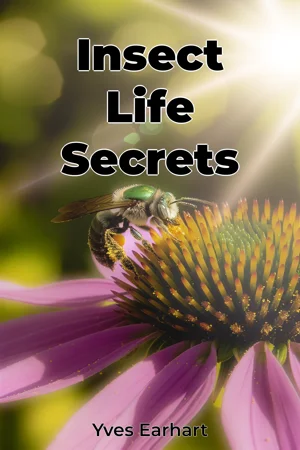
About This Book
"Insect Life Secrets" examines the fundamental yet often overlooked roles that insects play in maintaining Earth's biological systems. From microscopic soil interactions to continental-scale pollination networks, this comprehensive exploration reveals how insects form the backbone of terrestrial ecosystems worldwide. The book presents three core themes: the intricate relationships between insects and plant reproduction, the crucial role of insects in decomposition and nutrient cycling, and their position as keystone species in global food webs. These interconnected topics demonstrate how insects influence everything from crop production to waste management in natural systems. Drawing from fifty years of entomological research and recent technological advances in microscopy and genetic analysis, the text provides readers with both historical perspective and cutting-edge insights. The first section details the evolution of insect-plant relationships over 400 million years, establishing the context for current ecosystem dynamics. The central thesis argues that insects are essential engineers of ecological stability, without which most terrestrial ecosystems would collapse. This argument is developed through detailed examination of insect impacts at multiple scales, from individual plant-pollinator relationships to landscape-level ecosystem services. The content progresses systematically through three major sections. The first explores pollination systems, including specialized relationships between insects and flowering plants, and their economic impact on global agriculture. The second section examines decomposition processes, revealing how insects break down organic matter and maintain soil health. The final section synthesizes these roles by analyzing food web dynamics and ecosystem resilience. Research evidence is drawn from long-term field studies, laboratory experiments, and satellite monitoring of insect migration patterns. The book incorporates data from six continents, providing a truly global perspective on insect ecology. The work connects entomology with climate science, agriculture, and conservation biology, demonstrating how insect behavior influences and responds to environmental changes. These connections highlight the broader implications of insect ecology for food security and ecosystem management. The text employs a systematic, evidence-based approach, using clear language to explain complex ecological concepts. Technical terms are carefully defined, making the content accessible to readers with basic scientific literacy while maintaining sufficient depth for specialists. This book serves both as a comprehensive reference for environmental scientists and as an informative resource for land managers, agricultural professionals, and informed general readers interested in ecosystem function. The material is particularly relevant for those involved in conservation, agriculture, and environmental policy. Following scientific writing conventions, each chapter provides detailed citations and case studies, while including practical applications such as habitat conservation strategies and agricultural management techniques. The scope encompasses both macro and microscopic scales of insect influence, though it primarily focuses on terrestrial rather than aquatic systems. Current debates addressed include the impact of pesticides on beneficial insects and the effects of climate change on insect populations. Practical applications include guidelines for promoting beneficial insects in agricultural settings, creating insect-friendly gardens, and understanding how local actions affect larger ecosystem processes. The book presents this information through a measured, factual lens, emphasizing observable patterns and documented relationships rather than sensationalized claims. This work fills a crucial gap in ecological literature by synthesizing current understanding of insect ecosystem services while highlighting critical areas for future research and conservation efforts.
"Insect Life Secrets" examines the fundamental yet often overlooked roles that insects play in maintaining Earth's biological systems. From microscopic soil interactions to continental-scale pollination networks, this comprehensive exploration reveals how insects form the backbone of terrestrial ecosystems worldwide. The book presents three core themes: the intricate relationships between insects and plant reproduction, the crucial role of insects in decomposition and nutrient cycling, and their position as keystone species in global food webs. These interconnected topics demonstrate how insects influence everything from crop production to waste management in natural systems. Drawing from fifty years of entomological research and recent technological advances in microscopy and genetic analysis, the text provides readers with both historical perspective and cutting-edge insights. The first section details the evolution of insect-plant relationships over 400 million years, establishing the context for current ecosystem dynamics. The central thesis argues that insects are essential engineers of ecological stability, without which most terrestrial ecosystems would collapse. This argument is developed through detailed examination of insect impacts at multiple scales, from individual plant-pollinator relationships to landscape-level ecosystem services. The content progresses systematically through three major sections. The first explores pollination systems, including specialized relationships between insects and flowering plants, and their economic impact on global agriculture. The second section examines decomposition processes, revealing how insects break down organic matter and maintain soil health. The final section synthesizes these roles by analyzing food web dynamics and ecosystem resilience. Research evidence is drawn from long-term field studies, laboratory experiments, and satellite monitoring of insect migration patterns. The book incorporates data from six continents, providing a truly global perspective on insect ecology. The work connects entomology with climate science, agriculture, and conservation biology, demonstrating how insect behavior influences and responds to environmental changes. These connections highlight the broader implications of insect ecology for food security and ecosystem management. The text employs a systematic, evidence-based approach, using clear language to explain complex ecological concepts. Technical terms are carefully defined, making the content accessible to readers with basic scientific literacy while maintaining sufficient depth for specialists. This book serves both as a comprehensive reference for environmental scientists and as an informative resource for land managers, agricultural professionals, and informed general readers interested in ecosystem function. The material is particularly relevant for those involved in conservation, agriculture, and environmental policy. Following scientific writing conventions, each chapter provides detailed citations and case studies, while including practical applications such as habitat conservation strategies and agricultural management techniques. The scope encompasses both macro and microscopic scales of insect influence, though it primarily focuses on terrestrial rather than aquatic systems. Current debates addressed include the impact of pesticides on beneficial insects and the effects of climate change on insect populations. Practical applications include guidelines for promoting beneficial insects in agricultural settings, creating insect-friendly gardens, and understanding how local actions affect larger ecosystem processes. The book presents this information through a measured, factual lens, emphasizing observable patterns and documented relationships rather than sensationalized claims. This work fills a crucial gap in ecological literature by synthesizing current understanding of insect ecosystem services while highlighting critical areas for future research and conservation efforts.
"Insect Life Secrets" offers a comprehensive exploration of insects' vital roles in maintaining Earth's ecological balance, from microscopic soil interactions to global-scale pollination networks. This accessible yet thorough examination reveals how these small creatures serve as the fundamental engineers of terrestrial ecosystems, without which most land-based life systems would fail. The book skillfully weaves together fifty years of entomological research with modern scientific discoveries to demonstrate insects' irreplaceable contributions to environmental stability. The text progresses through three interconnected themes, beginning with the fascinating 400-million-year evolution of insect-plant relationships and their critical role in pollination. It then delves into insects' essential function in decomposition and nutrient cycling, revealing how these processes maintain soil health and support agricultural productivity. The final section synthesizes these concepts by examining how insects serve as keystone species in global food webs, incorporating data from six continents to provide a truly worldwide perspective. Drawing from long-term field studies and cutting-edge research techniques, the book bridges the gap between complex scientific concepts and practical applications. While maintaining scientific rigor, it presents information in clear, accessible language that appeals to both specialists and general readers interested in environmental science. The work is particularly valuable for its comprehensive integration of entomology with climate science, agriculture, and conservation biology, offering practical insights for ecosystem management while highlighting critical areas for future research and conservation efforts.
Book Details
ISBN
9788233943165
Publisher
Publifye AS
Your Licenses
You don't own any licenses for this book
Purchase a license below to unlock this book and download the EPUB.
Purchase License
Select a tier to unlock this book
Need bulk licensing?
Contact us for enterprise agreements.