
About This Book
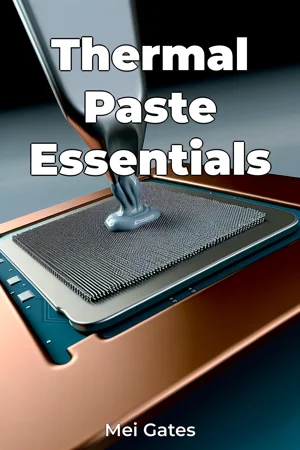
"Thermal Paste Essentials" addresses a critical yet often overlooked aspect of computer hardware maintenance: the proper application of thermal interface materials. This comprehensive guide examines how microscopic gaps between CPU surfaces and heatsinks can significantly impact cooling efficiency, and how proper thermal paste application can bridge these gaps to optimize system performance. The book begins by exploring the fundamental physics of heat transfer in computer systems, establishing why even seemingly insignificant air gaps can lead to thermal throttling and reduced CPU performance. Through detailed microscopic analysis and thermal imaging, readers learn how surface imperfections as small as 2-3 micrometers can impede heat dissipation. Three core sections form the backbone of this technical guide. The first examines the composition and properties of various thermal interface materials, from traditional zinc oxide compounds to liquid metal solutions, providing comparative thermal conductivity data and application characteristics. The second section presents research-backed application methodologies, using precise measurements to demonstrate how different application patterns affect heat distribution. The final section addresses common misconceptions and problems, supported by thermal performance data collected from laboratory testing. The book's central thesis maintains that optimal thermal paste application is both a science and a skill, requiring understanding of material properties, surface characteristics, and application techniques. This argument is supported by extensive testing data, including electron microscope imaging of surface interfaces and real-world performance measurements across different CPU architectures. Technical content is presented through detailed diagrams, high-resolution photographs, and thermal imaging, making complex concepts accessible to both enthusiasts and professionals. The research draws from both academic studies and practical industry experience, incorporating thermal testing data from multiple hardware configurations and environmental conditions. The work connects engineering principles with practical computer maintenance, bridging materials science, thermodynamics, and computer hardware optimization. It maintains a technical yet approachable tone, using precise language while explaining complex concepts in clear terms. Written for IT professionals, computer hardware enthusiasts, and system builders, the book provides both theoretical foundation and practical application guidelines. It addresses ongoing debates about application methods, using empirical data to evaluate competing techniques and their effectiveness under different conditions. The scope encompasses desktop and laptop processors, covering various socket types and mounting pressures. While focused primarily on CPU cooling, the principles extend to GPU and other high-performance computing applications. The material is organized progressively, building from basic concepts to advanced techniques. Notable attention is given to emerging technologies and materials, including phase-change compounds and graphene-enhanced solutions. The book examines their potential benefits and limitations, supported by current research data and testing results. Practical applications are emphasized throughout, with step-by-step guides for different processor types and mounting systems. Each method is accompanied by before-and-after thermal performance data, enabling readers to understand the impact of proper application techniques. The work acknowledges and addresses ongoing debates in the tech community regarding application patterns and material selection, using controlled testing to provide evidence-based recommendations rather than relying on conventional wisdom. This guide serves as a definitive resource for understanding and implementing effective thermal interface solutions, combining technical depth with practical utility for anyone involved in computer hardware assembly or maintenance.
"Thermal Paste Essentials" addresses a critical yet often overlooked aspect of computer hardware maintenance: the proper application of thermal interface materials. This comprehensive guide examines how microscopic gaps between CPU surfaces and heatsinks can significantly impact cooling efficiency, and how proper thermal paste application can bridge these gaps to optimize system performance. The book begins by exploring the fundamental physics of heat transfer in computer systems, establishing why even seemingly insignificant air gaps can lead to thermal throttling and reduced CPU performance. Through detailed microscopic analysis and thermal imaging, readers learn how surface imperfections as small as 2-3 micrometers can impede heat dissipation. Three core sections form the backbone of this technical guide. The first examines the composition and properties of various thermal interface materials, from traditional zinc oxide compounds to liquid metal solutions, providing comparative thermal conductivity data and application characteristics. The second section presents research-backed application methodologies, using precise measurements to demonstrate how different application patterns affect heat distribution. The final section addresses common misconceptions and problems, supported by thermal performance data collected from laboratory testing. The book's central thesis maintains that optimal thermal paste application is both a science and a skill, requiring understanding of material properties, surface characteristics, and application techniques. This argument is supported by extensive testing data, including electron microscope imaging of surface interfaces and real-world performance measurements across different CPU architectures. Technical content is presented through detailed diagrams, high-resolution photographs, and thermal imaging, making complex concepts accessible to both enthusiasts and professionals. The research draws from both academic studies and practical industry experience, incorporating thermal testing data from multiple hardware configurations and environmental conditions. The work connects engineering principles with practical computer maintenance, bridging materials science, thermodynamics, and computer hardware optimization. It maintains a technical yet approachable tone, using precise language while explaining complex concepts in clear terms. Written for IT professionals, computer hardware enthusiasts, and system builders, the book provides both theoretical foundation and practical application guidelines. It addresses ongoing debates about application methods, using empirical data to evaluate competing techniques and their effectiveness under different conditions. The scope encompasses desktop and laptop processors, covering various socket types and mounting pressures. While focused primarily on CPU cooling, the principles extend to GPU and other high-performance computing applications. The material is organized progressively, building from basic concepts to advanced techniques. Notable attention is given to emerging technologies and materials, including phase-change compounds and graphene-enhanced solutions. The book examines their potential benefits and limitations, supported by current research data and testing results. Practical applications are emphasized throughout, with step-by-step guides for different processor types and mounting systems. Each method is accompanied by before-and-after thermal performance data, enabling readers to understand the impact of proper application techniques. The work acknowledges and addresses ongoing debates in the tech community regarding application patterns and material selection, using controlled testing to provide evidence-based recommendations rather than relying on conventional wisdom. This guide serves as a definitive resource for understanding and implementing effective thermal interface solutions, combining technical depth with practical utility for anyone involved in computer hardware assembly or maintenance.
"Thermal Paste Essentials" delves into the crucial world of thermal interface materials and their impact on computer system performance. This comprehensive guide explains how microscopic gaps between CPU surfaces and heatsinks can significantly affect cooling efficiency, presenting both theoretical foundations and practical applications. The book uniquely combines materials science with hands-on computer maintenance, making complex thermodynamics concepts accessible to both IT professionals and enthusiasts. The content progresses logically through three main sections, starting with an exploration of various thermal interface materials and their properties, from traditional zinc oxide compounds to cutting-edge liquid metal solutions. The guide then advances to evidence-based application methodologies, using precise measurements and thermal imaging to demonstrate optimal techniques. The final section tackles common misconceptions, backed by laboratory testing data and real-world performance measurements across different CPU architectures. What sets this book apart is its empirical approach to a often-debated topic, using electron microscope imaging and thermal performance data to support its recommendations. Through detailed diagrams and high-resolution photographs, readers learn how surface imperfections as small as 2-3 micrometers can impact heat dissipation, and how proper thermal paste application can bridge these gaps. The guide maintains a perfect balance between technical accuracy and practical utility, making it an invaluable resource for anyone involved in computer hardware assembly or maintenance.
Book Details
ISBN
9788233942656
Publisher
Publifye AS
Your Licenses
You don't own any licenses for this book
Purchase a license below to unlock this book and download the EPUB.
Purchase License
Select a tier to unlock this book
Need bulk licensing?
Contact us for enterprise agreements.