
About This Book
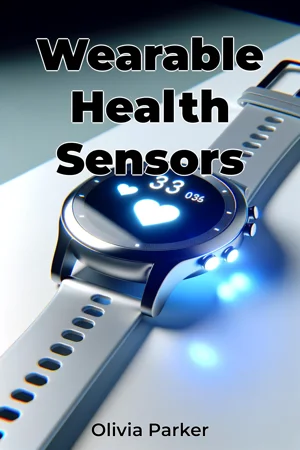
"Wearable Health Sensors" examines the transformative intersection of healthcare monitoring and personal technology, offering readers a comprehensive exploration of how body-worn devices are revolutionizing health management and preventive care. The book analyzes three primary developments: the evolution of miniaturized sensor technology, the integration of artificial intelligence in health data interpretation, and the emergence of real-time health monitoring systems. These innovations have created new possibilities for both medical professionals and individuals to track vital health metrics with clinical-grade accuracy. Beginning with a technical foundation, the text explains how modern sensors capture physiological data, from basic heart rate monitoring to complex electrocardiograms and blood oxygen measurements. Readers learn the underlying principles of bioelectric signals, optical sensing, and microelectromechanical systems that power these devices. The central thesis maintains that wearable health sensors represent a paradigm shift in healthcare delivery, enabling continuous monitoring instead of periodic clinical observations. This transition supports early detection of health issues and more personalized treatment approaches. Structured in three main sections, the book first covers sensor technology fundamentals and their historical development. The second section examines current applications in medical monitoring, fitness tracking, and preventive health. The final section explores future developments, including emerging sensor types and integration with healthcare systems. The research presented draws from peer-reviewed medical studies, engineering papers, and case studies from major healthcare institutions. Clinical trials demonstrating the efficacy of wearable monitoring in various medical conditions provide scientific validation for the technology's applications. The content connects multiple disciplines, including biomedical engineering, data science, and preventive medicine. These intersections highlight how wearable technology bridges the gap between consumer health tracking and clinical diagnostics. Written in a technical yet accessible style, the book maintains a balance between scientific detail and practical application. It includes detailed diagrams, technical specifications, and real-world examples while avoiding oversimplified explanations. The target audience includes healthcare professionals, biomedical engineers, technology developers, and informed consumers interested in health technology. The content serves both as a technical reference and a guide for implementing wearable health solutions. The text addresses current limitations in sensor accuracy, data privacy concerns, and regulatory challenges. It examines debates regarding the role of consumer health technology in clinical decision-making and the balance between continuous monitoring and patient privacy. Practical applications covered include: chronic disease management, athletic performance optimization, early warning systems for cardiac events, and remote patient monitoring solutions. The book provides frameworks for evaluating sensor reliability and implementing monitoring programs in various healthcare settings. The scope encompasses current commercial technologies while acknowledging rapid developments in the field. It focuses on validated applications rather than speculative future developments, providing readers with immediately applicable knowledge. This comprehensive examination of wearable health sensors reflects the growing integration of technology in healthcare delivery and personal health management. The book serves as both a technical reference and a practical guide for understanding and implementing these increasingly important monitoring tools.
"Wearable Health Sensors" examines the transformative intersection of healthcare monitoring and personal technology, offering readers a comprehensive exploration of how body-worn devices are revolutionizing health management and preventive care. The book analyzes three primary developments: the evolution of miniaturized sensor technology, the integration of artificial intelligence in health data interpretation, and the emergence of real-time health monitoring systems. These innovations have created new possibilities for both medical professionals and individuals to track vital health metrics with clinical-grade accuracy. Beginning with a technical foundation, the text explains how modern sensors capture physiological data, from basic heart rate monitoring to complex electrocardiograms and blood oxygen measurements. Readers learn the underlying principles of bioelectric signals, optical sensing, and microelectromechanical systems that power these devices. The central thesis maintains that wearable health sensors represent a paradigm shift in healthcare delivery, enabling continuous monitoring instead of periodic clinical observations. This transition supports early detection of health issues and more personalized treatment approaches. Structured in three main sections, the book first covers sensor technology fundamentals and their historical development. The second section examines current applications in medical monitoring, fitness tracking, and preventive health. The final section explores future developments, including emerging sensor types and integration with healthcare systems. The research presented draws from peer-reviewed medical studies, engineering papers, and case studies from major healthcare institutions. Clinical trials demonstrating the efficacy of wearable monitoring in various medical conditions provide scientific validation for the technology's applications. The content connects multiple disciplines, including biomedical engineering, data science, and preventive medicine. These intersections highlight how wearable technology bridges the gap between consumer health tracking and clinical diagnostics. Written in a technical yet accessible style, the book maintains a balance between scientific detail and practical application. It includes detailed diagrams, technical specifications, and real-world examples while avoiding oversimplified explanations. The target audience includes healthcare professionals, biomedical engineers, technology developers, and informed consumers interested in health technology. The content serves both as a technical reference and a guide for implementing wearable health solutions. The text addresses current limitations in sensor accuracy, data privacy concerns, and regulatory challenges. It examines debates regarding the role of consumer health technology in clinical decision-making and the balance between continuous monitoring and patient privacy. Practical applications covered include: chronic disease management, athletic performance optimization, early warning systems for cardiac events, and remote patient monitoring solutions. The book provides frameworks for evaluating sensor reliability and implementing monitoring programs in various healthcare settings. The scope encompasses current commercial technologies while acknowledging rapid developments in the field. It focuses on validated applications rather than speculative future developments, providing readers with immediately applicable knowledge. This comprehensive examination of wearable health sensors reflects the growing integration of technology in healthcare delivery and personal health management. The book serves as both a technical reference and a practical guide for understanding and implementing these increasingly important monitoring tools.
"Wearable Health Sensors" delivers a comprehensive exploration of how body-worn technology is revolutionizing healthcare monitoring and preventive medicine. The book expertly navigates the convergence of miniaturized sensor technology, artificial intelligence, and real-time health monitoring systems, demonstrating how these innovations enable continuous health tracking with clinical-grade accuracy. Through a well-structured approach, the text first establishes the technical foundations of modern sensor technology, explaining how devices capture everything from basic heart rate data to complex electrocardiograms. Readers gain insight into the sophisticated mechanisms behind bioelectric signals and optical sensing, while learning how these technologies translate into practical applications for chronic disease management and athletic performance optimization. The book's examination of real-world case studies and clinical trials provides compelling evidence for the effectiveness of wearable monitoring solutions. The final section looks toward future developments while addressing critical considerations such as data privacy and regulatory challenges. Written for healthcare professionals, biomedical engineers, and tech-savvy consumers, the book maintains an accessible yet technically precise tone throughout. By connecting multiple disciplines and providing frameworks for implementing wearable health solutions, it serves as both an authoritative reference and a practical guide for anyone interested in the intersection of healthcare and personal technology.
Book Details
ISBN
9788233942403
Publisher
Publifye AS
Your Licenses
You don't own any licenses for this book
Purchase a license below to unlock this book and download the EPUB.
Purchase License
Select a tier to unlock this book
Need bulk licensing?
Contact us for enterprise agreements.