
About This Book
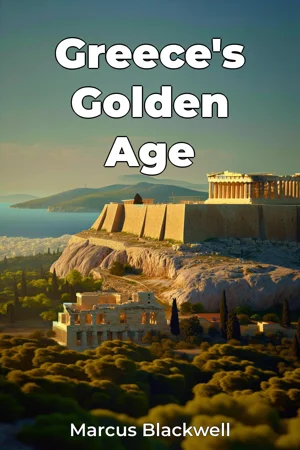
"Greece's Golden Age" examines the pivotal period between 800-323 BCE when Greek civilization established the foundational elements of Western culture. The book presents a detailed analysis of how interconnected city-states, philosophical inquiry, and cultural innovations shaped modern democratic principles, artistic expression, and intellectual discourse. The narrative begins by exploring the unique geography of ancient Greece, demonstrating how the mountainous terrain and scattered islands led to the development of independent city-states, each with distinct political systems and cultural identities. This decentralized structure fostered competition and innovation while maintaining a shared Hellenic identity through language, religion, and trade networks. Three primary themes weave through the work: the evolution of political thought and democratic principles in Athens; the emergence of systematic philosophical inquiry through figures like Socrates, Plato, and Aristotle; and the development of artistic and architectural innovations that continue to influence modern aesthetics. The book's central argument posits that Greece's golden age represented a crucial period of human development where rational inquiry, political experimentation, and artistic expression converged to create lasting paradigms of Western civilization. This thesis is supported by extensive archaeological evidence, contemporary historical accounts, and architectural remains that demonstrate the sophistication of Greek society. Readers follow the progression of Greek thought through carefully structured chapters that examine: - The transition from oral to written culture and its impact on knowledge preservation - The development of citizenship concepts and political participation - The establishment of philosophical schools and their methodologies - The role of religion and mythology in shaping social structures - The advancement of mathematics, science, and systematic observation The work draws from primary sources including Herodotus, Thucydides, and recovered inscriptions, while incorporating recent archaeological findings and modern scholarly interpretations. This multi-disciplinary approach connects classical studies with political science, philosophy, and art history, providing readers with a comprehensive understanding of the period's significance. The book maintains an academic tone while remaining accessible to general readers interested in classical civilization. It addresses ongoing scholarly debates about the nature of Greek democracy, the role of women and slaves in society, and the accuracy of historical accounts. Technical terms and concepts are clearly defined, making the material approachable for readers with limited background knowledge while providing sufficient depth for those well-versed in classical studies. The work pays particular attention to dismantling common misconceptions about ancient Greek society while highlighting less-known aspects of daily life and social organization. The scope encompasses the major Greek city-states but focuses primarily on Athens and Sparta as contrasting models of social organization. This limitation allows for detailed examination of political and social structures while acknowledging the diversity of Greek civilization. For modern readers, the book demonstrates how Greek innovations in governance, education, and civic participation remain relevant to contemporary discussions of democracy, citizenship, and public discourse. It examines how Greek approaches to problem-solving and rational inquiry established methods still employed in modern academic and professional fields. The work serves academics, students, and general readers interested in understanding the origins of Western intellectual traditions and their modern applications. It provides context for current political and philosophical debates while illuminating the historical roots of contemporary cultural practices.
"Greece's Golden Age" examines the pivotal period between 800-323 BCE when Greek civilization established the foundational elements of Western culture. The book presents a detailed analysis of how interconnected city-states, philosophical inquiry, and cultural innovations shaped modern democratic principles, artistic expression, and intellectual discourse. The narrative begins by exploring the unique geography of ancient Greece, demonstrating how the mountainous terrain and scattered islands led to the development of independent city-states, each with distinct political systems and cultural identities. This decentralized structure fostered competition and innovation while maintaining a shared Hellenic identity through language, religion, and trade networks. Three primary themes weave through the work: the evolution of political thought and democratic principles in Athens; the emergence of systematic philosophical inquiry through figures like Socrates, Plato, and Aristotle; and the development of artistic and architectural innovations that continue to influence modern aesthetics. The book's central argument posits that Greece's golden age represented a crucial period of human development where rational inquiry, political experimentation, and artistic expression converged to create lasting paradigms of Western civilization. This thesis is supported by extensive archaeological evidence, contemporary historical accounts, and architectural remains that demonstrate the sophistication of Greek society. Readers follow the progression of Greek thought through carefully structured chapters that examine: - The transition from oral to written culture and its impact on knowledge preservation - The development of citizenship concepts and political participation - The establishment of philosophical schools and their methodologies - The role of religion and mythology in shaping social structures - The advancement of mathematics, science, and systematic observation The work draws from primary sources including Herodotus, Thucydides, and recovered inscriptions, while incorporating recent archaeological findings and modern scholarly interpretations. This multi-disciplinary approach connects classical studies with political science, philosophy, and art history, providing readers with a comprehensive understanding of the period's significance. The book maintains an academic tone while remaining accessible to general readers interested in classical civilization. It addresses ongoing scholarly debates about the nature of Greek democracy, the role of women and slaves in society, and the accuracy of historical accounts. Technical terms and concepts are clearly defined, making the material approachable for readers with limited background knowledge while providing sufficient depth for those well-versed in classical studies. The work pays particular attention to dismantling common misconceptions about ancient Greek society while highlighting less-known aspects of daily life and social organization. The scope encompasses the major Greek city-states but focuses primarily on Athens and Sparta as contrasting models of social organization. This limitation allows for detailed examination of political and social structures while acknowledging the diversity of Greek civilization. For modern readers, the book demonstrates how Greek innovations in governance, education, and civic participation remain relevant to contemporary discussions of democracy, citizenship, and public discourse. It examines how Greek approaches to problem-solving and rational inquiry established methods still employed in modern academic and professional fields. The work serves academics, students, and general readers interested in understanding the origins of Western intellectual traditions and their modern applications. It provides context for current political and philosophical debates while illuminating the historical roots of contemporary cultural practices.
"Greece's Golden Age" presents a comprehensive exploration of ancient Greece's transformative period from 800-323 BCE, revealing how this pivotal era laid the groundwork for Western civilization. The book masterfully weaves together the story of how scattered city-states, united by language and religion yet distinct in their governance, fostered an unprecedented explosion of cultural and intellectual achievement. Through careful examination of archaeological evidence and historical accounts, readers discover how Greece's mountainous geography influenced the development of independent city-states, ultimately contributing to the birth of democratic principles and philosophical inquiry. The narrative progresses systematically through interconnected themes, examining how the transition from oral to written culture revolutionized knowledge preservation, while the emergence of systematic philosophical thought through figures like Socrates and Plato transformed human understanding. Particularly fascinating is the book's analysis of how Athens and Sparta represented contrasting models of social organization, demonstrating the diversity within Greek civilization. The text skillfully balances academic rigor with accessibility, making complex concepts understandable through clear explanations and relevant examples. The book's unique value lies in its ability to connect ancient Greek innovations to contemporary issues, showing how classical approaches to governance, education, and civic participation remain relevant today. Through carefully structured chapters exploring political thought, artistic expression, and philosophical advancement, readers gain insight into how this golden age created lasting paradigms that continue to influence modern Western society. The multi-disciplinary approach, incorporating recent archaeological findings and scholarly interpretations, provides a thorough understanding of how Greek civilization's achievements in democracy, philosophy, and cultural expression continue to resonate in our modern world.
Book Details
ISBN
9788233941048
Publisher
Publifye AS
Your Licenses
You don't own any licenses for this book
Purchase a license below to unlock this book and download the EPUB.
Purchase License
Select a tier to unlock this book
Need bulk licensing?
Contact us for enterprise agreements.