
About This Book
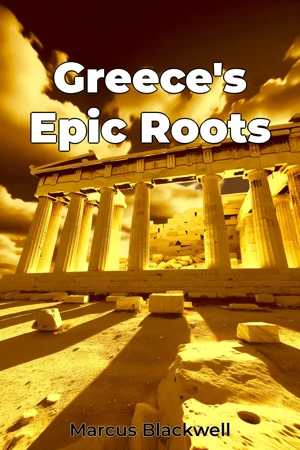
"Greece's Epic Roots" examines how a collection of competitive city-states birthed the foundational ideas that continue to shape modern civilization. From the agoras of Athens to the peaks of Mount Olympus, this comprehensive exploration reveals how ancient Greek thought systems created lasting frameworks for democracy, philosophy, and social organization. The book presents three primary threads: the evolution of Greek mythology and its role in societal development, the emergence of democratic principles through competing city-state systems, and the establishment of philosophical schools that would influence millennia of human thought. These interconnected elements demonstrate how Greek civilization created enduring patterns for understanding both governance and human nature. Beginning with the Mycenaean period (1600-1100 BCE), the narrative traces how early Greek settlements developed distinct cultural and political identities while maintaining shared linguistic and religious traditions. The text examines how this unique balance of competition and cooperation fostered innovation in political theory, artistic expression, and intellectual discourse. The book's central thesis posits that Greek contributions to human thought weren't merely historical achievements but represent fundamental patterns of reasoning that remain relevant to contemporary challenges in governance, ethics, and social organization. This argument is developed through careful analysis of primary sources, including political documents, philosophical texts, and architectural evidence. Structured in three main sections, the work first examines the role of mythology in shaping Greek worldviews and social structures. The second section analyzes the development of city-states, particularly Athens and Sparta, as competing models of social organization. The final section explores the emergence of systematic philosophy, from the pre-Socratics through the Hellenistic period. The research draws from archaeological findings, contemporary historical accounts, and modern scholarly analysis. Notable attention is given to recent archaeological discoveries that have refined our understanding of Greek social structures and daily life. The book integrates epigraphic evidence, architectural analysis, and textual sources to present a comprehensive view of Greek civilization. The work creates significant connections between ancient Greek thought and modern fields including political science, psychology, and urban planning. It demonstrates how Greek concepts of civic responsibility and philosophical inquiry influence contemporary approaches to education and governance. This book distinguishes itself by examining Greek achievements not as isolated historical events but as part of an interconnected system of social and intellectual development. The narrative maintains an academic foundation while remaining accessible to general readers interested in understanding the origins of Western thought. Written for both scholars and educated general readers, the text particularly appeals to those interested in political theory, philosophy, and cultural history. It serves as both an introduction to Greek civilization and a detailed analysis of its lasting influence. The book acknowledges ongoing debates about the nature of Greek democracy and its influence on modern systems of governance. It addresses controversies surrounding the interpretation of classical texts and their application to contemporary issues. While focused primarily on the period from 800-323 BCE, the work also examines the lasting impact of Greek ideas through the Roman period and into modern times. This scope allows readers to trace the evolution and adaptation of Greek concepts across different historical contexts. The content provides practical insights for modern readers, particularly in understanding the foundations of democratic systems, the role of public discourse in civic life, and the relationship between individual and collective interests in society.
"Greece's Epic Roots" examines how a collection of competitive city-states birthed the foundational ideas that continue to shape modern civilization. From the agoras of Athens to the peaks of Mount Olympus, this comprehensive exploration reveals how ancient Greek thought systems created lasting frameworks for democracy, philosophy, and social organization. The book presents three primary threads: the evolution of Greek mythology and its role in societal development, the emergence of democratic principles through competing city-state systems, and the establishment of philosophical schools that would influence millennia of human thought. These interconnected elements demonstrate how Greek civilization created enduring patterns for understanding both governance and human nature. Beginning with the Mycenaean period (1600-1100 BCE), the narrative traces how early Greek settlements developed distinct cultural and political identities while maintaining shared linguistic and religious traditions. The text examines how this unique balance of competition and cooperation fostered innovation in political theory, artistic expression, and intellectual discourse. The book's central thesis posits that Greek contributions to human thought weren't merely historical achievements but represent fundamental patterns of reasoning that remain relevant to contemporary challenges in governance, ethics, and social organization. This argument is developed through careful analysis of primary sources, including political documents, philosophical texts, and architectural evidence. Structured in three main sections, the work first examines the role of mythology in shaping Greek worldviews and social structures. The second section analyzes the development of city-states, particularly Athens and Sparta, as competing models of social organization. The final section explores the emergence of systematic philosophy, from the pre-Socratics through the Hellenistic period. The research draws from archaeological findings, contemporary historical accounts, and modern scholarly analysis. Notable attention is given to recent archaeological discoveries that have refined our understanding of Greek social structures and daily life. The book integrates epigraphic evidence, architectural analysis, and textual sources to present a comprehensive view of Greek civilization. The work creates significant connections between ancient Greek thought and modern fields including political science, psychology, and urban planning. It demonstrates how Greek concepts of civic responsibility and philosophical inquiry influence contemporary approaches to education and governance. This book distinguishes itself by examining Greek achievements not as isolated historical events but as part of an interconnected system of social and intellectual development. The narrative maintains an academic foundation while remaining accessible to general readers interested in understanding the origins of Western thought. Written for both scholars and educated general readers, the text particularly appeals to those interested in political theory, philosophy, and cultural history. It serves as both an introduction to Greek civilization and a detailed analysis of its lasting influence. The book acknowledges ongoing debates about the nature of Greek democracy and its influence on modern systems of governance. It addresses controversies surrounding the interpretation of classical texts and their application to contemporary issues. While focused primarily on the period from 800-323 BCE, the work also examines the lasting impact of Greek ideas through the Roman period and into modern times. This scope allows readers to trace the evolution and adaptation of Greek concepts across different historical contexts. The content provides practical insights for modern readers, particularly in understanding the foundations of democratic systems, the role of public discourse in civic life, and the relationship between individual and collective interests in society.
"Greece's Epic Roots" masterfully explores how ancient Greek civilization laid the groundwork for modern Western thought through three interconnected pillars: mythology, democracy, and philosophy. This comprehensive examination reveals how a network of competitive city-states fostered innovations in governance, intellectual discourse, and social organization that continue to shape our world today. The book uniquely positions Greek achievements not as isolated historical events, but as fundamental patterns of reasoning that remain remarkably relevant to contemporary challenges. The narrative begins with the Mycenaean period, tracing how early Greek settlements maintained their distinct identities while sharing crucial cultural bonds. Through careful analysis of archaeological findings, historical accounts, and philosophical texts, the book illuminates how the Greeks' unique balance of competition and cooperation sparked unprecedented advances in political theory and civic responsibility. The development of city-states, particularly the contrasting models of Athens and Sparta, demonstrates how diverse approaches to governance contributed to lasting frameworks for democracy. Moving from the physical agoras to the realm of ideas, the book examines how Greek philosophical schools established enduring methods of inquiry that would influence millennia of human thought. By integrating recent archaeological discoveries with classical texts, the work offers fresh insights into Greek social structures and daily life, making complex concepts accessible to both scholars and general readers interested in understanding the origins of Western civilization. The author's approach effectively demonstrates how ancient Greek concepts of civic engagement and philosophical investigation continue to inform modern approaches to education, governance, and social organization.
Book Details
ISBN
9788233940898
Publisher
Publifye AS
Your Licenses
You don't own any licenses for this book
Purchase a license below to unlock this book and download the EPUB.
Purchase License
Select a tier to unlock this book
Need bulk licensing?
Contact us for enterprise agreements.