
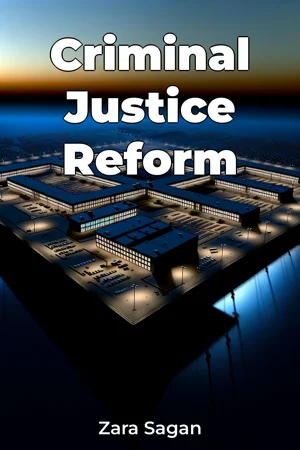
About This Book
Criminal Justice Reform examines the complex landscape of America's legal system through a data-driven analysis of current practices, systemic failures, and evidence-based solutions. The book opens with a stark reality: despite representing 5% of the world's population, the United States houses 25% of the world's prison population, prompting critical questions about the effectiveness and fairness of existing judicial frameworks. The work systematically explores three primary themes: the structural inequities within sentencing guidelines, the economic impact of mass incarceration, and the role of evidence-based rehabilitation programs. These interconnected issues form the foundation for understanding both the challenges and opportunities within criminal justice reform. Drawing from extensive legal research, demographic data, and outcome studies spanning the past three decades, the book builds its central argument: current criminal justice practices often perpetuate rather than prevent criminal behavior, while disproportionately affecting marginalized communities. This thesis is supported by comprehensive analyses of state and federal court records, incarceration statistics, and recidivism rates. The content progresses through carefully structured sections, beginning with an historical overview of American criminal justice evolution since the 1970s. Subsequent chapters examine the impact of mandatory minimum sentences, three-strikes laws, and the war on drugs. The analysis culminates in a detailed examination of successful reform initiatives from various states and countries. Research methodology combines quantitative data from the Bureau of Justice Statistics with qualitative studies from legal scholars, criminologists, and social scientists. The book particularly emphasizes longitudinal studies tracking outcomes of alternative sentencing programs and their impact on recidivism rates. The work creates meaningful connections between criminal justice, economics, and public health, demonstrating how reforms in one area potentially benefit others. For instance, it explores the relationship between mental health treatment accessibility and crime rates, while also analyzing the fiscal implications of various reform proposals. Written in an academic yet accessible style, the book maintains scholarly rigor while ensuring content remains comprehensible to non-specialists. It serves legal professionals, policymakers, students, and engaged citizens seeking to understand the complexities of justice reform. The book distinguishes itself through its systematic integration of international comparative analysis, examining successful reform models from countries like Norway and Portugal. This global perspective provides practical frameworks for policy adaptation and implementation. Particular attention is given to emerging reform strategies, including risk assessment tools, alternative sentencing programs, and restorative justice practices. The work carefully evaluates their effectiveness through empirical evidence rather than theoretical frameworks alone. The scope encompasses both federal and state-level systems, though it acknowledges variations in local implementation and resources. Limitations are clearly stated, particularly regarding data availability from private prison systems and juvenile justice programs. Current debates addressed include the role of private prisons, the impact of technological surveillance, and the balance between public safety and rehabilitation. The book maintains neutrality while presenting evidence for various policy positions. For practitioners and policymakers, the work offers practical implementation guidelines for reform initiatives, complete with cost-benefit analyses and timeline projections. Each chapter concludes with specific policy recommendations supported by research findings. This comprehensive examination of criminal justice reform combines rigorous analysis with practical solutions, making it a valuable resource for understanding and advancing meaningful changes in the American legal system.
Criminal Justice Reform examines the complex landscape of America's legal system through a data-driven analysis of current practices, systemic failures, and evidence-based solutions. The book opens with a stark reality: despite representing 5% of the world's population, the United States houses 25% of the world's prison population, prompting critical questions about the effectiveness and fairness of existing judicial frameworks. The work systematically explores three primary themes: the structural inequities within sentencing guidelines, the economic impact of mass incarceration, and the role of evidence-based rehabilitation programs. These interconnected issues form the foundation for understanding both the challenges and opportunities within criminal justice reform. Drawing from extensive legal research, demographic data, and outcome studies spanning the past three decades, the book builds its central argument: current criminal justice practices often perpetuate rather than prevent criminal behavior, while disproportionately affecting marginalized communities. This thesis is supported by comprehensive analyses of state and federal court records, incarceration statistics, and recidivism rates. The content progresses through carefully structured sections, beginning with an historical overview of American criminal justice evolution since the 1970s. Subsequent chapters examine the impact of mandatory minimum sentences, three-strikes laws, and the war on drugs. The analysis culminates in a detailed examination of successful reform initiatives from various states and countries. Research methodology combines quantitative data from the Bureau of Justice Statistics with qualitative studies from legal scholars, criminologists, and social scientists. The book particularly emphasizes longitudinal studies tracking outcomes of alternative sentencing programs and their impact on recidivism rates. The work creates meaningful connections between criminal justice, economics, and public health, demonstrating how reforms in one area potentially benefit others. For instance, it explores the relationship between mental health treatment accessibility and crime rates, while also analyzing the fiscal implications of various reform proposals. Written in an academic yet accessible style, the book maintains scholarly rigor while ensuring content remains comprehensible to non-specialists. It serves legal professionals, policymakers, students, and engaged citizens seeking to understand the complexities of justice reform. The book distinguishes itself through its systematic integration of international comparative analysis, examining successful reform models from countries like Norway and Portugal. This global perspective provides practical frameworks for policy adaptation and implementation. Particular attention is given to emerging reform strategies, including risk assessment tools, alternative sentencing programs, and restorative justice practices. The work carefully evaluates their effectiveness through empirical evidence rather than theoretical frameworks alone. The scope encompasses both federal and state-level systems, though it acknowledges variations in local implementation and resources. Limitations are clearly stated, particularly regarding data availability from private prison systems and juvenile justice programs. Current debates addressed include the role of private prisons, the impact of technological surveillance, and the balance between public safety and rehabilitation. The book maintains neutrality while presenting evidence for various policy positions. For practitioners and policymakers, the work offers practical implementation guidelines for reform initiatives, complete with cost-benefit analyses and timeline projections. Each chapter concludes with specific policy recommendations supported by research findings. This comprehensive examination of criminal justice reform combines rigorous analysis with practical solutions, making it a valuable resource for understanding and advancing meaningful changes in the American legal system.
"Criminal Justice Reform" presents a comprehensive examination of America's legal system, focusing on the striking reality that the United States, with just 5% of the world's population, houses 25% of global prison inmates. This data-driven analysis explores the interconnected challenges of structural inequities, mass incarceration's economic impact, and the potential of evidence-based rehabilitation programs to transform the current system. The book methodically progresses from an historical overview of criminal justice since the 1970s through detailed examinations of key issues like mandatory minimum sentences and three-strikes laws. By combining quantitative data from the Bureau of Justice Statistics with qualitative research from legal scholars and criminologists, it builds a compelling case that current practices often perpetuate rather than prevent criminal behavior. The analysis is particularly noteworthy for its integration of international perspectives, examining successful reform models from countries like Norway and Portugal. What sets this work apart is its practical approach to reform, offering concrete solutions backed by empirical evidence rather than theoretical frameworks alone. The book explores emerging strategies such as risk assessment tools and restorative justice practices, while carefully evaluating their effectiveness. For practitioners and policymakers, it provides detailed implementation guidelines complete with cost-benefit analyses, making it an invaluable resource for anyone seeking to understand or advance meaningful changes in America's criminal justice system.
Book Details
ISBN
9788233940775
Publisher
Publifye AS
Your Licenses
You don't own any licenses for this book
Purchase a license below to unlock this book and download the EPUB.
Purchase License
Select a tier to unlock this book
Need bulk licensing?
Contact us for enterprise agreements.