
About This Book
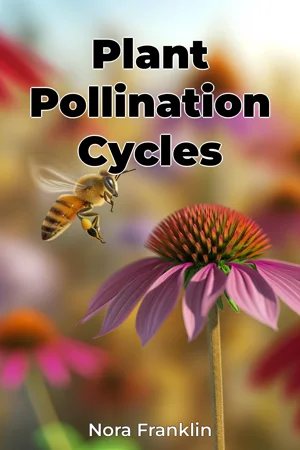
"Plant Pollination Cycles" examines the intricate relationship between plants and their pollinators, revealing how this fundamental biological process sustains life on Earth. From microscopic pollen grains to complex behavioral patterns of insects, birds, and mammals, this comprehensive guide illuminates the mechanisms that enable plant reproduction and maintain biodiversity. The book presents three core themes: the evolution of plant reproductive strategies, the diverse array of pollination mechanisms, and the critical role of pollinator species in global ecosystems. These interconnected topics form the foundation for understanding both natural history and contemporary environmental challenges, including crop production and species conservation. Beginning with the transition from primitive spore-based reproduction to the development of seeds and flowers, the text traces 470 million years of plant evolution. This historical context establishes how current pollination systems emerged and why they remain vital for ecosystem functioning. Readers will gain essential knowledge about plant anatomy, reproductive cycles, and the co-evolution of plants with their pollinators. The central thesis demonstrates that pollination represents more than a simple biological function—it is a complex network of relationships that shapes ecosystems, influences food production, and impacts global biodiversity. Through detailed examination of both wind and animal pollination, the book reveals how these processes maintain genetic diversity and enable plant species adaptation. Structured in three main sections, the content progresses from basic botanical concepts to specialized pollination mechanisms and concludes with implications for agriculture and conservation. Each chapter incorporates current research data, including recent findings on pollinator decline and its effects on food security. The text draws from peer-reviewed studies, long-term field observations, and agricultural research to support its arguments. The book connects biology with agriculture, ecology, and climate science, demonstrating how pollination processes influence food production, habitat preservation, and ecosystem stability. These interdisciplinary links help readers understand the broader implications of pollination beyond pure biology. Written in clear, technical language accessible to college-level readers, the text maintains scientific accuracy while avoiding unnecessary jargon. Detailed illustrations and microscopy images support complex concepts, making the material accessible to both students and professionals. The target audience includes biology students, environmental scientists, agricultural professionals, and informed general readers interested in plant sciences. The content serves as both an academic resource and a practical guide for understanding plant reproduction and ecosystem management. Following standard scientific literature conventions, the book presents methodologically sound research while addressing current debates in the field, such as the impact of pesticides on pollinator populations and the effectiveness of various conservation strategies. The scope encompasses both natural and agricultural systems, though it focuses primarily on flowering plants and their primary pollinators. While touching on global patterns, the book emphasizes well-documented examples from major ecological regions. Practical applications include guidelines for garden planning, agricultural practice recommendations, and conservation strategies. These elements allow readers to apply scientific principles to real-world situations, whether in research, farming, or habitat preservation. The text addresses ongoing scientific discussions about pollinator decline, the effectiveness of artificial pollination methods, and strategies for maintaining pollinator diversity in changing environments. These topics are presented objectively, with evidence supporting various perspectives in current scientific discourse.
"Plant Pollination Cycles" examines the intricate relationship between plants and their pollinators, revealing how this fundamental biological process sustains life on Earth. From microscopic pollen grains to complex behavioral patterns of insects, birds, and mammals, this comprehensive guide illuminates the mechanisms that enable plant reproduction and maintain biodiversity. The book presents three core themes: the evolution of plant reproductive strategies, the diverse array of pollination mechanisms, and the critical role of pollinator species in global ecosystems. These interconnected topics form the foundation for understanding both natural history and contemporary environmental challenges, including crop production and species conservation. Beginning with the transition from primitive spore-based reproduction to the development of seeds and flowers, the text traces 470 million years of plant evolution. This historical context establishes how current pollination systems emerged and why they remain vital for ecosystem functioning. Readers will gain essential knowledge about plant anatomy, reproductive cycles, and the co-evolution of plants with their pollinators. The central thesis demonstrates that pollination represents more than a simple biological function—it is a complex network of relationships that shapes ecosystems, influences food production, and impacts global biodiversity. Through detailed examination of both wind and animal pollination, the book reveals how these processes maintain genetic diversity and enable plant species adaptation. Structured in three main sections, the content progresses from basic botanical concepts to specialized pollination mechanisms and concludes with implications for agriculture and conservation. Each chapter incorporates current research data, including recent findings on pollinator decline and its effects on food security. The text draws from peer-reviewed studies, long-term field observations, and agricultural research to support its arguments. The book connects biology with agriculture, ecology, and climate science, demonstrating how pollination processes influence food production, habitat preservation, and ecosystem stability. These interdisciplinary links help readers understand the broader implications of pollination beyond pure biology. Written in clear, technical language accessible to college-level readers, the text maintains scientific accuracy while avoiding unnecessary jargon. Detailed illustrations and microscopy images support complex concepts, making the material accessible to both students and professionals. The target audience includes biology students, environmental scientists, agricultural professionals, and informed general readers interested in plant sciences. The content serves as both an academic resource and a practical guide for understanding plant reproduction and ecosystem management. Following standard scientific literature conventions, the book presents methodologically sound research while addressing current debates in the field, such as the impact of pesticides on pollinator populations and the effectiveness of various conservation strategies. The scope encompasses both natural and agricultural systems, though it focuses primarily on flowering plants and their primary pollinators. While touching on global patterns, the book emphasizes well-documented examples from major ecological regions. Practical applications include guidelines for garden planning, agricultural practice recommendations, and conservation strategies. These elements allow readers to apply scientific principles to real-world situations, whether in research, farming, or habitat preservation. The text addresses ongoing scientific discussions about pollinator decline, the effectiveness of artificial pollination methods, and strategies for maintaining pollinator diversity in changing environments. These topics are presented objectively, with evidence supporting various perspectives in current scientific discourse.
"Plant Pollination Cycles" offers a comprehensive exploration of one of nature's most crucial processes: the intricate dance between plants and their pollinators that sustains life on Earth. The book masterfully weaves together three fundamental themes: plant reproductive evolution, diverse pollination mechanisms, and the essential role of pollinators in maintaining global ecosystems. Through clear, technical language and detailed illustrations, readers journey through 470 million years of plant evolution, from primitive spore-based reproduction to the complex flowering systems we see today. This authoritative guide demonstrates how pollination transcends simple biological function to become a complex network that shapes our world's ecosystems and food security. The book presents fascinating insights into how microscopic pollen grains and the behavioral patterns of various pollinators—from insects to mammals—work together to maintain biodiversity and enable plant adaptation. Particularly compelling is its examination of recent research on pollinator decline and its implications for global food production and ecosystem stability. Progressing from fundamental botanical concepts through specialized pollination mechanisms to real-world applications in agriculture and conservation, the book serves multiple audiences, from biology students to agricultural professionals. What sets this work apart is its interdisciplinary approach, connecting biological principles with practical applications in farming and habitat preservation, while maintaining scientific rigor and accessibility. The inclusion of current research data and ongoing scientific debates about pollinator conservation makes it particularly relevant for understanding contemporary environmental challenges.
Book Details
ISBN
9788233940263
Publisher
Publifye AS
Your Licenses
You don't own any licenses for this book
Purchase a license below to unlock this book and download the EPUB.
Purchase License
Select a tier to unlock this book
Need bulk licensing?
Contact us for enterprise agreements.