
About This Book
"Insect Colony Life" delves into the sophisticated world of social insects, where millions of individuals work in concert to create some of Earth's most complex animal societies. From the climate-controlled chambers of leaf-cutter ant colonies to the precisely hexagonal cells of honey bee hives, this book examines how insect societies have evolved intricate solutions to collective living. The text presents three central themes: the evolution of social organization in insects, the complex communication systems that enable colony cohesion, and the adaptive strategies that have allowed insect colonies to thrive across diverse environments. These topics reveal how social insects have developed solutions to challenges that parallel human societies, including division of labor, resource allocation, and collective decision-making. Drawing from fifty years of field research and laboratory studies, the book builds upon the foundational work of early entomologists while incorporating recent discoveries in chemical ecology, behavioral genetics, and collective intelligence. Readers will gain essential background in basic insect biology while exploring advanced concepts in social organization. The core argument presents insect colonies as superorganisms—entities where individual insects function like cells in a larger body, demonstrating how collective behavior can emerge from simple interactions between colony members. This perspective offers insights into the evolution of social behavior and the principles of self-organization in complex systems. The book's structure progresses from individual insect biology to colony dynamics, examining: - The evolution of eusociality and caste systems - Chemical and behavioral communication networks - Colony defense and resource management strategies - The relationship between colony size and social complexity Supporting evidence comes from long-term observational studies, chemical analyses of pheromone communications, and new research using radio-frequency identification to track individual insects within colonies. The text incorporates data from multiple species, including ants, bees, wasps, and termites, providing comparative analyses that highlight universal principles of social organization. The work connects biology with computer science through discussions of swarm intelligence, mathematics through analyses of colony growth patterns, and environmental science through examinations of colony responses to climate change. These interdisciplinary links demonstrate the broader applications of insights gained from studying insect societies. Written in an academic yet accessible style, the text uses detailed observations and case studies to illustrate complex concepts. Technical terms are carefully introduced and explained, making the material accessible to both biology students and informed general readers interested in natural history. The book addresses current scientific debates, including questions about the role of genetic relationships in social evolution and the impact of environmental changes on social insect populations. It examines how climate change and habitat destruction affect colony survival and adaptation. The practical applications section explores biomimicry in robotics, architectural design inspired by social insect nests, and potential applications in organizational management. These examples show how understanding insect societies can inform human innovation and problem-solving. The scope encompasses both tropical and temperate species, though it focuses primarily on well-studied model organisms. While the book addresses broader evolutionary questions, it maintains its focus on contemporary colony life and behavior rather than attempting to cover the entire evolutionary history of social insects. This comprehensive examination of insect societies offers valuable insights for biologists, ecology students, and anyone interested in understanding complex social systems in nature. By examining how insect colonies solve universal problems of social living, the book provides a fresh perspective on cooperation, communication, and collective behavior in biological systems.
"Insect Colony Life" delves into the sophisticated world of social insects, where millions of individuals work in concert to create some of Earth's most complex animal societies. From the climate-controlled chambers of leaf-cutter ant colonies to the precisely hexagonal cells of honey bee hives, this book examines how insect societies have evolved intricate solutions to collective living. The text presents three central themes: the evolution of social organization in insects, the complex communication systems that enable colony cohesion, and the adaptive strategies that have allowed insect colonies to thrive across diverse environments. These topics reveal how social insects have developed solutions to challenges that parallel human societies, including division of labor, resource allocation, and collective decision-making. Drawing from fifty years of field research and laboratory studies, the book builds upon the foundational work of early entomologists while incorporating recent discoveries in chemical ecology, behavioral genetics, and collective intelligence. Readers will gain essential background in basic insect biology while exploring advanced concepts in social organization. The core argument presents insect colonies as superorganisms—entities where individual insects function like cells in a larger body, demonstrating how collective behavior can emerge from simple interactions between colony members. This perspective offers insights into the evolution of social behavior and the principles of self-organization in complex systems. The book's structure progresses from individual insect biology to colony dynamics, examining: - The evolution of eusociality and caste systems - Chemical and behavioral communication networks - Colony defense and resource management strategies - The relationship between colony size and social complexity Supporting evidence comes from long-term observational studies, chemical analyses of pheromone communications, and new research using radio-frequency identification to track individual insects within colonies. The text incorporates data from multiple species, including ants, bees, wasps, and termites, providing comparative analyses that highlight universal principles of social organization. The work connects biology with computer science through discussions of swarm intelligence, mathematics through analyses of colony growth patterns, and environmental science through examinations of colony responses to climate change. These interdisciplinary links demonstrate the broader applications of insights gained from studying insect societies. Written in an academic yet accessible style, the text uses detailed observations and case studies to illustrate complex concepts. Technical terms are carefully introduced and explained, making the material accessible to both biology students and informed general readers interested in natural history. The book addresses current scientific debates, including questions about the role of genetic relationships in social evolution and the impact of environmental changes on social insect populations. It examines how climate change and habitat destruction affect colony survival and adaptation. The practical applications section explores biomimicry in robotics, architectural design inspired by social insect nests, and potential applications in organizational management. These examples show how understanding insect societies can inform human innovation and problem-solving. The scope encompasses both tropical and temperate species, though it focuses primarily on well-studied model organisms. While the book addresses broader evolutionary questions, it maintains its focus on contemporary colony life and behavior rather than attempting to cover the entire evolutionary history of social insects. This comprehensive examination of insect societies offers valuable insights for biologists, ecology students, and anyone interested in understanding complex social systems in nature. By examining how insect colonies solve universal problems of social living, the book provides a fresh perspective on cooperation, communication, and collective behavior in biological systems.
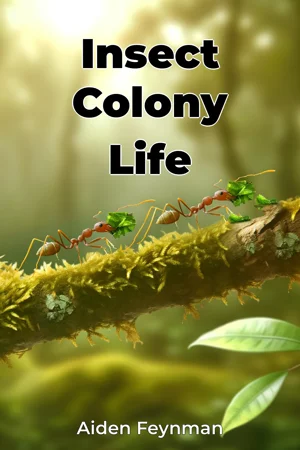
"Insect Colony Life" offers a fascinating exploration of social insects' complex societies, where millions of individuals collaborate to create remarkably sophisticated communities. The book unveils how these tiny creatures have developed intricate solutions to collective living, from the temperature-regulated chambers of leaf-cutter ants to the architectural precision of bee colonies. Through three central themes – social organization evolution, communication systems, and adaptive strategies – readers discover how insect societies parallel human communities in their approaches to division of labor, resource management, and group decision-making. Drawing from fifty years of research, the text presents colonies as superorganisms, where individual insects function like cells in a larger living entity. The book progresses logically from basic insect biology to complex colony dynamics, examining eusociality, pheromone communication networks, and the fascinating relationship between colony size and social complexity. Real-world examples and detailed case studies make complex concepts accessible, while incorporating cutting-edge research using modern tracking technologies and chemical analysis. The work uniquely bridges multiple disciplines, connecting insights from biology with computer science through discussions of swarm intelligence, and exploring practical applications in biomimicry and architectural design. While maintaining scientific rigor, the book presents information in an accessible style that serves both biology students and curious general readers. By examining how insect colonies tackle universal challenges of social living, it offers valuable perspectives on cooperation and collective behavior in nature.
Book Details
ISBN
9788233940225
Publisher
Publifye AS
Your Licenses
You don't own any licenses for this book
Purchase a license below to unlock this book and download the EPUB.
Purchase License
Select a tier to unlock this book
Need bulk licensing?
Contact us for enterprise agreements.