
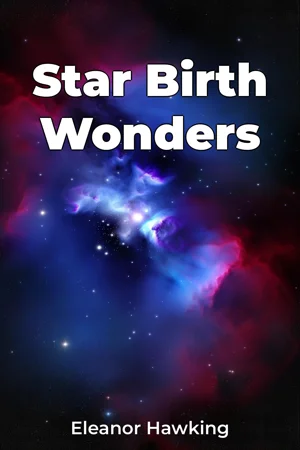
About This Book
"Star Birth Wonders" examines the intricate process of stellar formation, offering readers a detailed journey through one of the most fundamental processes in the universe. The book begins by addressing a deceptively simple question: How does scattered cosmic material transform into the luminous celestial bodies that populate our night sky? The text presents three primary areas of focus: the composition and behavior of molecular clouds, the physics of gravitational collapse, and the stages of protostellar evolution. These interconnected topics form the foundation for understanding how matter dispersed across light-years eventually becomes concentrated enough to initiate nuclear fusion. Drawing from recent observations by the James Webb Space Telescope and other advanced instruments, the book provides current data on stellar nurseries, including the Orion Nebula and the Eagle Nebula's Pillars of Creation. This research is complemented by computational models that demonstrate the complex interplay between gravity, magnetic fields, and radiation pressure during star formation. The central thesis argues that star formation represents a crucial intersection of fundamental physical forces, where quantum mechanics meets gravitational physics in a process that ultimately enables life itself through the creation of essential elements. The book structures this argument through progressive chapters that build from basic principles to complex interactions. The content follows a logical progression, beginning with an examination of interstellar medium composition and molecular cloud dynamics. It then explores the Jeans instability criterion and the conditions necessary for cloud collapse, before culminating in an analysis of protostellar evolution and the ignition of fusion reactions. Supporting evidence comes from multiple sources, including spectroscopic analysis of molecular clouds, radio telescope observations of gas distributions, and infrared imaging of young stellar objects. The book incorporates data from both ground-based and space-based observatories, providing readers with a comprehensive view of current research methodologies. The text connects astronomy with other scientific disciplines, including quantum physics in examining molecular behavior, chemistry in analyzing cloud composition, and fluid dynamics in understanding gas movements. These interdisciplinary links demonstrate how various scientific fields contribute to our understanding of stellar evolution. Written in a methodical, accessible style, the book maintains scientific accuracy while ensuring concepts remain comprehensible to readers with a basic understanding of physics and astronomy. Technical terms are carefully introduced and explained, with supporting diagrams and images to illustrate complex processes. The target audience includes undergraduate science students, astronomy enthusiasts, and educated general readers interested in understanding fundamental cosmic processes. The book assumes basic familiarity with physical sciences but provides necessary background information for more complex concepts. Within the science genre, the book adheres to established conventions of peer-reviewed research while maintaining narrative coherence. It addresses current debates in the field, including the role of magnetic fields in controlling star formation rates and the impact of nearby massive stars on protostellar development. The scope encompasses the complete process of star formation, from initial cloud conditions to the onset of main sequence status, while acknowledging that certain aspects of early stellar evolution remain active areas of research. Practical applications include understanding our own solar system's origin and identifying potential star-forming regions for further study. The book provides readers with tools to interpret astronomical observations and understand scientific papers about stellar evolution, making complex astrophysical concepts accessible without oversimplifying the underlying science.
"Star Birth Wonders" examines the intricate process of stellar formation, offering readers a detailed journey through one of the most fundamental processes in the universe. The book begins by addressing a deceptively simple question: How does scattered cosmic material transform into the luminous celestial bodies that populate our night sky? The text presents three primary areas of focus: the composition and behavior of molecular clouds, the physics of gravitational collapse, and the stages of protostellar evolution. These interconnected topics form the foundation for understanding how matter dispersed across light-years eventually becomes concentrated enough to initiate nuclear fusion. Drawing from recent observations by the James Webb Space Telescope and other advanced instruments, the book provides current data on stellar nurseries, including the Orion Nebula and the Eagle Nebula's Pillars of Creation. This research is complemented by computational models that demonstrate the complex interplay between gravity, magnetic fields, and radiation pressure during star formation. The central thesis argues that star formation represents a crucial intersection of fundamental physical forces, where quantum mechanics meets gravitational physics in a process that ultimately enables life itself through the creation of essential elements. The book structures this argument through progressive chapters that build from basic principles to complex interactions. The content follows a logical progression, beginning with an examination of interstellar medium composition and molecular cloud dynamics. It then explores the Jeans instability criterion and the conditions necessary for cloud collapse, before culminating in an analysis of protostellar evolution and the ignition of fusion reactions. Supporting evidence comes from multiple sources, including spectroscopic analysis of molecular clouds, radio telescope observations of gas distributions, and infrared imaging of young stellar objects. The book incorporates data from both ground-based and space-based observatories, providing readers with a comprehensive view of current research methodologies. The text connects astronomy with other scientific disciplines, including quantum physics in examining molecular behavior, chemistry in analyzing cloud composition, and fluid dynamics in understanding gas movements. These interdisciplinary links demonstrate how various scientific fields contribute to our understanding of stellar evolution. Written in a methodical, accessible style, the book maintains scientific accuracy while ensuring concepts remain comprehensible to readers with a basic understanding of physics and astronomy. Technical terms are carefully introduced and explained, with supporting diagrams and images to illustrate complex processes. The target audience includes undergraduate science students, astronomy enthusiasts, and educated general readers interested in understanding fundamental cosmic processes. The book assumes basic familiarity with physical sciences but provides necessary background information for more complex concepts. Within the science genre, the book adheres to established conventions of peer-reviewed research while maintaining narrative coherence. It addresses current debates in the field, including the role of magnetic fields in controlling star formation rates and the impact of nearby massive stars on protostellar development. The scope encompasses the complete process of star formation, from initial cloud conditions to the onset of main sequence status, while acknowledging that certain aspects of early stellar evolution remain active areas of research. Practical applications include understanding our own solar system's origin and identifying potential star-forming regions for further study. The book provides readers with tools to interpret astronomical observations and understand scientific papers about stellar evolution, making complex astrophysical concepts accessible without oversimplifying the underlying science.
"Star Birth Wonders" takes readers on a fascinating journey through the complex process of stellar formation, exploring how scattered cosmic material transforms into the brilliant stars that illuminate our universe. The book masterfully weaves together three crucial elements of star birth: molecular cloud behavior, gravitational collapse physics, and protostellar evolution stages, presenting these concepts in a way that bridges fundamental physics with astronomical observation. Drawing from cutting-edge research, including recent data from the James Webb Space Telescope, the book examines famous stellar nurseries like the Orion Nebula and the Eagle Nebula's Pillars of Creation. It demonstrates how various forces - gravity, magnetic fields, and radiation pressure - work in concert to create stars, while explaining how quantum mechanics intersects with gravitational physics during this cosmic process. The progression from basic principles to complex interactions makes the material accessible to readers with a basic science background. Through methodical chapters that build upon each other, the book connects multiple scientific disciplines, from quantum physics to chemistry, illustrating how each field contributes to our understanding of stellar evolution. What sets this work apart is its comprehensive approach to explaining star formation, combining observational evidence from ground-based and space-based telescopes with computational models, while maintaining scientific rigor without sacrificing clarity. The result is an engaging exploration of one of the universe's most fundamental processes, essential for anyone interested in understanding how stars come into being.
Book Details
ISBN
9788233940188
Publisher
Publifye AS
Your Licenses
You don't own any licenses for this book
Purchase a license below to unlock this book and download the EPUB.
Purchase License
Select a tier to unlock this book
Need bulk licensing?
Contact us for enterprise agreements.