
About This Book
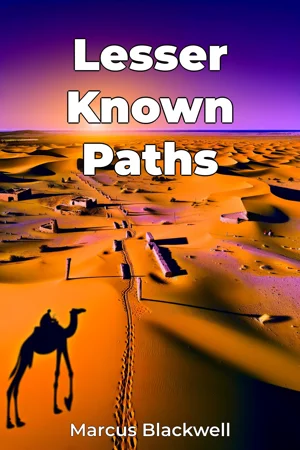
"Lesser Known Paths" challenges our understanding of historical connectivity by examining overlooked routes that operated parallel to well-documented trading networks, migration patterns, and exploration endeavors. Through careful analysis of archaeological findings, historical records, and geographical data, this book reveals how these alternative pathways significantly influenced cultural exchange, economic development, and societal evolution across continents. The book presents three core themes: the maritime trade routes of the Indian Ocean that predated European exploration, the grassland corridors of Central Asia that facilitated lesser-known migrations, and the trans-Saharan networks that connected sub-Saharan Africa with the Mediterranean world. These paths, while less celebrated than the Silk Road or Atlantic trade routes, played equally crucial roles in shaping human civilization. Drawing from recent archaeological discoveries, satellite imagery analysis, and previously untranslated historical documents, the work reconstructs these forgotten networks with methodical precision. The research combines traditional historical analysis with modern geological and climatological data to understand how these routes developed and functioned. The book's central argument posits that our current understanding of historical connectivity is incomplete without considering these alternative pathways. It demonstrates how these routes often proved more influential in facilitating cultural exchange and technological transfer than their better-known counterparts. Structured in three main sections, the book first establishes the methodological framework for identifying and studying these hidden pathways. The second section examines specific case studies, including the maritime networks of Southeast Asian archipelagos and the mountain passes of the Caucasus. The final section synthesizes these findings to reveal their collective impact on world history. The evidence presented includes archaeological artifacts, genetic studies, linguistic analysis, and climatological data. The book features newly discovered trade documents from multiple civilizations and archaeological findings from remote locations, providing fresh perspectives on historical connectivity. The work bridges multiple disciplines, connecting archaeology with climatology, linguistics with geography, and economics with cultural studies. This interdisciplinary approach allows for a more comprehensive understanding of how these routes influenced human civilization. Written in an academic yet accessible style, the book maintains scholarly rigor while ensuring clarity for educated general readers. It appeals to historians, geographers, archaeologists, and anyone interested in understanding how lesser-known historical connections shaped our world. The book's scope encompasses a period from approximately 3000 BCE to 1500 CE, focusing on regions typically underrepresented in traditional historical narratives. While it acknowledges the limitations of available evidence, it demonstrates how modern scientific methods can fill historical gaps. The research addresses ongoing debates about the relative importance of different historical trade routes and migration patterns, offering new evidence that challenges established narratives about the primacy of certain well-known paths. For modern readers, the book provides insights into how alternative networks develop and function, offering relevant parallels to contemporary global connectivity. It demonstrates how understanding these historical patterns can inform current approaches to international trade, cultural exchange, and human migration. The work maintains a measured, evidence-based approach throughout, focusing on verifiable data rather than speculation. It contributes to the field by illuminating previously overlooked connections that were vital to human development and continue to influence global patterns today.
"Lesser Known Paths" challenges our understanding of historical connectivity by examining overlooked routes that operated parallel to well-documented trading networks, migration patterns, and exploration endeavors. Through careful analysis of archaeological findings, historical records, and geographical data, this book reveals how these alternative pathways significantly influenced cultural exchange, economic development, and societal evolution across continents. The book presents three core themes: the maritime trade routes of the Indian Ocean that predated European exploration, the grassland corridors of Central Asia that facilitated lesser-known migrations, and the trans-Saharan networks that connected sub-Saharan Africa with the Mediterranean world. These paths, while less celebrated than the Silk Road or Atlantic trade routes, played equally crucial roles in shaping human civilization. Drawing from recent archaeological discoveries, satellite imagery analysis, and previously untranslated historical documents, the work reconstructs these forgotten networks with methodical precision. The research combines traditional historical analysis with modern geological and climatological data to understand how these routes developed and functioned. The book's central argument posits that our current understanding of historical connectivity is incomplete without considering these alternative pathways. It demonstrates how these routes often proved more influential in facilitating cultural exchange and technological transfer than their better-known counterparts. Structured in three main sections, the book first establishes the methodological framework for identifying and studying these hidden pathways. The second section examines specific case studies, including the maritime networks of Southeast Asian archipelagos and the mountain passes of the Caucasus. The final section synthesizes these findings to reveal their collective impact on world history. The evidence presented includes archaeological artifacts, genetic studies, linguistic analysis, and climatological data. The book features newly discovered trade documents from multiple civilizations and archaeological findings from remote locations, providing fresh perspectives on historical connectivity. The work bridges multiple disciplines, connecting archaeology with climatology, linguistics with geography, and economics with cultural studies. This interdisciplinary approach allows for a more comprehensive understanding of how these routes influenced human civilization. Written in an academic yet accessible style, the book maintains scholarly rigor while ensuring clarity for educated general readers. It appeals to historians, geographers, archaeologists, and anyone interested in understanding how lesser-known historical connections shaped our world. The book's scope encompasses a period from approximately 3000 BCE to 1500 CE, focusing on regions typically underrepresented in traditional historical narratives. While it acknowledges the limitations of available evidence, it demonstrates how modern scientific methods can fill historical gaps. The research addresses ongoing debates about the relative importance of different historical trade routes and migration patterns, offering new evidence that challenges established narratives about the primacy of certain well-known paths. For modern readers, the book provides insights into how alternative networks develop and function, offering relevant parallels to contemporary global connectivity. It demonstrates how understanding these historical patterns can inform current approaches to international trade, cultural exchange, and human migration. The work maintains a measured, evidence-based approach throughout, focusing on verifiable data rather than speculation. It contributes to the field by illuminating previously overlooked connections that were vital to human development and continue to influence global patterns today.
"Lesser Known Paths" unveils a fascinating exploration of overlooked historical trade routes and migration patterns that shaped human civilization alongside more famous networks like the Silk Road. This comprehensive study examines three crucial but understudied pathways: the ancient maritime routes of the Indian Ocean, Central Asian grassland corridors, and trans-Saharan networks. Through a unique combination of archaeological findings, satellite imagery, and newly translated historical documents, the book reveals how these alternative routes were equally influential in facilitating cultural exchange and technological advancement across civilizations. The book's innovative approach combines traditional historical analysis with modern scientific methods, including genetic studies, linguistic analysis, and climatological data. Spanning from 3000 BCE to 1500 CE, it focuses particularly on underrepresented regions and demonstrates how these lesser-known paths connected diverse cultures and economies. The research challenges conventional narratives about historical connectivity by presenting compelling evidence from remote archaeological sites and previously undiscovered trade documents. Structured in three main sections, the work progresses from establishing methodological frameworks to examining specific case studies, such as Southeast Asian archipelago networks and Caucasus mountain passages, before synthesizing these findings to demonstrate their collective impact on world history. This interdisciplinary approach, combining archaeology, climatology, linguistics, and geography, offers readers a fresh perspective on how alternative historical networks contributed to the development of human civilization, while providing relevant insights for understanding modern global connectivity patterns.
Book Details
ISBN
9788233940171
Publisher
Publifye AS
Your Licenses
You don't own any licenses for this book
Purchase a license below to unlock this book and download the EPUB.
Purchase License
Select a tier to unlock this book
Need bulk licensing?
Contact us for enterprise agreements.