
About This Book
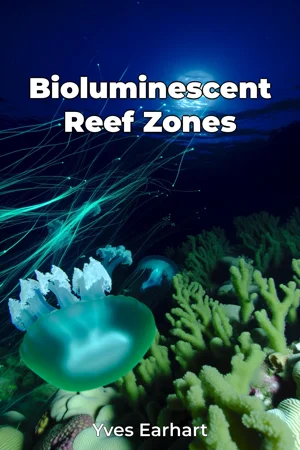
"Bioluminescent Reef Zones" delves into one of nature's most intriguing phenomena: the ability of marine organisms to produce living light in reef ecosystems. This comprehensive exploration begins with a fundamental question: How do complex reef systems sustain communities of light-producing organisms, and what roles do these illuminated species play in their marine environments? The book presents three core themes: the biochemical mechanisms of marine bioluminescence, the ecological relationships within illuminated reef zones, and the evolutionary pathways that led to light-producing capabilities. These topics interweave to demonstrate how bioluminescence shapes marine ecosystems and influences species interactions across depth zones. Drawing from recent marine biology research and long-term reef studies, the text examines the diversity of light-producing organisms, from tiny dinoflagellates to complex vertebrates. The biochemical analysis focuses on the luciferin-luciferase reaction, explaining how different species have developed varied approaches to generating light. This foundation helps readers understand the cellular processes that enable marine bioluminescence. The book's central argument posits that bioluminescence serves as a crucial communication and survival mechanism in reef ecosystems, driving species evolution and ecological relationships. This perspective is supported by extensive field research, including deep-sea observations, genetic analyses, and behavioral studies of marine organisms. Structured in three main sections, the content progresses from basic chemical mechanisms to ecosystem dynamics and evolutionary implications. The first section details the biochemistry of bioluminescence, including the role of substrate availability and environmental factors. The second examines reef zones and their distinct bioluminescent communities, while the third explores evolutionary advantages and species adaptation patterns. The research presented incorporates data from submersible expeditions, genetic sequencing, and advanced imaging techniques. This multifaceted approach provides readers with comprehensive evidence supporting the book's conclusions about bioluminescent systems in reef environments. The text connects marine biology with chemistry, evolution, and environmental science, demonstrating how these fields intersect in the study of bioluminescent reefs. This interdisciplinary approach helps readers understand the broader implications of marine bioluminescence for ocean health and biodiversity. Written in an academic yet accessible style, the book maintains scientific accuracy while engaging readers through clear explanations and specific examples. It serves researchers, marine biology students, and informed general readers interested in marine ecosystems and biochemical processes. The scope encompasses shallow reef systems to mesophotic zones, examining how light production varies across depth gradients. While focusing primarily on reef ecosystems, the book acknowledges parallel bioluminescent systems in open ocean environments for context. Current debates addressed include the impact of ocean acidification on bioluminescent organisms and the potential effects of climate change on these specialized marine communities. The text presents emerging research on these topics while acknowledging areas requiring further study. Practical applications discussed include biotechnology potential, marine conservation strategies, and the development of new research methodologies for studying deep-reef environments. These applications demonstrate the broader relevance of understanding bioluminescent systems for marine science and conservation efforts. The book provides readers with tools to understand marine bioluminescence as both a biological phenomenon and an indicator of reef ecosystem health, offering insights into the complexity and interconnectedness of marine life through the lens of living light.
"Bioluminescent Reef Zones" delves into one of nature's most intriguing phenomena: the ability of marine organisms to produce living light in reef ecosystems. This comprehensive exploration begins with a fundamental question: How do complex reef systems sustain communities of light-producing organisms, and what roles do these illuminated species play in their marine environments? The book presents three core themes: the biochemical mechanisms of marine bioluminescence, the ecological relationships within illuminated reef zones, and the evolutionary pathways that led to light-producing capabilities. These topics interweave to demonstrate how bioluminescence shapes marine ecosystems and influences species interactions across depth zones. Drawing from recent marine biology research and long-term reef studies, the text examines the diversity of light-producing organisms, from tiny dinoflagellates to complex vertebrates. The biochemical analysis focuses on the luciferin-luciferase reaction, explaining how different species have developed varied approaches to generating light. This foundation helps readers understand the cellular processes that enable marine bioluminescence. The book's central argument posits that bioluminescence serves as a crucial communication and survival mechanism in reef ecosystems, driving species evolution and ecological relationships. This perspective is supported by extensive field research, including deep-sea observations, genetic analyses, and behavioral studies of marine organisms. Structured in three main sections, the content progresses from basic chemical mechanisms to ecosystem dynamics and evolutionary implications. The first section details the biochemistry of bioluminescence, including the role of substrate availability and environmental factors. The second examines reef zones and their distinct bioluminescent communities, while the third explores evolutionary advantages and species adaptation patterns. The research presented incorporates data from submersible expeditions, genetic sequencing, and advanced imaging techniques. This multifaceted approach provides readers with comprehensive evidence supporting the book's conclusions about bioluminescent systems in reef environments. The text connects marine biology with chemistry, evolution, and environmental science, demonstrating how these fields intersect in the study of bioluminescent reefs. This interdisciplinary approach helps readers understand the broader implications of marine bioluminescence for ocean health and biodiversity. Written in an academic yet accessible style, the book maintains scientific accuracy while engaging readers through clear explanations and specific examples. It serves researchers, marine biology students, and informed general readers interested in marine ecosystems and biochemical processes. The scope encompasses shallow reef systems to mesophotic zones, examining how light production varies across depth gradients. While focusing primarily on reef ecosystems, the book acknowledges parallel bioluminescent systems in open ocean environments for context. Current debates addressed include the impact of ocean acidification on bioluminescent organisms and the potential effects of climate change on these specialized marine communities. The text presents emerging research on these topics while acknowledging areas requiring further study. Practical applications discussed include biotechnology potential, marine conservation strategies, and the development of new research methodologies for studying deep-reef environments. These applications demonstrate the broader relevance of understanding bioluminescent systems for marine science and conservation efforts. The book provides readers with tools to understand marine bioluminescence as both a biological phenomenon and an indicator of reef ecosystem health, offering insights into the complexity and interconnectedness of marine life through the lens of living light.
"Bioluminescent Reef Zones" explores the fascinating world of living light in marine ecosystems, unraveling how various organisms produce and utilize bioluminescence in reef environments. The book masterfully weaves together three fundamental aspects: the biochemical mechanisms behind light production, particularly the luciferin-luciferase reaction; the complex ecological relationships within illuminated reef communities; and the evolutionary journey that led to these remarkable adaptations. Through a compelling blend of recent research and long-term studies, the text illuminates how marine organisms from microscopic dinoflagellates to complex vertebrates harness the power of bioluminescence for communication, survival, and species interaction. The book progresses logically from the basic chemistry of light production to broader ecosystem dynamics, incorporating cutting-edge data from submersible expeditions and advanced imaging techniques. What sets this work apart is its comprehensive examination of how bioluminescence shapes marine ecosystems across different depth zones, from shallow reefs to mesophotic environments. The interdisciplinary approach connects marine biology with chemistry, evolution, and environmental science, making complex concepts accessible to both academic and general readers. By addressing current challenges such as ocean acidification and climate change impacts on bioluminescent communities, the book demonstrates the broader significance of these light-producing systems for marine conservation and ecosystem health. This thorough exploration of living light serves as both a scientific resource and a testament to the intricate relationships within marine ecosystems.
Book Details
ISBN
9788233939977
Publisher
Publifye AS
Your Licenses
You don't own any licenses for this book
Purchase a license below to unlock this book and download the EPUB.
Purchase License
Select a tier to unlock this book
Need bulk licensing?
Contact us for enterprise agreements.