
About This Book
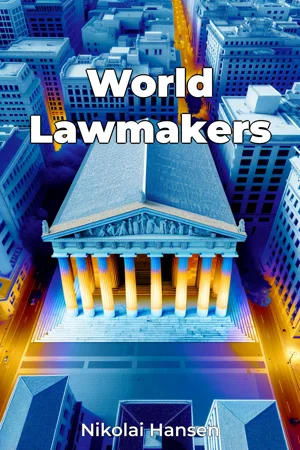
"World Lawmakers" examines the fundamental mechanisms that shape modern governance systems and the complex relationships between laws, society, and power structures. This comprehensive analysis delves into how different societies develop and maintain their legal frameworks, and who truly holds the reins of legislative power in various political systems. The book presents three core themes: the evolution of legal systems across different societies, the distribution of legislative power among various institutions, and the impact of cultural values on governance structures. These interconnected elements form the foundation for understanding how modern states function and why they develop distinct approaches to law-making. Drawing from historical records spanning ancient civilizations to contemporary governments, the work establishes how legal systems emerged from basic social contracts to become sophisticated governance mechanisms. The analysis covers crucial transitions, including the development of common law, civil law systems, and hybrid legal frameworks that characterize modern nations. The central argument posits that effective governance systems result from a delicate balance between institutional power, cultural norms, and societal needs. This balance, the book argues, determines the stability and effectiveness of legal frameworks across different political contexts. The content progresses through several key sections: First, it examines the historical development of legal systems and their philosophical underpinnings. Second, it analyzes modern governance structures, including the separation of powers and checks and balances. Finally, it explores how different societies adapt these principles to their specific contexts. The research draws from comparative legal studies, political science data, and sociological surveys across 50 countries. The methodology combines quantitative analysis of governance indicators with qualitative assessment of legal traditions and cultural factors. The book connects legal studies with anthropology, economics, and sociology, demonstrating how legal systems influence and are influenced by these fields. This interdisciplinary approach provides readers with a comprehensive understanding of how laws shape society and vice versa. The writing maintains an academic tone while remaining accessible to non-specialists. Technical concepts are explained clearly, supported by real-world examples and case studies from various legal systems worldwide. The target audience includes policy makers, legal professionals, students of political science, and informed citizens interested in understanding governance systems. The book serves as both an academic resource and a practical guide for understanding legal frameworks. The scope encompasses both democratic and non-democratic systems, examining how different political structures approach law-making and enforcement. However, it focuses primarily on post-industrial societies while acknowledging the unique challenges facing developing nations. Current debates addressed include the role of technology in governance, the balance between security and individual rights, and the challenges of maintaining national sovereignty in an increasingly globalized legal environment. The book provides practical insights for understanding political processes, participating in civic activities, and navigating different legal systems. It offers tools for analyzing governance structures and evaluating their effectiveness in meeting societal needs. Throughout the work, careful attention is paid to avoiding cultural bias, presenting objective analysis rather than advocating for specific systems. The analysis acknowledges the complexity of governance while providing clear frameworks for understanding these systems.
"World Lawmakers" examines the fundamental mechanisms that shape modern governance systems and the complex relationships between laws, society, and power structures. This comprehensive analysis delves into how different societies develop and maintain their legal frameworks, and who truly holds the reins of legislative power in various political systems. The book presents three core themes: the evolution of legal systems across different societies, the distribution of legislative power among various institutions, and the impact of cultural values on governance structures. These interconnected elements form the foundation for understanding how modern states function and why they develop distinct approaches to law-making. Drawing from historical records spanning ancient civilizations to contemporary governments, the work establishes how legal systems emerged from basic social contracts to become sophisticated governance mechanisms. The analysis covers crucial transitions, including the development of common law, civil law systems, and hybrid legal frameworks that characterize modern nations. The central argument posits that effective governance systems result from a delicate balance between institutional power, cultural norms, and societal needs. This balance, the book argues, determines the stability and effectiveness of legal frameworks across different political contexts. The content progresses through several key sections: First, it examines the historical development of legal systems and their philosophical underpinnings. Second, it analyzes modern governance structures, including the separation of powers and checks and balances. Finally, it explores how different societies adapt these principles to their specific contexts. The research draws from comparative legal studies, political science data, and sociological surveys across 50 countries. The methodology combines quantitative analysis of governance indicators with qualitative assessment of legal traditions and cultural factors. The book connects legal studies with anthropology, economics, and sociology, demonstrating how legal systems influence and are influenced by these fields. This interdisciplinary approach provides readers with a comprehensive understanding of how laws shape society and vice versa. The writing maintains an academic tone while remaining accessible to non-specialists. Technical concepts are explained clearly, supported by real-world examples and case studies from various legal systems worldwide. The target audience includes policy makers, legal professionals, students of political science, and informed citizens interested in understanding governance systems. The book serves as both an academic resource and a practical guide for understanding legal frameworks. The scope encompasses both democratic and non-democratic systems, examining how different political structures approach law-making and enforcement. However, it focuses primarily on post-industrial societies while acknowledging the unique challenges facing developing nations. Current debates addressed include the role of technology in governance, the balance between security and individual rights, and the challenges of maintaining national sovereignty in an increasingly globalized legal environment. The book provides practical insights for understanding political processes, participating in civic activities, and navigating different legal systems. It offers tools for analyzing governance structures and evaluating their effectiveness in meeting societal needs. Throughout the work, careful attention is paid to avoiding cultural bias, presenting objective analysis rather than advocating for specific systems. The analysis acknowledges the complexity of governance while providing clear frameworks for understanding these systems.
"World Lawmakers" offers a comprehensive exploration of how modern governance systems function and evolve, examining the intricate relationships between legal frameworks, cultural values, and power structures across different societies. The book uniquely combines historical analysis with contemporary research, drawing from a vast study of 50 countries to illuminate how legal systems have transformed from basic social contracts into the sophisticated governance mechanisms we see today. The analysis progresses through three major themes: the historical development of legal systems, the distribution of legislative power, and the influence of cultural norms on governance. By examining both democratic and non-democratic systems, the book reveals how different societies adapt common principles like separation of powers and checks and balances to their specific contexts. Notable insights include the emergence of hybrid legal frameworks in modern nations and the delicate balance required between institutional power and societal needs for effective governance. Through an accessible academic approach, the book weaves together perspectives from anthropology, economics, and sociology, supported by real-world examples and case studies. This interdisciplinary methodology helps readers understand complex concepts like the evolution of common law and civil law systems while addressing contemporary challenges such as technological integration in governance and maintaining national sovereignty in a globalized world. The result is a valuable resource that serves both as an academic reference and a practical guide for understanding how laws shape society and vice versa.
Book Details
ISBN
9788233939755
Publisher
Publifye AS
Your Licenses
You don't own any licenses for this book
Purchase a license below to unlock this book and download the EPUB.
Purchase License
Select a tier to unlock this book
Need bulk licensing?
Contact us for enterprise agreements.