
About This Book
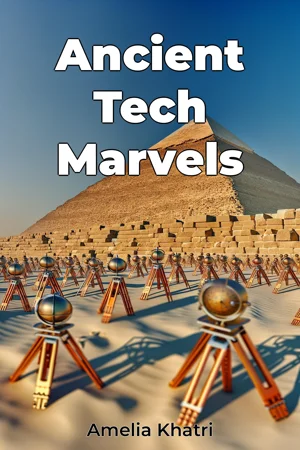
"Ancient Tech Marvels" challenges our modern assumptions about technological progress by presenting concrete evidence of sophisticated engineering and scientific achievements from civilizations that flourished thousands of years ago. Through meticulous research and archaeological findings, this book reconstructs the advanced capabilities of ancient societies, from precision astronomical instruments to complex hydraulic systems. The book examines three primary areas: architectural engineering, mechanical innovations, and scientific instruments. In architecture, it analyzes the construction methods of structures like the Great Pyramid of Giza, demonstrating how ancient builders achieved near-perfect geometric alignment without modern tools. The mechanical innovations section reveals the sophisticated geared devices of Antikythera and the advanced water management systems of the Indus Valley. The scientific instruments portion explores astronomical calculators and surgical tools that rivaled those of the early modern period. Drawing from archaeological evidence, ancient texts, and contemporary engineering analysis, the book reconstructs the technical knowledge and methodologies these civilizations possessed. It presents detailed technical drawings, material analysis results, and experimental archaeology findings that support its assertions. The research combines input from engineers, archaeologists, historians, and materials scientists to provide a comprehensive understanding of ancient technological capabilities. The central thesis establishes that ancient civilizations developed sophisticated solutions to complex engineering challenges, often using principles that parallel modern scientific understanding. This argument is supported by examining specific technologies within their historical context while applying current scientific analysis to understand their functioning. The book's structure progresses from fundamental engineering principles to specific technological achievements, organized chronologically and by civilization. It begins with early Mesopotamian innovations, moves through Egyptian and Greek advancements, and concludes with Roman-era technological syntheses. Each chapter includes technical specifications, historical context, and the significance of these developments for their respective societies. Several interdisciplinary connections emerge throughout the work. The book links engineering principles with archaeological methods, connects ancient mathematical knowledge to architectural achievements, and relates metallurgical advances to technological capabilities. These connections demonstrate how various fields of knowledge contributed to technological development. The writing maintains an analytical tone while remaining accessible to non-specialist readers. Technical concepts are explained clearly, supported by illustrations and diagrams. The target audience includes technology enthusiasts, history readers, and professionals interested in the development of engineering and scientific thinking. While the book focuses primarily on civilizations of the Mediterranean, Middle East, and South Asia from 3000 BCE to 500 CE, it acknowledges parallel developments in other regions. It addresses ongoing debates about the capabilities of ancient civilizations, presenting evidence-based arguments rather than speculative claims. The practical applications section shows how understanding ancient technologies can inform modern sustainable design, architectural practices, and engineering solutions. It examines how ancient approaches to problems like water management and climate control offer relevant insights for contemporary challenges. The work avoids sensationalism, instead relying on documented evidence and peer-reviewed research to support its conclusions. It addresses scholarly controversies about the interpretation of archaeological evidence and ancient technical capabilities while maintaining a balanced, evidence-based approach. For readers seeking to understand the development of human technical achievement, this book provides a well-researched examination of ancient engineering and scientific capabilities, demonstrating how past societies developed sophisticated solutions to complex technical challenges.
"Ancient Tech Marvels" challenges our modern assumptions about technological progress by presenting concrete evidence of sophisticated engineering and scientific achievements from civilizations that flourished thousands of years ago. Through meticulous research and archaeological findings, this book reconstructs the advanced capabilities of ancient societies, from precision astronomical instruments to complex hydraulic systems. The book examines three primary areas: architectural engineering, mechanical innovations, and scientific instruments. In architecture, it analyzes the construction methods of structures like the Great Pyramid of Giza, demonstrating how ancient builders achieved near-perfect geometric alignment without modern tools. The mechanical innovations section reveals the sophisticated geared devices of Antikythera and the advanced water management systems of the Indus Valley. The scientific instruments portion explores astronomical calculators and surgical tools that rivaled those of the early modern period. Drawing from archaeological evidence, ancient texts, and contemporary engineering analysis, the book reconstructs the technical knowledge and methodologies these civilizations possessed. It presents detailed technical drawings, material analysis results, and experimental archaeology findings that support its assertions. The research combines input from engineers, archaeologists, historians, and materials scientists to provide a comprehensive understanding of ancient technological capabilities. The central thesis establishes that ancient civilizations developed sophisticated solutions to complex engineering challenges, often using principles that parallel modern scientific understanding. This argument is supported by examining specific technologies within their historical context while applying current scientific analysis to understand their functioning. The book's structure progresses from fundamental engineering principles to specific technological achievements, organized chronologically and by civilization. It begins with early Mesopotamian innovations, moves through Egyptian and Greek advancements, and concludes with Roman-era technological syntheses. Each chapter includes technical specifications, historical context, and the significance of these developments for their respective societies. Several interdisciplinary connections emerge throughout the work. The book links engineering principles with archaeological methods, connects ancient mathematical knowledge to architectural achievements, and relates metallurgical advances to technological capabilities. These connections demonstrate how various fields of knowledge contributed to technological development. The writing maintains an analytical tone while remaining accessible to non-specialist readers. Technical concepts are explained clearly, supported by illustrations and diagrams. The target audience includes technology enthusiasts, history readers, and professionals interested in the development of engineering and scientific thinking. While the book focuses primarily on civilizations of the Mediterranean, Middle East, and South Asia from 3000 BCE to 500 CE, it acknowledges parallel developments in other regions. It addresses ongoing debates about the capabilities of ancient civilizations, presenting evidence-based arguments rather than speculative claims. The practical applications section shows how understanding ancient technologies can inform modern sustainable design, architectural practices, and engineering solutions. It examines how ancient approaches to problems like water management and climate control offer relevant insights for contemporary challenges. The work avoids sensationalism, instead relying on documented evidence and peer-reviewed research to support its conclusions. It addresses scholarly controversies about the interpretation of archaeological evidence and ancient technical capabilities while maintaining a balanced, evidence-based approach. For readers seeking to understand the development of human technical achievement, this book provides a well-researched examination of ancient engineering and scientific capabilities, demonstrating how past societies developed sophisticated solutions to complex technical challenges.
"Ancient Tech Marvels" challenges our modern perception of technological advancement by revealing the remarkable engineering achievements of ancient civilizations. Through a compelling blend of archaeological evidence, historical texts, and modern scientific analysis, the book demonstrates how early societies mastered complex technical challenges without the tools we take for granted today. From the precise astronomical instruments of ancient astronomers to the sophisticated hydraulic systems of the Indus Valley, these innovations showcase the ingenious problem-solving abilities of our ancestors. The book systematically explores three key areas: architectural engineering, mechanical innovations, and scientific instruments. Readers discover how the Great Pyramid of Giza achieved its near-perfect geometric alignment, examine the intricate geared mechanisms of the Antikythera device, and explore ancient surgical tools that rivaled those of much later periods. Each chapter progresses chronologically, starting with Mesopotamian developments and moving through Egyptian and Greek advancements to Roman-era syntheses, providing detailed technical specifications alongside crucial historical context. What sets this work apart is its rigorous, evidence-based approach that combines insights from engineers, archaeologists, historians, and materials scientists. Rather than relying on speculation, the book uses documented findings and peer-reviewed research to reconstruct ancient technological capabilities. It demonstrates how understanding these historical achievements can inform modern sustainable design and engineering solutions, making it valuable for both technology enthusiasts and history buffs seeking to understand humanity's technical evolution.
Book Details
ISBN
9788233939618
Publisher
Publifye AS
Your Licenses
You don't own any licenses for this book
Purchase a license below to unlock this book and download the EPUB.
Purchase License
Select a tier to unlock this book
Need bulk licensing?
Contact us for enterprise agreements.