
About This Book
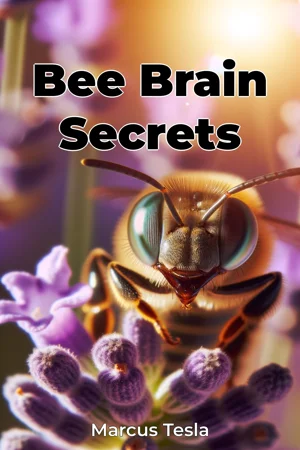
"Bee Brain Secrets" unravels the sophisticated neural mechanisms that enable honeybees to perform complex tasks with a brain containing fewer than one million neurons. This exploration into bee cognition challenges our understanding of intelligence and efficient biological computing. The book presents three core areas of bee capability: spatial navigation, social communication, and decision-making processes. Through detailed examination of bee behavior, readers discover how these insects master abstract concepts, communicate through the waggle dance, and make collective decisions that ensure colony survival. Drawing from decades of research in neurobiology and behavioral science, the text establishes how bees process information through parallel neural networks. The first section examines their remarkable navigational abilities, explaining how bees integrate celestial cues, landmarks, and distance measurements to create cognitive maps. The second part analyzes the waggle dance communication system, detailing how bees convert three-dimensional flight paths into two-dimensional dance movements. The final section explores collective intelligence and decision-making mechanisms within colonies. The central thesis demonstrates that complex behavior does not necessarily require large brains, but rather efficient neural architecture and information processing systems. This understanding has significant implications for artificial intelligence development, robotics, and our conception of intelligence itself. Supporting evidence comes from multiple sources, including laboratory experiments, field observations, and neuroimaging studies. The book incorporates recent findings from international research teams, featuring data from high-resolution microscopy of bee brains and computational models of neural networks. The work connects biology with computer science, neuroscience, and robotics. These interdisciplinary links reveal how bee cognitive systems inspire technological innovations in autonomous navigation, swarm robotics, and efficient computing algorithms. The writing maintains a clear, systematic approach, using technical language when necessary while providing adequate context for non-specialist readers. Each chapter builds upon previous concepts, creating a comprehensive understanding of bee cognition and its broader implications. This book serves researchers, students, and professionals in biology, computer science, and cognitive science. It provides valuable insights for those interested in biomimicry, artificial intelligence, and animal behavior. The content is particularly relevant for developers working on autonomous systems and those studying collective intelligence. The scope focuses specifically on cognitive processes and neural mechanisms, intentionally limiting coverage of other aspects of bee biology. This allows for detailed exploration of information processing and decision-making systems. Practical applications include improving autonomous navigation systems, developing more efficient algorithms for collective decision-making, and advancing our understanding of minimal neural requirements for complex behaviors. The research presented helps inform conservation efforts by demonstrating the sophisticated nature of these crucial pollinators. The book addresses ongoing debates about the nature of intelligence and consciousness in insects, presenting evidence that challenges traditional vertebrate-centric views of cognitive capability. It examines controversial topics such as bee consciousness and the extent of their abstract thinking abilities, while maintaining a balanced, evidence-based approach. The text fills a crucial gap in our understanding of how relatively simple nervous systems can generate sophisticated behaviors. This work is particularly timely as it coincides with growing interest in efficient biological computing systems and the need to develop more sustainable technological solutions inspired by nature.
"Bee Brain Secrets" unravels the sophisticated neural mechanisms that enable honeybees to perform complex tasks with a brain containing fewer than one million neurons. This exploration into bee cognition challenges our understanding of intelligence and efficient biological computing. The book presents three core areas of bee capability: spatial navigation, social communication, and decision-making processes. Through detailed examination of bee behavior, readers discover how these insects master abstract concepts, communicate through the waggle dance, and make collective decisions that ensure colony survival. Drawing from decades of research in neurobiology and behavioral science, the text establishes how bees process information through parallel neural networks. The first section examines their remarkable navigational abilities, explaining how bees integrate celestial cues, landmarks, and distance measurements to create cognitive maps. The second part analyzes the waggle dance communication system, detailing how bees convert three-dimensional flight paths into two-dimensional dance movements. The final section explores collective intelligence and decision-making mechanisms within colonies. The central thesis demonstrates that complex behavior does not necessarily require large brains, but rather efficient neural architecture and information processing systems. This understanding has significant implications for artificial intelligence development, robotics, and our conception of intelligence itself. Supporting evidence comes from multiple sources, including laboratory experiments, field observations, and neuroimaging studies. The book incorporates recent findings from international research teams, featuring data from high-resolution microscopy of bee brains and computational models of neural networks. The work connects biology with computer science, neuroscience, and robotics. These interdisciplinary links reveal how bee cognitive systems inspire technological innovations in autonomous navigation, swarm robotics, and efficient computing algorithms. The writing maintains a clear, systematic approach, using technical language when necessary while providing adequate context for non-specialist readers. Each chapter builds upon previous concepts, creating a comprehensive understanding of bee cognition and its broader implications. This book serves researchers, students, and professionals in biology, computer science, and cognitive science. It provides valuable insights for those interested in biomimicry, artificial intelligence, and animal behavior. The content is particularly relevant for developers working on autonomous systems and those studying collective intelligence. The scope focuses specifically on cognitive processes and neural mechanisms, intentionally limiting coverage of other aspects of bee biology. This allows for detailed exploration of information processing and decision-making systems. Practical applications include improving autonomous navigation systems, developing more efficient algorithms for collective decision-making, and advancing our understanding of minimal neural requirements for complex behaviors. The research presented helps inform conservation efforts by demonstrating the sophisticated nature of these crucial pollinators. The book addresses ongoing debates about the nature of intelligence and consciousness in insects, presenting evidence that challenges traditional vertebrate-centric views of cognitive capability. It examines controversial topics such as bee consciousness and the extent of their abstract thinking abilities, while maintaining a balanced, evidence-based approach. The text fills a crucial gap in our understanding of how relatively simple nervous systems can generate sophisticated behaviors. This work is particularly timely as it coincides with growing interest in efficient biological computing systems and the need to develop more sustainable technological solutions inspired by nature.
"Bee Brain Secrets" delves into the remarkable world of honeybee intelligence, revealing how these insects accomplish sophisticated tasks with less than a million neurons. The book challenges conventional wisdom about brain size and intelligence by demonstrating how bees navigate complex environments, communicate through intricate dance patterns, and make collective decisions that ensure their survival. Through a systematic exploration of three key areas - spatial navigation, social communication, and decision-making processes - readers discover how bees integrate celestial cues and landmarks to create cognitive maps, translate three-dimensional flight paths into the famous waggle dance, and coordinate colony-wide decisions. The book's progression from individual bee cognition to collective intelligence provides a fascinating window into how relatively simple neural architectures can produce complex behaviors. Supporting evidence from laboratory experiments, field observations, and cutting-edge neuroimaging studies builds a compelling case for bee intelligence. This interdisciplinary work bridges biology with computer science and robotics, showing how bee cognitive systems inspire technological innovations in autonomous navigation and swarm robotics. While maintaining technical accuracy, the book remains accessible to non-specialists, making it valuable for researchers, students, and professionals across multiple fields. The research presented not only advances our understanding of insect intelligence but also has practical applications in artificial intelligence development and conservation efforts for these essential pollinators.
Book Details
ISBN
9788233939519
Publisher
Publifye AS
Your Licenses
You don't own any licenses for this book
Purchase a license below to unlock this book and download the EPUB.
Purchase License
Select a tier to unlock this book
Need bulk licensing?
Contact us for enterprise agreements.