
About This Book
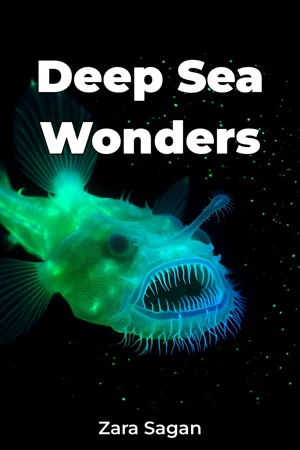
"Deep Sea Wonders" delves into the largely unexplored realm of deep-sea ecosystems, where life thrives in conditions once thought impossible. At depths reaching 11,000 meters, creatures have evolved remarkable adaptations that challenge our understanding of biological possibilities. The book systematically examines three primary areas: bioluminescence as a survival mechanism, extreme pressure adaptations, and the complex food webs of hydrothermal vent communities. These topics illuminate how marine life forms have developed solutions to seemingly insurmountable environmental challenges, offering insights into evolution and potential applications in biotechnology. Drawing from recent deep-sea expeditions and research conducted between 2010-2023, the text presents findings from unmanned submersible missions, high-pressure laboratory studies, and genetic analyses. The research incorporates data from international oceanographic institutions, including previously unpublished findings from the Deep Ocean Research Initiative. The book's central thesis demonstrates how deep-sea organisms' adaptations provide crucial insights into life's fundamental processes and potential applications in medical and industrial fields. These insights are organized into three main sections: "Pressure and Physiology," "Chemical Ecology," and "Ecosystem Interactions." Each chapter builds upon established marine biology principles while introducing new research. The pressure adaptation section examines protein structures that maintain functionality at extreme depths. The chemical ecology portion analyzes novel compounds produced by deep-sea organisms, including potential pharmaceutical applications. The ecosystem section maps previously unknown relationships between species in the absence of sunlight. The text connects marine biology with chemistry, physics, and bioengineering. For instance, the study of pressure-resistant proteins has implications for medical preservation techniques, while bioluminescence research influences the development of new imaging technologies. Written in an analytical style that balances technical accuracy with accessibility, the book uses detailed diagrams, microscopy images, and case studies to illustrate complex concepts. While aimed primarily at marine biology students, researchers, and environmental professionals, it remains accessible to readers with basic biology knowledge. The book addresses current debates in marine science, including the impact of deep-sea mining on fragile ecosystems and the role of deep ocean environments in global carbon cycles. It presents evidence from multiple viewpoints while maintaining scientific objectivity. Practical applications discussed include biomimetic engineering inspired by deep-sea organisms, potential pharmaceutical compounds derived from marine life, and conservation strategies for vulnerable deep-sea habitats. The scope encompasses organisms from mesopelagic to hadal zones but focuses primarily on depths below 2,000 meters. While the book acknowledges shallow water connections, it maintains its focus on deep-sea environments to provide comprehensive coverage of these less-studied ecosystems. The text presents several noteworthy findings, including newly documented species behaviors, unexpected symbiotic relationships, and novel biochemical pathways. These discoveries demonstrate how deep-sea research continues to reshape our understanding of life's capabilities and evolution. Research methodologies detailed in the book include pressure chamber experiments, ROV observations, and molecular analysis techniques. This combination of approaches provides readers with a comprehensive understanding of how marine scientists gather and interpret data from these challenging environments. The book concludes by examining conservation challenges facing deep-sea ecosystems and their broader implications for marine biodiversity and global climate systems, emphasizing the interconnected nature of ocean health and human welfare.
"Deep Sea Wonders" delves into the largely unexplored realm of deep-sea ecosystems, where life thrives in conditions once thought impossible. At depths reaching 11,000 meters, creatures have evolved remarkable adaptations that challenge our understanding of biological possibilities. The book systematically examines three primary areas: bioluminescence as a survival mechanism, extreme pressure adaptations, and the complex food webs of hydrothermal vent communities. These topics illuminate how marine life forms have developed solutions to seemingly insurmountable environmental challenges, offering insights into evolution and potential applications in biotechnology. Drawing from recent deep-sea expeditions and research conducted between 2010-2023, the text presents findings from unmanned submersible missions, high-pressure laboratory studies, and genetic analyses. The research incorporates data from international oceanographic institutions, including previously unpublished findings from the Deep Ocean Research Initiative. The book's central thesis demonstrates how deep-sea organisms' adaptations provide crucial insights into life's fundamental processes and potential applications in medical and industrial fields. These insights are organized into three main sections: "Pressure and Physiology," "Chemical Ecology," and "Ecosystem Interactions." Each chapter builds upon established marine biology principles while introducing new research. The pressure adaptation section examines protein structures that maintain functionality at extreme depths. The chemical ecology portion analyzes novel compounds produced by deep-sea organisms, including potential pharmaceutical applications. The ecosystem section maps previously unknown relationships between species in the absence of sunlight. The text connects marine biology with chemistry, physics, and bioengineering. For instance, the study of pressure-resistant proteins has implications for medical preservation techniques, while bioluminescence research influences the development of new imaging technologies. Written in an analytical style that balances technical accuracy with accessibility, the book uses detailed diagrams, microscopy images, and case studies to illustrate complex concepts. While aimed primarily at marine biology students, researchers, and environmental professionals, it remains accessible to readers with basic biology knowledge. The book addresses current debates in marine science, including the impact of deep-sea mining on fragile ecosystems and the role of deep ocean environments in global carbon cycles. It presents evidence from multiple viewpoints while maintaining scientific objectivity. Practical applications discussed include biomimetic engineering inspired by deep-sea organisms, potential pharmaceutical compounds derived from marine life, and conservation strategies for vulnerable deep-sea habitats. The scope encompasses organisms from mesopelagic to hadal zones but focuses primarily on depths below 2,000 meters. While the book acknowledges shallow water connections, it maintains its focus on deep-sea environments to provide comprehensive coverage of these less-studied ecosystems. The text presents several noteworthy findings, including newly documented species behaviors, unexpected symbiotic relationships, and novel biochemical pathways. These discoveries demonstrate how deep-sea research continues to reshape our understanding of life's capabilities and evolution. Research methodologies detailed in the book include pressure chamber experiments, ROV observations, and molecular analysis techniques. This combination of approaches provides readers with a comprehensive understanding of how marine scientists gather and interpret data from these challenging environments. The book concludes by examining conservation challenges facing deep-sea ecosystems and their broader implications for marine biodiversity and global climate systems, emphasizing the interconnected nature of ocean health and human welfare.
"Deep Sea Wonders" takes readers on a fascinating journey into the mysterious world of deep-sea ecosystems, where life flourishes in extreme conditions up to 11,000 meters below the surface. The book masterfully explores three critical aspects of deep-ocean life: the phenomenon of bioluminescence as a survival strategy, remarkable adaptations to crushing pressures, and the intricate food webs surrounding hydrothermal vents. Drawing from recent expeditions and cutting-edge research conducted between 2010-2023, the text presents groundbreaking discoveries that challenge our understanding of life's possibilities. Through a carefully structured approach across three main sections - "Pressure and Physiology," "Chemical Ecology," and "Ecosystem Interactions" - the book reveals how deep-sea organisms have evolved extraordinary solutions to seemingly impossible environmental challenges. Particularly fascinating are the findings about pressure-resistant proteins that function in extreme depths and the complex chemical compounds produced by marine organisms that hold promise for pharmaceutical applications. The integration of detailed diagrams, microscopy images, and case studies makes complex concepts accessible while maintaining scientific rigor. The book stands out for its comprehensive examination of practical applications, from biomimetic engineering inspired by deep-sea creatures to potential medical breakthroughs. It addresses crucial contemporary issues such as deep-sea mining impacts and the role of ocean environments in global carbon cycles, making it valuable for both marine biology professionals and interested general readers with basic biology knowledge. The presentation of new species behaviors, unexpected symbiotic relationships, and novel biochemical pathways demonstrates how deep-sea research continues to expand our understanding of life's adaptability.
Book Details
ISBN
9788233939465
Publisher
Publifye AS
Your Licenses
You don't own any licenses for this book
Purchase a license below to unlock this book and download the EPUB.
Purchase License
Select a tier to unlock this book
Need bulk licensing?
Contact us for enterprise agreements.