
About This Book
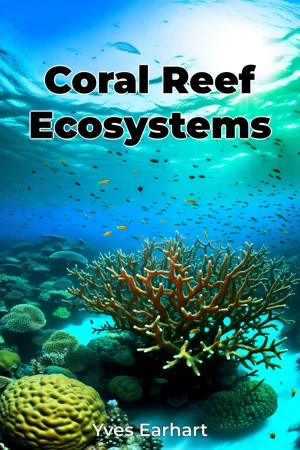
"Coral Reef Ecosystems" presents a comprehensive examination of one of Earth's most complex and vulnerable marine environments, where a quarter of all ocean species depend on coral reefs for survival despite these ecosystems occupying less than 1% of the ocean floor. The book systematically explores three core themes: the intricate biology of coral reef formation and maintenance, the mounting threats to reef survival worldwide, and the scientific innovations driving conservation efforts. These topics are particularly relevant as coral reefs face unprecedented challenges from climate change and human activity, directly affecting marine biodiversity and coastal communities that rely on these ecosystems. Beginning with reef formation, the text details the symbiotic relationship between coral polyps and zooxanthellae algae, explaining how this partnership has evolved over millions of years to create the limestone structures that form reef foundations. This section includes detailed microscopic imagery and current research data on coral growth patterns and reef development stages. The central argument emphasizes that coral reefs serve as crucial indicators of ocean health and climate change impacts, positioning them as essential subjects for environmental research and conservation. The book presents evidence through long-term studies from major reef systems, including the Great Barrier Reef, Caribbean coral networks, and Indo-Pacific reefs, incorporating data from marine biology institutions and environmental monitoring stations worldwide. Substantial attention is given to coral bleaching, examining its causes, patterns, and consequences. The text analyzes temperature threshold data, ocean acidification measurements, and coral stress responses, supported by satellite imagery and field observations. This leads into discussions of other threats, including ocean pollution, overfishing, and coastal development. The book connects marine biology with climatology, oceanography, and environmental science, demonstrating how reef health intersects with global weather patterns, ocean currents, and chemical cycles. These interdisciplinary links help readers understand the broader implications of reef degradation for planetary systems. The conservation section presents current restoration techniques, including coral nurseries, genetic research, and artificial reef structures. Case studies of successful reef rehabilitation projects provide practical examples of conservation in action, while examining the challenges and limitations of various approaches. Written in an academic yet accessible style, the book targets environmental science students, marine biology professionals, and informed general readers interested in ocean conservation. Technical terms are clearly defined, and complex concepts are illustrated through detailed diagrams and real-world examples. The text acknowledges ongoing debates in coral reef science, such as the effectiveness of artificial reefs and the potential for coral adaptation to warming waters. It presents multiple viewpoints while maintaining focus on evidence-based conclusions. The scope encompasses both shallow and deep-water reef systems worldwide, though it primarily focuses on tropical reef ecosystems where the majority of research has been conducted. The book concludes with practical guidelines for reef conservation, including recommendations for policymakers, researchers, and coastal communities. Throughout, the work maintains a measured, evidence-based approach to examining both the challenges facing coral reefs and the potential solutions emerging from current research, providing readers with a solid foundation for understanding these critical marine ecosystems and their conservation.
"Coral Reef Ecosystems" presents a comprehensive examination of one of Earth's most complex and vulnerable marine environments, where a quarter of all ocean species depend on coral reefs for survival despite these ecosystems occupying less than 1% of the ocean floor. The book systematically explores three core themes: the intricate biology of coral reef formation and maintenance, the mounting threats to reef survival worldwide, and the scientific innovations driving conservation efforts. These topics are particularly relevant as coral reefs face unprecedented challenges from climate change and human activity, directly affecting marine biodiversity and coastal communities that rely on these ecosystems. Beginning with reef formation, the text details the symbiotic relationship between coral polyps and zooxanthellae algae, explaining how this partnership has evolved over millions of years to create the limestone structures that form reef foundations. This section includes detailed microscopic imagery and current research data on coral growth patterns and reef development stages. The central argument emphasizes that coral reefs serve as crucial indicators of ocean health and climate change impacts, positioning them as essential subjects for environmental research and conservation. The book presents evidence through long-term studies from major reef systems, including the Great Barrier Reef, Caribbean coral networks, and Indo-Pacific reefs, incorporating data from marine biology institutions and environmental monitoring stations worldwide. Substantial attention is given to coral bleaching, examining its causes, patterns, and consequences. The text analyzes temperature threshold data, ocean acidification measurements, and coral stress responses, supported by satellite imagery and field observations. This leads into discussions of other threats, including ocean pollution, overfishing, and coastal development. The book connects marine biology with climatology, oceanography, and environmental science, demonstrating how reef health intersects with global weather patterns, ocean currents, and chemical cycles. These interdisciplinary links help readers understand the broader implications of reef degradation for planetary systems. The conservation section presents current restoration techniques, including coral nurseries, genetic research, and artificial reef structures. Case studies of successful reef rehabilitation projects provide practical examples of conservation in action, while examining the challenges and limitations of various approaches. Written in an academic yet accessible style, the book targets environmental science students, marine biology professionals, and informed general readers interested in ocean conservation. Technical terms are clearly defined, and complex concepts are illustrated through detailed diagrams and real-world examples. The text acknowledges ongoing debates in coral reef science, such as the effectiveness of artificial reefs and the potential for coral adaptation to warming waters. It presents multiple viewpoints while maintaining focus on evidence-based conclusions. The scope encompasses both shallow and deep-water reef systems worldwide, though it primarily focuses on tropical reef ecosystems where the majority of research has been conducted. The book concludes with practical guidelines for reef conservation, including recommendations for policymakers, researchers, and coastal communities. Throughout, the work maintains a measured, evidence-based approach to examining both the challenges facing coral reefs and the potential solutions emerging from current research, providing readers with a solid foundation for understanding these critical marine ecosystems and their conservation.
"Coral Reef Ecosystems" delivers a compelling exploration of Earth's most intricate marine environments, which host a quarter of all ocean species while occupying less than 1% of the ocean floor. The book masterfully weaves together three fundamental themes: coral reef biology, existential threats to reef survival, and innovative conservation efforts. Through detailed microscopic imagery and current research data, readers discover the fascinating symbiotic relationship between coral polyps and zooxanthellae algae that forms the foundation of these remarkable ecosystems. The text expertly bridges the gap between complex marine science and public understanding by examining major reef systems worldwide, including the Great Barrier Reef and Caribbean coral networks. Particular attention is given to pressing issues like coral bleaching, ocean acidification, and pollution, supported by comprehensive data from global marine biology institutions. The book's interdisciplinary approach demonstrates how reef health serves as a crucial indicator of broader ocean and climate conditions, making these ecosystems invaluable for environmental research. The final sections present cutting-edge conservation techniques, including coral nurseries and artificial reef structures, while maintaining a balanced view of their effectiveness. Written for both academic and general audiences, the book employs clear explanations and real-world examples to illuminate complex concepts. This approach makes it an essential resource for environmental science students, marine biology professionals, and anyone concerned about ocean conservation, offering practical guidelines while acknowledging the ongoing debates in coral reef science.
Book Details
ISBN
9788233938802
Publisher
Publifye AS
Your Licenses
You don't own any licenses for this book
Purchase a license below to unlock this book and download the EPUB.
Purchase License
Select a tier to unlock this book
Need bulk licensing?
Contact us for enterprise agreements.