
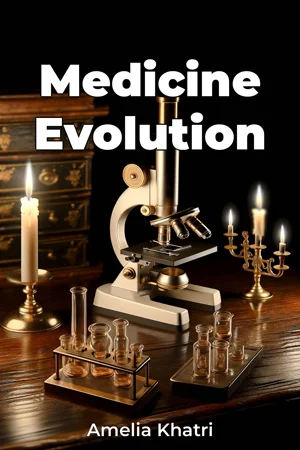
About This Book
"Medicine Evolution" examines the transformation of medical science from ancient healing practices to modern precision medicine, revealing how each breakthrough has shaped our understanding of human health and disease. The book presents three pivotal themes: the role of scientific methodology in medical advances, the impact of technological innovations on treatment capabilities, and the evolution of medical education and practice. These interconnected elements demonstrate how medical knowledge has built upon itself across centuries, creating the foundation for contemporary healthcare. Beginning with early civilizations' understanding of disease and healing, the narrative traces the development of medical science through key historical periods. From the empirical observations of Hippocrates to the microscopic discoveries of the Renaissance, and into the era of evidence-based medicine, readers gain insight into how medical knowledge has accumulated and evolved. The central thesis argues that medical advancement occurs through a combination of scientific discovery, technological innovation, and social change. This progression isn't linear but rather involves complex interactions between different fields of study, cultural factors, and practical necessities. The book's structure follows chronological and thematic arrangements. The first section establishes the foundations of early medicine, examining how different cultures approached healing. The middle chapters focus on revolutionary discoveries in anatomy, microbiology, and pharmacology. The final section explores modern medical practices and future directions, including personalized medicine and AI-driven diagnostics. Supporting evidence comes from historical medical texts, archaeological findings, clinical trial data, and contemporary research papers. The book incorporates case studies from medical archives and interviews with leading researchers and practitioners, providing both historical depth and current relevance. The work connects medicine with chemistry, biology, and physics, while also exploring links to social sciences and ethics. These interdisciplinary perspectives help readers understand how medical advancement depends on progress across multiple fields. Written in an analytical yet accessible style, the book balances technical information with clear explanations suitable for both healthcare professionals and interested general readers. It maintains academic rigor while ensuring complex concepts are comprehensible to non-specialists. The target audience includes medical students, healthcare professionals, historians, and readers interested in the development of scientific thought. The book serves as both a comprehensive reference and an engaging narrative of medical progress. Particular attention is given to the scientific method's role in medical advancement, the evolution of clinical trials, and the development of evidence-based practice. The book addresses current debates about traditional versus modern medicine, the role of AI in healthcare, and ethical considerations in medical research. While the scope spans the entire history of medicine, it focuses primarily on developments that have shaped current medical practice. The book acknowledges regional variations in medical development but emphasizes innovations that have had global impact. Practical applications include insights for medical education, research methodology, and understanding the context of current medical practices. Readers gain perspective on how past developments inform current medical challenges and future directions. The work addresses ongoing debates about the balance between technological advancement and patient-centered care, the role of alternative medicine, and the future of medical practice in an increasingly digital world.
"Medicine Evolution" examines the transformation of medical science from ancient healing practices to modern precision medicine, revealing how each breakthrough has shaped our understanding of human health and disease. The book presents three pivotal themes: the role of scientific methodology in medical advances, the impact of technological innovations on treatment capabilities, and the evolution of medical education and practice. These interconnected elements demonstrate how medical knowledge has built upon itself across centuries, creating the foundation for contemporary healthcare. Beginning with early civilizations' understanding of disease and healing, the narrative traces the development of medical science through key historical periods. From the empirical observations of Hippocrates to the microscopic discoveries of the Renaissance, and into the era of evidence-based medicine, readers gain insight into how medical knowledge has accumulated and evolved. The central thesis argues that medical advancement occurs through a combination of scientific discovery, technological innovation, and social change. This progression isn't linear but rather involves complex interactions between different fields of study, cultural factors, and practical necessities. The book's structure follows chronological and thematic arrangements. The first section establishes the foundations of early medicine, examining how different cultures approached healing. The middle chapters focus on revolutionary discoveries in anatomy, microbiology, and pharmacology. The final section explores modern medical practices and future directions, including personalized medicine and AI-driven diagnostics. Supporting evidence comes from historical medical texts, archaeological findings, clinical trial data, and contemporary research papers. The book incorporates case studies from medical archives and interviews with leading researchers and practitioners, providing both historical depth and current relevance. The work connects medicine with chemistry, biology, and physics, while also exploring links to social sciences and ethics. These interdisciplinary perspectives help readers understand how medical advancement depends on progress across multiple fields. Written in an analytical yet accessible style, the book balances technical information with clear explanations suitable for both healthcare professionals and interested general readers. It maintains academic rigor while ensuring complex concepts are comprehensible to non-specialists. The target audience includes medical students, healthcare professionals, historians, and readers interested in the development of scientific thought. The book serves as both a comprehensive reference and an engaging narrative of medical progress. Particular attention is given to the scientific method's role in medical advancement, the evolution of clinical trials, and the development of evidence-based practice. The book addresses current debates about traditional versus modern medicine, the role of AI in healthcare, and ethical considerations in medical research. While the scope spans the entire history of medicine, it focuses primarily on developments that have shaped current medical practice. The book acknowledges regional variations in medical development but emphasizes innovations that have had global impact. Practical applications include insights for medical education, research methodology, and understanding the context of current medical practices. Readers gain perspective on how past developments inform current medical challenges and future directions. The work addresses ongoing debates about the balance between technological advancement and patient-centered care, the role of alternative medicine, and the future of medical practice in an increasingly digital world.
"Medicine Evolution" offers a comprehensive journey through the transformation of medical science, from ancient healing practices to today's cutting-edge precision medicine. This engaging narrative explores three fundamental themes: scientific methodology's role in medical progress, technological innovation's impact on treatments, and the evolution of medical education. Through carefully structured chapters, the book reveals how medical knowledge has built upon itself across centuries, creating an intricate web of understanding that shapes modern healthcare. The book uniquely connects diverse disciplines, demonstrating how medical advancement relies on the interplay between scientific discovery, technological innovation, and social change. From Hippocrates' empirical observations to Renaissance microscopic discoveries, readers witness how each era contributed to our current understanding of human health. The presentation balances technical depth with accessibility, incorporating fascinating case studies from medical archives and interviews with contemporary experts to illustrate key developments in medical science. Moving chronologically and thematically, the narrative examines how different cultures approached healing before delving into revolutionary discoveries in anatomy, microbiology, and pharmacology. The final section explores modern practices and future directions, including AI-driven diagnostics and personalized medicine. This structure helps readers understand both the historical context and current implications of medical advancement, making it valuable for healthcare professionals and general readers alike.
Book Details
ISBN
9788233937515
Publisher
Publifye AS
Your Licenses
You don't own any licenses for this book
Purchase a license below to unlock this book and download the EPUB.
Purchase License
Select a tier to unlock this book
Need bulk licensing?
Contact us for enterprise agreements.