
About This Book
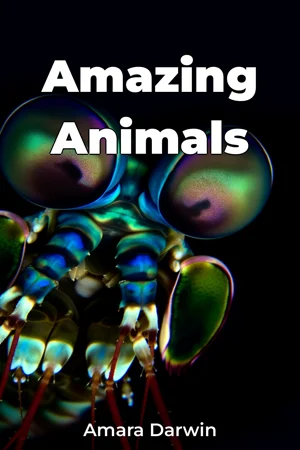
"Amazing Animals" delves into the scientifically documented capabilities of Earth's diverse fauna, presenting a comprehensive examination of adaptive behaviors, specialized anatomical features, and survival mechanisms that have evolved across species worldwide. The book systematically explores three core areas: sensory perception abilities that exceed human capacity, physical adaptations that enable survival in extreme environments, and complex social behaviors that challenge our understanding of animal intelligence. Through detailed case studies and research findings, readers discover how mantis shrimp perceive twelve color channels compared to humans' three, how tardigrades survive in the vacuum of space, and how corvids demonstrate tool use and problem-solving abilities comparable to great apes. Drawing from decades of zoological research and recent technological advances in behavioral studies, the text presents evidence gathered through field observations, laboratory experiments, and breakthrough imaging techniques. Each chapter builds upon fundamental biological principles while incorporating insights from genetics, evolutionary biology, and environmental science to provide a multi-faceted understanding of animal capabilities. The book is structured in three main sections: First, it examines the physiological basis of animal abilities, including echolocation in bats, electroreception in sharks, and magnetoreception in birds. The second section analyzes adaptive mechanisms, from the camouflage systems of octopi to the regenerative abilities of axolotls. The final section explores collective behaviors and intelligence, featuring studies on elephant communication, dolphin social networks, and ant colony organization. What distinguishes this work is its integration of classical zoological studies with cutting-edge research, including recent discoveries in neuroscience and genetic analysis. The text connects animal abilities to potential applications in biomimicry, medical research, and conservation biology, demonstrating how understanding these capabilities can advance human technology and medicine. Written in an accessible academic style, the book balances scientific rigor with engaging narratives of field research and laboratory breakthroughs. While technical terms are precisely defined, the writing maintains clarity for educated general readers, university students, and professionals in related fields. The target audience includes biology students, wildlife enthusiasts, and researchers seeking a comprehensive reference on animal adaptations. The book serves as both an academic resource and a bridge between specialized scientific literature and public understanding of animal biology. Interdisciplinary connections link animal studies to engineering (biomimetic design), medicine (drug development based on animal biochemistry), and environmental science (adaptation to climate change). The text addresses current debates in animal consciousness, the evolution of intelligence, and the impact of human activity on animal behavior. The scope encompasses both vertebrate and invertebrate species across terrestrial, aquatic, and aerial environments, though it acknowledges that many species remain unstudied. The book emphasizes the practical applications of this knowledge, from developing new materials inspired by spider silk to advancing surgical techniques based on snake infrared sensing mechanisms. A crucial theme throughout is the role of these findings in conservation efforts, highlighting how understanding animal capabilities informs habitat protection and species preservation strategies. The book concludes by examining emerging research questions and the potential for new discoveries as technology advances.
"Amazing Animals" delves into the scientifically documented capabilities of Earth's diverse fauna, presenting a comprehensive examination of adaptive behaviors, specialized anatomical features, and survival mechanisms that have evolved across species worldwide. The book systematically explores three core areas: sensory perception abilities that exceed human capacity, physical adaptations that enable survival in extreme environments, and complex social behaviors that challenge our understanding of animal intelligence. Through detailed case studies and research findings, readers discover how mantis shrimp perceive twelve color channels compared to humans' three, how tardigrades survive in the vacuum of space, and how corvids demonstrate tool use and problem-solving abilities comparable to great apes. Drawing from decades of zoological research and recent technological advances in behavioral studies, the text presents evidence gathered through field observations, laboratory experiments, and breakthrough imaging techniques. Each chapter builds upon fundamental biological principles while incorporating insights from genetics, evolutionary biology, and environmental science to provide a multi-faceted understanding of animal capabilities. The book is structured in three main sections: First, it examines the physiological basis of animal abilities, including echolocation in bats, electroreception in sharks, and magnetoreception in birds. The second section analyzes adaptive mechanisms, from the camouflage systems of octopi to the regenerative abilities of axolotls. The final section explores collective behaviors and intelligence, featuring studies on elephant communication, dolphin social networks, and ant colony organization. What distinguishes this work is its integration of classical zoological studies with cutting-edge research, including recent discoveries in neuroscience and genetic analysis. The text connects animal abilities to potential applications in biomimicry, medical research, and conservation biology, demonstrating how understanding these capabilities can advance human technology and medicine. Written in an accessible academic style, the book balances scientific rigor with engaging narratives of field research and laboratory breakthroughs. While technical terms are precisely defined, the writing maintains clarity for educated general readers, university students, and professionals in related fields. The target audience includes biology students, wildlife enthusiasts, and researchers seeking a comprehensive reference on animal adaptations. The book serves as both an academic resource and a bridge between specialized scientific literature and public understanding of animal biology. Interdisciplinary connections link animal studies to engineering (biomimetic design), medicine (drug development based on animal biochemistry), and environmental science (adaptation to climate change). The text addresses current debates in animal consciousness, the evolution of intelligence, and the impact of human activity on animal behavior. The scope encompasses both vertebrate and invertebrate species across terrestrial, aquatic, and aerial environments, though it acknowledges that many species remain unstudied. The book emphasizes the practical applications of this knowledge, from developing new materials inspired by spider silk to advancing surgical techniques based on snake infrared sensing mechanisms. A crucial theme throughout is the role of these findings in conservation efforts, highlighting how understanding animal capabilities informs habitat protection and species preservation strategies. The book concludes by examining emerging research questions and the potential for new discoveries as technology advances.
"Amazing Animals" presents a fascinating exploration of Earth's remarkable fauna, examining the extraordinary abilities that have evolved across species through the lens of modern scientific research. The book systematically investigates three fundamental aspects: advanced sensory capabilities, physical adaptations for extreme environments, and sophisticated social behaviors that challenge our traditional understanding of animal intelligence. From the mantis shrimp's incredible twelve-channel color vision to the space-surviving abilities of tardigrades, the text reveals how various species have developed remarkable solutions to survival challenges. Through a carefully structured approach, the book progresses from examining the physiological foundations of unique animal abilities to analyzing complex adaptive mechanisms and collective behaviors. Readers discover how bats master echolocation, octopi perfect their camouflage, and elephant communities maintain sophisticated communication networks. The integration of classical zoological studies with cutting-edge research, including recent breakthroughs in neuroscience and genetic analysis, sets this work apart from traditional animal biology texts. What makes this book particularly valuable is its ability to connect animal capabilities to practical applications in biomimicry and medical research while maintaining scientific rigor and accessibility. The text bridges the gap between specialized scientific literature and public understanding, making it relevant for both academic audiences and wildlife enthusiasts. By linking animal adaptations to potential technological innovations and conservation strategies, the book demonstrates how understanding these remarkable creatures could benefit human advancement while supporting species preservation efforts.
Book Details
ISBN
9788233937423
Publisher
Publifye AS
Your Licenses
You don't own any licenses for this book
Purchase a license below to unlock this book and download the EPUB.
Purchase License
Select a tier to unlock this book
Need bulk licensing?
Contact us for enterprise agreements.