
About This Book
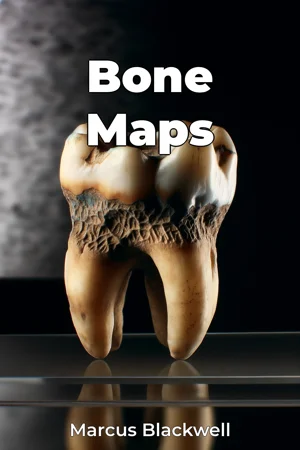
"Bone Maps" explores how human dental records serve as biological time capsules, revealing the complex patterns of ancient human migration across continents. Through detailed analysis of teeth discovered at archaeological sites spanning multiple continents, this comprehensive study demonstrates how dental morphology helps reconstruct human movement patterns dating back hundreds of thousands of years. The book presents three primary areas of investigation: dental anthropology methodology, chemical composition analysis of teeth, and the correlation between dental traits and population genetics. These elements combine to form a robust framework for tracking human migration routes with previously unattainable precision. The research draws from an extensive database of dental samples collected from both ancient burial sites and modern populations, creating a temporal bridge that connects past and present human populations. Central to the work is the argument that teeth provide more reliable migration data than other skeletal remains due to their durability and resistance to environmental degradation. The book systematically demonstrates how specific dental traits serve as genetic markers, allowing researchers to trace population movements and interactions across geographical boundaries and time periods. The content progresses through several key sections: First, it establishes the fundamentals of dental anthropology and introduces the specialized techniques used in modern analysis. Second, it examines case studies from major migration routes, including the movement out of Africa, the peopling of the Americas, and the settlement patterns across Eurasia. Finally, it synthesizes these findings to create a comprehensive map of human migration patterns. The research methodology combines traditional anthropological techniques with cutting-edge technology, including 3D imaging, isotope analysis, and DNA sampling from dental pulp. This multidisciplinary approach incorporates elements of genetics, chemistry, archaeology, and historical linguistics to create a more complete picture of human migration patterns. The book connects multiple scientific disciplines, linking dental anthropology with population genetics, evolutionary biology, and climatology. These connections help explain how environmental factors influenced migration patterns and how genetic markers in teeth correlate with linguistic and cultural distributions across populations. Written in an academic yet accessible style, the text maintains scientific rigor while ensuring comprehension for readers with basic scientific literacy. It serves various audiences, including anthropologists, archaeologists, historians, and students of human evolution, while remaining accessible to informed general readers interested in human origins and migration. The scope encompasses the last 300,000 years of human migration, focusing primarily on major population movements that can be verified through dental evidence. While acknowledging gaps in the archaeological record, the book presents a systematic approach to reconstructing migration patterns through available dental data. Practical applications extend to modern forensic anthropology, archaeological dating methods, and understanding the genetic basis of dental development. The work addresses ongoing debates in the field, including the timing of major migration events and the interpretation of dental trait frequencies in isolated populations. The book's distinctive contribution lies in its synthesis of decades of dental anthropological research with modern analytical techniques, providing a new perspective on human migration patterns. It presents this information without sensationalism, focusing instead on the methodical construction of evidence-based conclusions about human population movements throughout prehistory.
"Bone Maps" explores how human dental records serve as biological time capsules, revealing the complex patterns of ancient human migration across continents. Through detailed analysis of teeth discovered at archaeological sites spanning multiple continents, this comprehensive study demonstrates how dental morphology helps reconstruct human movement patterns dating back hundreds of thousands of years. The book presents three primary areas of investigation: dental anthropology methodology, chemical composition analysis of teeth, and the correlation between dental traits and population genetics. These elements combine to form a robust framework for tracking human migration routes with previously unattainable precision. The research draws from an extensive database of dental samples collected from both ancient burial sites and modern populations, creating a temporal bridge that connects past and present human populations. Central to the work is the argument that teeth provide more reliable migration data than other skeletal remains due to their durability and resistance to environmental degradation. The book systematically demonstrates how specific dental traits serve as genetic markers, allowing researchers to trace population movements and interactions across geographical boundaries and time periods. The content progresses through several key sections: First, it establishes the fundamentals of dental anthropology and introduces the specialized techniques used in modern analysis. Second, it examines case studies from major migration routes, including the movement out of Africa, the peopling of the Americas, and the settlement patterns across Eurasia. Finally, it synthesizes these findings to create a comprehensive map of human migration patterns. The research methodology combines traditional anthropological techniques with cutting-edge technology, including 3D imaging, isotope analysis, and DNA sampling from dental pulp. This multidisciplinary approach incorporates elements of genetics, chemistry, archaeology, and historical linguistics to create a more complete picture of human migration patterns. The book connects multiple scientific disciplines, linking dental anthropology with population genetics, evolutionary biology, and climatology. These connections help explain how environmental factors influenced migration patterns and how genetic markers in teeth correlate with linguistic and cultural distributions across populations. Written in an academic yet accessible style, the text maintains scientific rigor while ensuring comprehension for readers with basic scientific literacy. It serves various audiences, including anthropologists, archaeologists, historians, and students of human evolution, while remaining accessible to informed general readers interested in human origins and migration. The scope encompasses the last 300,000 years of human migration, focusing primarily on major population movements that can be verified through dental evidence. While acknowledging gaps in the archaeological record, the book presents a systematic approach to reconstructing migration patterns through available dental data. Practical applications extend to modern forensic anthropology, archaeological dating methods, and understanding the genetic basis of dental development. The work addresses ongoing debates in the field, including the timing of major migration events and the interpretation of dental trait frequencies in isolated populations. The book's distinctive contribution lies in its synthesis of decades of dental anthropological research with modern analytical techniques, providing a new perspective on human migration patterns. It presents this information without sensationalism, focusing instead on the methodical construction of evidence-based conclusions about human population movements throughout prehistory.
"Bone Maps" offers a groundbreaking exploration of human migration history through the unlikely lens of dental records, demonstrating how teeth serve as remarkably durable biological time capsules. This comprehensive study combines traditional anthropological methods with cutting-edge technology to unlock the secrets hidden within ancient dental remains, revealing migration patterns dating back 300,000 years. The book masterfully weaves together three core investigative areas: dental anthropology methodology, chemical analysis of teeth, and the relationship between dental traits and population genetics. Through detailed case studies spanning multiple continents, readers discover how specific dental characteristics function as genetic markers, enabling researchers to track ancient population movements with unprecedented accuracy. The durability of teeth compared to other skeletal remains makes them particularly valuable for understanding human migration patterns, especially when traditional archaeological evidence is scarce. Progressing from fundamental concepts to complex analysis, the text bridges multiple scientific disciplines, including genetics, chemistry, and archaeology. The authors present their findings in an accessible yet scientifically rigorous manner, examining major migration events such as the movement out of Africa and the peopling of the Americas. By incorporating modern analytical techniques like 3D imaging and isotope analysis, the research provides fresh insights into how environmental factors influenced human movement patterns and how dental traits correlate with linguistic and cultural distributions across populations.
Book Details
ISBN
9788233937096
Publisher
Publifye AS
Your Licenses
You don't own any licenses for this book
Purchase a license below to unlock this book and download the EPUB.
Purchase License
Select a tier to unlock this book
Need bulk licensing?
Contact us for enterprise agreements.