
About This Book
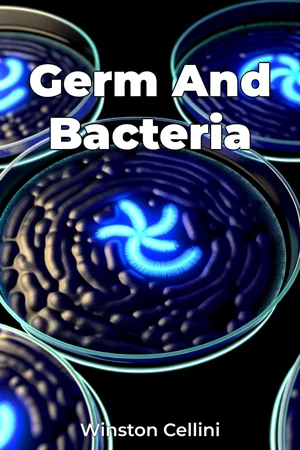
"Germ And Bacteria" opens with a fundamental question that shapes our existence: How do microscopic organisms, invisible to the naked eye, sustain all life on Earth? This comprehensive exploration delves into the intricate world of microorganisms, revealing their crucial role in both human health and global ecosystems. The book systematically examines three core topics: the basic structure and function of microorganisms, their evolutionary significance, and their impact on human health and environmental systems. These subjects are particularly relevant as society faces challenges like antibiotic resistance and the need for sustainable agriculture. Beginning with historical context, the text traces the development of microbiology from van Leeuwenhoek's first microscopic observations to modern genetic sequencing techniques. This foundation helps readers understand how our knowledge of microorganisms has evolved and shaped current scientific understanding. The central thesis argues that bacteria and other microorganisms are not merely agents of disease but are fundamental to life itself, playing vital roles in everything from human digestion to global nutrient cycles. This perspective challenges common misconceptions about germs while highlighting their essential functions. The content is structured in three main sections. The first explores microbial diversity and basic cellular mechanisms. The second examines the human microbiome and its influence on health, immunity, and disease. The third section investigates environmental microbiology, including soil health, water systems, and climate regulation. Supporting evidence comes from peer-reviewed research, including recent studies in molecular biology, metagenomics, and clinical trials. The book incorporates data from international research institutions and long-term ecological studies, providing a robust scientific foundation. The work connects multiple disciplines, linking microbiology with ecology, medicine, and climate science. These connections demonstrate how microscopic life influences macro-scale phenomena, from human health to global environmental processes. The book employs an innovative approach by using scale comparisons and detailed illustrations to make microscopic concepts tangible for readers. Complex processes are explained through clear analogies and real-world examples, making the content accessible without oversimplification. Written in a clear, methodical style, the text balances technical accuracy with readable prose, making it suitable for both science students and informed general readers. While maintaining scientific rigor, it avoids excessive jargon and includes helpful glossaries and explanatory notes. The primary audience includes undergraduate students, healthcare professionals, and scientifically curious general readers. The book serves as both an educational resource and a practical guide for understanding microbial influence on daily life. Following conventions of scientific literature, each chapter includes current research, methodological explanations, and practical applications. The scope covers both fundamental principles and current developments in the field, though it necessarily limits detailed coverage of specialized technical procedures. Practical applications include understanding personal health choices, environmental conservation, and public health measures. Readers gain insights applicable to personal hygiene, food safety, and environmental awareness. The book addresses ongoing debates in the field, such as the role of microbiome manipulation in treating disease and the impact of antimicrobial products on beneficial bacteria. It presents balanced viewpoints while emphasizing evidence-based conclusions. This work provides a thorough foundation in microbiology while highlighting the practical significance of microscopic life in our macro world.
"Germ And Bacteria" opens with a fundamental question that shapes our existence: How do microscopic organisms, invisible to the naked eye, sustain all life on Earth? This comprehensive exploration delves into the intricate world of microorganisms, revealing their crucial role in both human health and global ecosystems. The book systematically examines three core topics: the basic structure and function of microorganisms, their evolutionary significance, and their impact on human health and environmental systems. These subjects are particularly relevant as society faces challenges like antibiotic resistance and the need for sustainable agriculture. Beginning with historical context, the text traces the development of microbiology from van Leeuwenhoek's first microscopic observations to modern genetic sequencing techniques. This foundation helps readers understand how our knowledge of microorganisms has evolved and shaped current scientific understanding. The central thesis argues that bacteria and other microorganisms are not merely agents of disease but are fundamental to life itself, playing vital roles in everything from human digestion to global nutrient cycles. This perspective challenges common misconceptions about germs while highlighting their essential functions. The content is structured in three main sections. The first explores microbial diversity and basic cellular mechanisms. The second examines the human microbiome and its influence on health, immunity, and disease. The third section investigates environmental microbiology, including soil health, water systems, and climate regulation. Supporting evidence comes from peer-reviewed research, including recent studies in molecular biology, metagenomics, and clinical trials. The book incorporates data from international research institutions and long-term ecological studies, providing a robust scientific foundation. The work connects multiple disciplines, linking microbiology with ecology, medicine, and climate science. These connections demonstrate how microscopic life influences macro-scale phenomena, from human health to global environmental processes. The book employs an innovative approach by using scale comparisons and detailed illustrations to make microscopic concepts tangible for readers. Complex processes are explained through clear analogies and real-world examples, making the content accessible without oversimplification. Written in a clear, methodical style, the text balances technical accuracy with readable prose, making it suitable for both science students and informed general readers. While maintaining scientific rigor, it avoids excessive jargon and includes helpful glossaries and explanatory notes. The primary audience includes undergraduate students, healthcare professionals, and scientifically curious general readers. The book serves as both an educational resource and a practical guide for understanding microbial influence on daily life. Following conventions of scientific literature, each chapter includes current research, methodological explanations, and practical applications. The scope covers both fundamental principles and current developments in the field, though it necessarily limits detailed coverage of specialized technical procedures. Practical applications include understanding personal health choices, environmental conservation, and public health measures. Readers gain insights applicable to personal hygiene, food safety, and environmental awareness. The book addresses ongoing debates in the field, such as the role of microbiome manipulation in treating disease and the impact of antimicrobial products on beneficial bacteria. It presents balanced viewpoints while emphasizing evidence-based conclusions. This work provides a thorough foundation in microbiology while highlighting the practical significance of microscopic life in our macro world.
"Germ And Bacteria" presents a fascinating journey into the microscopic world that shapes all life on Earth, challenging common perceptions about microorganisms and revealing their essential role in sustaining life. The book expertly navigates through the complex relationship between microscopic organisms and macro-scale phenomena, from human health to global environmental processes, making sophisticated scientific concepts accessible to both academic and general audiences. Through three comprehensive sections, the book first establishes a foundation in microbial diversity and cellular mechanisms, then explores the fascinating realm of the human microbiome and its impact on health, before concluding with an examination of environmental microbiology. Readers discover how bacteria influence everything from nutrient cycles in soil to climate regulation, while gaining insights into pressing issues like antibiotic resistance and sustainable agriculture. The text employs engaging scale comparisons and clear analogies to make microscopic concepts tangible, supported by current research and peer-reviewed studies. What sets this work apart is its balanced approach to presenting microorganisms not merely as agents of disease but as fundamental components of life itself. By connecting multiple disciplines - from molecular biology to climate science - the book creates a comprehensive understanding of how microscopic life underlies all biological processes. This perspective is particularly valuable for students, healthcare professionals, and science enthusiasts seeking to understand the practical implications of microbiology in their daily lives and broader environmental contexts.
Book Details
ISBN
9788233935580
Publisher
Publifye AS
Your Licenses
You don't own any licenses for this book
Purchase a license below to unlock this book and download the EPUB.
Purchase License
Select a tier to unlock this book
Need bulk licensing?
Contact us for enterprise agreements.