
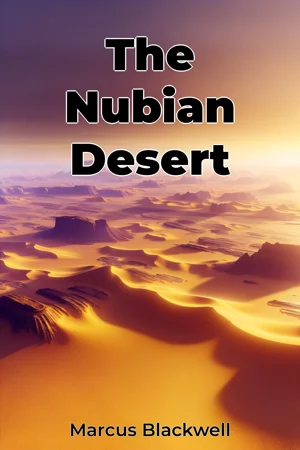
About This Book
"The Nubian Desert" examines one of Earth's most influential yet least understood geographical regions, where ancient civilizations and modern geological wonders converge across 400,000 square kilometers of northeastern Sudan and southern Egypt. The book presents three core themes: the desert's geological evolution over millions of years, its role as a crucial corridor for human civilization, and its impact on modern geopolitics and resource management. These interconnected narratives reveal how this arid expanse shaped human development in northeastern Africa and continues to influence regional dynamics today. Beginning with the formation of the desert's distinctive landscape during the Pleistocene epoch, the text explores how tectonic movements and climate fluctuations created a unique environment that would later support both nomadic peoples and settled communities. Archaeological evidence, including rock art and settlement remains, demonstrates how the region served as a vital trade route connecting sub-Saharan Africa to the Mediterranean world. The central argument posits that the Nubian Desert, rather than being a barrier, functioned as a facilitator of cultural exchange and technological advancement throughout history. This perspective challenges traditional views of desert regions as merely obstacles to human progress. The book's structure flows chronologically through three major sections. The first examines the physical characteristics of the desert, including its geology, climate patterns, and ecological systems. The second section chronicles human adaptation to the environment, from prehistoric settlements to the kingdoms of Kush and Meroe. The final section addresses contemporary challenges, including water resource management, mineral exploitation, and cultural preservation. Research draws from multiple disciplines, incorporating geological surveys, archaeological findings, historical documents, and contemporary environmental studies. Satellite imagery analysis and ground-penetrating radar data provide new insights into both ancient settlement patterns and modern resource distribution. The work connects to environmental science, anthropology, and economic development studies, demonstrating how ancient water management techniques inform modern conservation efforts and how historical trade routes influence current commercial corridors. Written in an academic yet accessible style, the text balances scholarly rigor with engaging narrative elements, making complex geological and historical concepts comprehensible to educated general readers. The target audience includes historians, archaeologists, environmental scientists, and informed readers interested in African history and desert ecosystems. The book maintains focus on verifiable data and academic research while acknowledging the limitations of available evidence, particularly regarding ancient climate patterns and population movements. It addresses ongoing debates about the extent of ancient Nubian influence on Egyptian civilization and the environmental impact of historical mining activities. Practical applications include insights for modern desert agriculture, water conservation strategies, and sustainable development practices. The text also provides context for current archaeological preservation efforts and resource management policies in the region. The book acknowledges scientific uncertainties and competing theories about population movements and climate change impacts, presenting multiple viewpoints where historical or scientific consensus remains unresolved. This approach ensures readers understand both the established facts and areas requiring further research in Nubian Desert studies.
"The Nubian Desert" examines one of Earth's most influential yet least understood geographical regions, where ancient civilizations and modern geological wonders converge across 400,000 square kilometers of northeastern Sudan and southern Egypt. The book presents three core themes: the desert's geological evolution over millions of years, its role as a crucial corridor for human civilization, and its impact on modern geopolitics and resource management. These interconnected narratives reveal how this arid expanse shaped human development in northeastern Africa and continues to influence regional dynamics today. Beginning with the formation of the desert's distinctive landscape during the Pleistocene epoch, the text explores how tectonic movements and climate fluctuations created a unique environment that would later support both nomadic peoples and settled communities. Archaeological evidence, including rock art and settlement remains, demonstrates how the region served as a vital trade route connecting sub-Saharan Africa to the Mediterranean world. The central argument posits that the Nubian Desert, rather than being a barrier, functioned as a facilitator of cultural exchange and technological advancement throughout history. This perspective challenges traditional views of desert regions as merely obstacles to human progress. The book's structure flows chronologically through three major sections. The first examines the physical characteristics of the desert, including its geology, climate patterns, and ecological systems. The second section chronicles human adaptation to the environment, from prehistoric settlements to the kingdoms of Kush and Meroe. The final section addresses contemporary challenges, including water resource management, mineral exploitation, and cultural preservation. Research draws from multiple disciplines, incorporating geological surveys, archaeological findings, historical documents, and contemporary environmental studies. Satellite imagery analysis and ground-penetrating radar data provide new insights into both ancient settlement patterns and modern resource distribution. The work connects to environmental science, anthropology, and economic development studies, demonstrating how ancient water management techniques inform modern conservation efforts and how historical trade routes influence current commercial corridors. Written in an academic yet accessible style, the text balances scholarly rigor with engaging narrative elements, making complex geological and historical concepts comprehensible to educated general readers. The target audience includes historians, archaeologists, environmental scientists, and informed readers interested in African history and desert ecosystems. The book maintains focus on verifiable data and academic research while acknowledging the limitations of available evidence, particularly regarding ancient climate patterns and population movements. It addresses ongoing debates about the extent of ancient Nubian influence on Egyptian civilization and the environmental impact of historical mining activities. Practical applications include insights for modern desert agriculture, water conservation strategies, and sustainable development practices. The text also provides context for current archaeological preservation efforts and resource management policies in the region. The book acknowledges scientific uncertainties and competing theories about population movements and climate change impacts, presenting multiple viewpoints where historical or scientific consensus remains unresolved. This approach ensures readers understand both the established facts and areas requiring further research in Nubian Desert studies.
"The Nubian Desert" offers a comprehensive exploration of a vast 400,000-square-kilometer region spanning northeastern Sudan and southern Egypt, revealing how this seemingly harsh environment has served as a crucial crossroads of human civilization. Rather than portraying the desert as an insurmountable barrier, the book presents it as a dynamic facilitator of cultural exchange and technological advancement throughout history, challenging traditional perspectives on desert regions. The narrative unfolds through three interconnected themes: geological evolution, human civilization, and modern implications. Starting with the desert's formation during the Pleistocene epoch, the book examines how tectonic movements and climate changes created an environment that supported both nomadic and settled communities. Archaeological evidence, including fascinating rock art and settlement remains, demonstrates the region's vital role as a trade route connecting sub-Saharan Africa to the Mediterranean world. Drawing from multiple disciplines, including geological surveys, archaeological findings, and environmental studies, the book bridges ancient wisdom with contemporary challenges. It explores how historical water management techniques inform modern conservation efforts and examines the desert's ongoing influence on regional dynamics. The work is particularly valuable for its integration of cutting-edge research methods, such as satellite imagery analysis and ground-penetrating radar data, providing new insights into both ancient settlement patterns and current resource distribution challenges.
Book Details
ISBN
9788233935009
Publisher
Publifye AS
Your Licenses
You don't own any licenses for this book
Purchase a license below to unlock this book and download the EPUB.
Purchase License
Select a tier to unlock this book
Need bulk licensing?
Contact us for enterprise agreements.