
About This Book
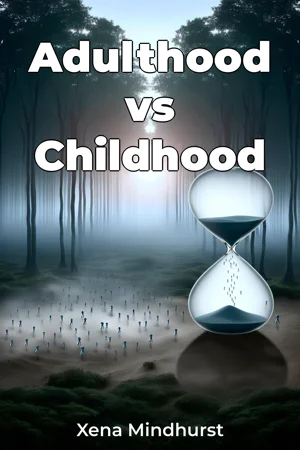
"Are we truly adults, or are we still children wearing grown-up clothes?" This provocative question opens "Adulthood vs Childhood: Navigating the Complex Transition in Modern Society," a groundbreaking exploration of the psychological and relational aspects of human development. This comprehensive work delves into three key topics: the blurred lines between adulthood and childhood in contemporary culture, the impact of extended adolescence on family dynamics, and the psychological challenges of assuming adult responsibilities. These themes are crucial for understanding the evolving nature of personal growth and societal expectations in the 21st century. The book is set against the backdrop of rapidly changing social norms, technological advancements, and economic pressures that have redefined traditional life stages. It draws on a rich tapestry of historical, sociological, and psychological research to provide context for the current state of adulthood and childhood. At its core, the book argues that the transition from childhood to adulthood has become increasingly complex and prolonged, leading to a new developmental stage that challenges conventional wisdom about maturity and independence. This central thesis is explored through a carefully structured narrative that builds a compelling case for reevaluating our understanding of life stages. The content is organized into three main sections. The first introduces the concept of "emerging adulthood" and its characteristics. The second examines how this extended transition affects family relationships, focusing on multigenerational households and changing parental roles. The final section addresses the psychological implications of delayed adulthood, including identity formation, decision-making skills, and emotional resilience. To support its arguments, the book draws on a wide range of evidence, including longitudinal studies, cross-cultural comparisons, and cutting-edge neuroscience research. It also incorporates case studies and personal narratives to illustrate key points and provide real-world context. The interdisciplinary nature of the work is evident in its connections to economics, sociology, and cultural studies. It explores how economic factors influence the timing of traditional adult milestones, how societal expectations shape individual choices, and how cultural differences affect the concept of adulthood across the globe. What sets this book apart is its nuanced approach to the topic, avoiding simplistic judgments about generational differences. Instead, it offers a balanced examination of the benefits and challenges of extended youth, providing readers with a framework for understanding their own developmental journey. The writing style is academic yet accessible, blending scholarly rigor with engaging prose. This approach makes the book suitable for both professionals in psychology and family studies as well as general readers interested in personal development and social trends. "Adulthood vs Childhood" is particularly relevant for young adults navigating their own transition to adulthood, parents of adolescents and young adults, educators, policymakers, and mental health professionals. It offers valuable insights for anyone seeking to understand the changing nature of human development in modern society. In keeping with the conventions of psychology and family relationship literature, the book includes practical exercises for self-reflection and strategies for fostering healthy transitions within families. It also addresses common misconceptions about adulthood and provides evidence-based advice for personal growth. While the book covers a broad range of topics related to the adult-child transition, it acknowledges its limitations, focusing primarily on Western societies and recognizing the need for further research in non-Western contexts. Readers will find numerous real-world applications, from guidance on communication between generations to strategies for developing adult competencies. The book also offers insights for organizations and institutions on how to support individuals through this extended transition period. The work engages with ongoing debates in developmental psychology, such as the validity of traditional life stage models and the impact of technology on social maturation. It presents multiple perspectives on these issues, encouraging readers to think critically about their own beliefs and experiences. "Adulthood vs Childhood" promises to be a thought-provoking and informative exploration of one of the most fundamental transitions in human life, offering readers a new lens through which to view their own journey from childhood to adulthood.
"Are we truly adults, or are we still children wearing grown-up clothes?" This provocative question opens "Adulthood vs Childhood: Navigating the Complex Transition in Modern Society," a groundbreaking exploration of the psychological and relational aspects of human development. This comprehensive work delves into three key topics: the blurred lines between adulthood and childhood in contemporary culture, the impact of extended adolescence on family dynamics, and the psychological challenges of assuming adult responsibilities. These themes are crucial for understanding the evolving nature of personal growth and societal expectations in the 21st century. The book is set against the backdrop of rapidly changing social norms, technological advancements, and economic pressures that have redefined traditional life stages. It draws on a rich tapestry of historical, sociological, and psychological research to provide context for the current state of adulthood and childhood. At its core, the book argues that the transition from childhood to adulthood has become increasingly complex and prolonged, leading to a new developmental stage that challenges conventional wisdom about maturity and independence. This central thesis is explored through a carefully structured narrative that builds a compelling case for reevaluating our understanding of life stages. The content is organized into three main sections. The first introduces the concept of "emerging adulthood" and its characteristics. The second examines how this extended transition affects family relationships, focusing on multigenerational households and changing parental roles. The final section addresses the psychological implications of delayed adulthood, including identity formation, decision-making skills, and emotional resilience. To support its arguments, the book draws on a wide range of evidence, including longitudinal studies, cross-cultural comparisons, and cutting-edge neuroscience research. It also incorporates case studies and personal narratives to illustrate key points and provide real-world context. The interdisciplinary nature of the work is evident in its connections to economics, sociology, and cultural studies. It explores how economic factors influence the timing of traditional adult milestones, how societal expectations shape individual choices, and how cultural differences affect the concept of adulthood across the globe. What sets this book apart is its nuanced approach to the topic, avoiding simplistic judgments about generational differences. Instead, it offers a balanced examination of the benefits and challenges of extended youth, providing readers with a framework for understanding their own developmental journey. The writing style is academic yet accessible, blending scholarly rigor with engaging prose. This approach makes the book suitable for both professionals in psychology and family studies as well as general readers interested in personal development and social trends. "Adulthood vs Childhood" is particularly relevant for young adults navigating their own transition to adulthood, parents of adolescents and young adults, educators, policymakers, and mental health professionals. It offers valuable insights for anyone seeking to understand the changing nature of human development in modern society. In keeping with the conventions of psychology and family relationship literature, the book includes practical exercises for self-reflection and strategies for fostering healthy transitions within families. It also addresses common misconceptions about adulthood and provides evidence-based advice for personal growth. While the book covers a broad range of topics related to the adult-child transition, it acknowledges its limitations, focusing primarily on Western societies and recognizing the need for further research in non-Western contexts. Readers will find numerous real-world applications, from guidance on communication between generations to strategies for developing adult competencies. The book also offers insights for organizations and institutions on how to support individuals through this extended transition period. The work engages with ongoing debates in developmental psychology, such as the validity of traditional life stage models and the impact of technology on social maturation. It presents multiple perspectives on these issues, encouraging readers to think critically about their own beliefs and experiences. "Adulthood vs Childhood" promises to be a thought-provoking and informative exploration of one of the most fundamental transitions in human life, offering readers a new lens through which to view their own journey from childhood to adulthood.
"Adulthood vs Childhood: Navigating the Complex Transition in Modern Society" explores the evolving nature of human development in the 21st century. This thought-provoking book examines the blurred lines between adulthood and childhood, introducing the concept of "emerging adulthood" as a new developmental stage. It delves into how extended adolescence impacts family dynamics and the psychological challenges of assuming adult responsibilities in today's rapidly changing world. The book's unique approach combines historical, sociological, and psychological research to provide a comprehensive view of life stages. It highlights intriguing insights, such as the influence of economic factors on traditional adult milestones and the role of cultural differences in shaping concepts of adulthood globally. By incorporating case studies and personal narratives, the authors bring these complex ideas to life, making them accessible to both professionals and general readers interested in personal growth and social trends. Progressing through three main sections, the book first introduces emerging adulthood, then examines its effects on family relationships, and finally addresses the psychological implications of delayed adulthood. This structure allows readers to grasp the multifaceted nature of modern human development, offering valuable insights for young adults, parents, educators, and mental health professionals alike.
Book Details
ISBN
9788233933302
Publisher
Publifye AS
Your Licenses
You don't own any licenses for this book
Purchase a license below to unlock this book and download the EPUB.
Purchase License
Select a tier to unlock this book
Need bulk licensing?
Contact us for enterprise agreements.