
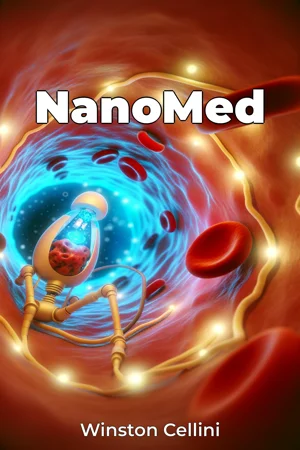
About This Book
"What if we could navigate the human body at the molecular level, targeting diseases with precision and minimal side effects?" This provocative question opens "NanoMed," a groundbreaking exploration of nanoproduction in medical science that promises to revolutionize healthcare as we know it. "NanoMed" delves into three key topics: the fundamentals of nanotechnology, its current applications in medicine, and the future potential of nanomedicine. These topics are crucial for understanding the ongoing transformation of healthcare, offering solutions to longstanding medical challenges and opening new frontiers in treatment possibilities. To provide context, the book traces the evolution of nanotechnology from Richard Feynman's visionary 1959 lecture "There's Plenty of Room at the Bottom" to today's cutting-edge research. It explains the basic principles of nanoscale manipulation and fabrication, ensuring readers have the necessary foundation to grasp the more complex medical applications discussed later. The central thesis of "NanoMed" is that nanotechnology will fundamentally reshape medicine, enabling more precise, personalized, and effective treatments while minimizing invasiveness and side effects. This paradigm shift has the potential to dramatically improve patient outcomes and quality of life across a wide range of medical conditions. The book is structured to guide readers through the nanomedicine landscape. It begins with an introduction to nanotechnology and its relevance to medicine, followed by chapters exploring current applications such as targeted drug delivery, nanodiagnostics, and tissue engineering. The narrative then progresses to emerging technologies like nanorobots and DNA origami, culminating in a discussion of the ethical and regulatory challenges facing the field. To support its arguments, "NanoMed" draws on a wealth of peer-reviewed research, case studies, and interviews with leading scientists and clinicians. It presents data from clinical trials, laboratory experiments, and computer simulations, offering a comprehensive view of the evidence supporting nanomedicine's potential. The book makes interdisciplinary connections between nanotechnology, medicine, materials science, and bioengineering, demonstrating how advances in these fields converge to drive innovation in healthcare. It also explores the intersection of nanomedicine with artificial intelligence and big data, illustrating how these technologies can synergize to accelerate medical breakthroughs. "NanoMed" stands out for its holistic approach, not only discussing the scientific and medical aspects of nanotechnology but also addressing the societal, economic, and ethical implications of its widespread adoption. It offers balanced perspectives on both the promises and potential risks of nanomedicine. Written in an accessible yet authoritative tone, "NanoMed" blends academic rigor with engaging narrative non-fiction elements, making complex scientific concepts understandable to a broad audience. While primarily targeted at healthcare professionals, researchers, and students in related fields, the book is also designed to appeal to informed general readers interested in the future of medicine. As a work in the biotechnology genre, "NanoMed" adheres to scientific accuracy and provides extensive references and a glossary of technical terms. It also includes diagrams and illustrations to help visualize nanoscale concepts and mechanisms. While comprehensive in its coverage of nanomedicine, the book acknowledges the rapidly evolving nature of the field and focuses on the most promising and well-researched applications. It also addresses current technological limitations and challenges that need to be overcome. "NanoMed" offers practical insights for healthcare providers considering integrating nanotechnology into their practice, as well as for patients seeking to understand emerging treatment options. It also provides valuable context for policymakers and investors navigating the complex landscape of medical innovation. The book doesn't shy away from addressing controversies, such as concerns about nanoparticle toxicity and the ethical implications of human enhancement technologies. It presents multiple viewpoints on these issues, encouraging readers to engage critically with the subject matter. In sum, "NanoMed" offers a comprehensive, engaging, and thought-provoking exploration of nanomedicine's transformative potential. By demystifying this complex field and highlighting its real-world implications, the book equips readers to understand and participate in one of the most exciting revolutions in medical history.
"What if we could navigate the human body at the molecular level, targeting diseases with precision and minimal side effects?" This provocative question opens "NanoMed," a groundbreaking exploration of nanoproduction in medical science that promises to revolutionize healthcare as we know it. "NanoMed" delves into three key topics: the fundamentals of nanotechnology, its current applications in medicine, and the future potential of nanomedicine. These topics are crucial for understanding the ongoing transformation of healthcare, offering solutions to longstanding medical challenges and opening new frontiers in treatment possibilities. To provide context, the book traces the evolution of nanotechnology from Richard Feynman's visionary 1959 lecture "There's Plenty of Room at the Bottom" to today's cutting-edge research. It explains the basic principles of nanoscale manipulation and fabrication, ensuring readers have the necessary foundation to grasp the more complex medical applications discussed later. The central thesis of "NanoMed" is that nanotechnology will fundamentally reshape medicine, enabling more precise, personalized, and effective treatments while minimizing invasiveness and side effects. This paradigm shift has the potential to dramatically improve patient outcomes and quality of life across a wide range of medical conditions. The book is structured to guide readers through the nanomedicine landscape. It begins with an introduction to nanotechnology and its relevance to medicine, followed by chapters exploring current applications such as targeted drug delivery, nanodiagnostics, and tissue engineering. The narrative then progresses to emerging technologies like nanorobots and DNA origami, culminating in a discussion of the ethical and regulatory challenges facing the field. To support its arguments, "NanoMed" draws on a wealth of peer-reviewed research, case studies, and interviews with leading scientists and clinicians. It presents data from clinical trials, laboratory experiments, and computer simulations, offering a comprehensive view of the evidence supporting nanomedicine's potential. The book makes interdisciplinary connections between nanotechnology, medicine, materials science, and bioengineering, demonstrating how advances in these fields converge to drive innovation in healthcare. It also explores the intersection of nanomedicine with artificial intelligence and big data, illustrating how these technologies can synergize to accelerate medical breakthroughs. "NanoMed" stands out for its holistic approach, not only discussing the scientific and medical aspects of nanotechnology but also addressing the societal, economic, and ethical implications of its widespread adoption. It offers balanced perspectives on both the promises and potential risks of nanomedicine. Written in an accessible yet authoritative tone, "NanoMed" blends academic rigor with engaging narrative non-fiction elements, making complex scientific concepts understandable to a broad audience. While primarily targeted at healthcare professionals, researchers, and students in related fields, the book is also designed to appeal to informed general readers interested in the future of medicine. As a work in the biotechnology genre, "NanoMed" adheres to scientific accuracy and provides extensive references and a glossary of technical terms. It also includes diagrams and illustrations to help visualize nanoscale concepts and mechanisms. While comprehensive in its coverage of nanomedicine, the book acknowledges the rapidly evolving nature of the field and focuses on the most promising and well-researched applications. It also addresses current technological limitations and challenges that need to be overcome. "NanoMed" offers practical insights for healthcare providers considering integrating nanotechnology into their practice, as well as for patients seeking to understand emerging treatment options. It also provides valuable context for policymakers and investors navigating the complex landscape of medical innovation. The book doesn't shy away from addressing controversies, such as concerns about nanoparticle toxicity and the ethical implications of human enhancement technologies. It presents multiple viewpoints on these issues, encouraging readers to engage critically with the subject matter. In sum, "NanoMed" offers a comprehensive, engaging, and thought-provoking exploration of nanomedicine's transformative potential. By demystifying this complex field and highlighting its real-world implications, the book equips readers to understand and participate in one of the most exciting revolutions in medical history.
"NanoMed" explores the revolutionary potential of nanotechnology in medicine, presenting a comprehensive overview of this cutting-edge field. The book delves into the fundamentals of nanotechnology, its current medical applications, and future possibilities, emphasizing how nanomedicine could transform healthcare by enabling more precise, personalized, and effective treatments with minimal side effects. From targeted drug delivery to nanodiagnostics and tissue engineering, "NanoMed" highlights the diverse applications of nanotechnology in medicine. It traces the evolution of the field from Richard Feynman's visionary lecture to today's advanced research, providing readers with a solid foundation in nanoscale manipulation and fabrication. The book's approach balances scientific rigor with accessibility, using case studies, clinical trial data, and expert interviews to support its arguments. As it progresses, "NanoMed" examines emerging technologies like nanorobots and DNA origami, while also addressing the ethical and regulatory challenges facing the field. By connecting nanotechnology with other disciplines and exploring its societal implications, the book offers a holistic view of nanomedicine's potential to reshape healthcare and improve patient outcomes across a wide range of medical conditions.
Book Details
ISBN
9788233932640
Publisher
Publifye AS
Your Licenses
You don't own any licenses for this book
Purchase a license below to unlock this book and download the EPUB.
Purchase License
Select a tier to unlock this book
Need bulk licensing?
Contact us for enterprise agreements.