
About This Book
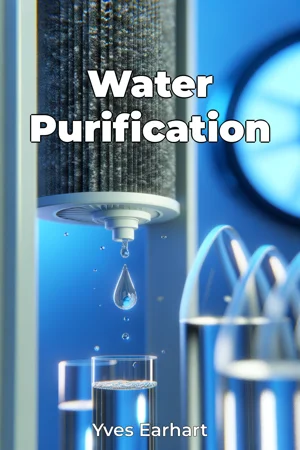
Water Purification: The Science and Practice of Ensuring Safe, Clean Water How do we transform potentially harmful water into a life-sustaining resource? This question forms the cornerstone of "Water Purification," a comprehensive exploration of the methods, technologies, and importance of purifying our most essential compound. From ancient filtration techniques to cutting-edge nanotechnology, this book delves into the multifaceted world of water treatment, offering readers a deep understanding of the processes that safeguard our health and environment. The book introduces three key topics: the science behind water contamination, traditional and modern purification methods, and the global challenges of providing clean water. These topics are crucial as they directly impact human health, environmental sustainability, and socioeconomic development worldwide. Understanding water purification is not just an academic exercise; it's a matter of survival and progress for communities across the globe. To set the stage, the book provides a historical context of water treatment, tracing its evolution from early civilizations to the present day. It explains the fundamental chemistry and microbiology of water, ensuring readers have the necessary background to grasp more complex concepts. The central argument posits that effective water purification is not only a scientific and technological challenge but also a social and political imperative, requiring a multidisciplinary approach to ensure universal access to clean water. The content is structured to guide readers through the intricacies of water purification. It begins by introducing the main types of water contaminants and their sources. The book then explores various purification methods, from basic filtration and chemical treatment to advanced techniques like reverse osmosis and UV disinfection. Finally, it examines the implementation of these technologies on both small and large scales, from household filters to municipal treatment plants. To support its arguments, the book draws upon a wealth of scientific studies, engineering reports, and case studies from around the world. It presents data from long-term water quality monitoring programs and analyzes the effectiveness of different purification strategies in various contexts. The research methodology includes both laboratory experiments and field studies, providing a comprehensive view of water purification in practice. "Water Purification" makes interdisciplinary connections to fields such as public health, environmental science, and international development. It explores how clean water access influences disease prevention, ecosystem health, and economic growth. These connections underscore the far-reaching implications of water purification beyond its immediate technical aspects. What sets this book apart is its holistic approach to water purification. It not only explains the how but also the why, integrating scientific principles with practical considerations and global perspectives. The book adopts an academic yet accessible tone, balancing technical details with clear explanations and real-world examples. The target audience includes environmental scientists, engineers, policymakers, and students in related fields. However, the book is also designed to be valuable to informed general readers interested in environmental issues and public health. As a work of scientific non-fiction, "Water Purification" adheres to rigorous standards of accuracy and objectivity. It presents current research and emerging technologies while acknowledging areas of ongoing study and debate. The book covers a broad spectrum of water purification topics but focuses primarily on technologies and practices applicable to drinking water and wastewater treatment. Readers will find practical applications throughout the book, from tips on choosing home water filters to insights into large-scale water management strategies. It addresses controversies in the field, such as the debate over water privatization and the environmental impacts of desalination. "Water Purification" offers a clear, informative, and comprehensive overview of a critical field. By elucidating the science and practice of ensuring clean water, it equips readers with the knowledge to understand and contribute to one of the most pressing challenges of our time: providing safe, pure water for all.
Water Purification: The Science and Practice of Ensuring Safe, Clean Water How do we transform potentially harmful water into a life-sustaining resource? This question forms the cornerstone of "Water Purification," a comprehensive exploration of the methods, technologies, and importance of purifying our most essential compound. From ancient filtration techniques to cutting-edge nanotechnology, this book delves into the multifaceted world of water treatment, offering readers a deep understanding of the processes that safeguard our health and environment. The book introduces three key topics: the science behind water contamination, traditional and modern purification methods, and the global challenges of providing clean water. These topics are crucial as they directly impact human health, environmental sustainability, and socioeconomic development worldwide. Understanding water purification is not just an academic exercise; it's a matter of survival and progress for communities across the globe. To set the stage, the book provides a historical context of water treatment, tracing its evolution from early civilizations to the present day. It explains the fundamental chemistry and microbiology of water, ensuring readers have the necessary background to grasp more complex concepts. The central argument posits that effective water purification is not only a scientific and technological challenge but also a social and political imperative, requiring a multidisciplinary approach to ensure universal access to clean water. The content is structured to guide readers through the intricacies of water purification. It begins by introducing the main types of water contaminants and their sources. The book then explores various purification methods, from basic filtration and chemical treatment to advanced techniques like reverse osmosis and UV disinfection. Finally, it examines the implementation of these technologies on both small and large scales, from household filters to municipal treatment plants. To support its arguments, the book draws upon a wealth of scientific studies, engineering reports, and case studies from around the world. It presents data from long-term water quality monitoring programs and analyzes the effectiveness of different purification strategies in various contexts. The research methodology includes both laboratory experiments and field studies, providing a comprehensive view of water purification in practice. "Water Purification" makes interdisciplinary connections to fields such as public health, environmental science, and international development. It explores how clean water access influences disease prevention, ecosystem health, and economic growth. These connections underscore the far-reaching implications of water purification beyond its immediate technical aspects. What sets this book apart is its holistic approach to water purification. It not only explains the how but also the why, integrating scientific principles with practical considerations and global perspectives. The book adopts an academic yet accessible tone, balancing technical details with clear explanations and real-world examples. The target audience includes environmental scientists, engineers, policymakers, and students in related fields. However, the book is also designed to be valuable to informed general readers interested in environmental issues and public health. As a work of scientific non-fiction, "Water Purification" adheres to rigorous standards of accuracy and objectivity. It presents current research and emerging technologies while acknowledging areas of ongoing study and debate. The book covers a broad spectrum of water purification topics but focuses primarily on technologies and practices applicable to drinking water and wastewater treatment. Readers will find practical applications throughout the book, from tips on choosing home water filters to insights into large-scale water management strategies. It addresses controversies in the field, such as the debate over water privatization and the environmental impacts of desalination. "Water Purification" offers a clear, informative, and comprehensive overview of a critical field. By elucidating the science and practice of ensuring clean water, it equips readers with the knowledge to understand and contribute to one of the most pressing challenges of our time: providing safe, pure water for all.
Book Details
ISBN
9788233932077
Publisher
Publifye AS
Your Licenses
You don't own any licenses for this book
Purchase a license below to unlock this book and download the EPUB.
Purchase License
Select a tier to unlock this book
Need bulk licensing?
Contact us for enterprise agreements.