
About This Book
"What if I told you that the device in your pocket is more powerful than all the computers used to send humans to the moon?" This provocative question opens "Silicon Revolution: How Hardware Shaped Our World," a captivating journey through the evolution of technology and its profound impact on society. This book offers a layman's guide to the fascinating world of hardware development, making complex concepts accessible and engaging for readers of all backgrounds. The book explores three main topics: the exponential growth of computing power, the miniaturization of electronic devices, and the democratization of technology. These themes are crucial in understanding how our daily lives have been transformed by hardware advancements. By examining these topics, readers will gain insight into the technological foundation of our modern world and glimpse potential future innovations. To provide context, the book begins with a brief history of computing, from the room-sized ENIAC of the 1940s to the smartphones of today. This background sets the stage for understanding the rapid pace of technological change and its far-reaching consequences. Readers need not have a technical background, as the book carefully introduces and explains key concepts in an accessible manner. The central argument of "Silicon Revolution" is that hardware evolution has been the primary driver of societal change in the past few decades, outpacing and enabling software advancements. This thesis challenges the common perception that software is the main force behind technological progress and highlights the often-overlooked importance of hardware innovation. The book is structured to guide readers through this argument, starting with an introduction to basic hardware components and their functions. It then delves into three major sections: the rise of personal computing, the mobile revolution, and the Internet of Things. Each section explores how hardware advancements enabled new capabilities and changed human behavior. The book culminates in a discussion of emerging technologies like quantum computing and neuromorphic chips, speculating on their potential impact on society. To support its claims, "Silicon Revolution" draws on a wide range of sources, including interviews with industry pioneers, academic research, and corporate archives. The book also features case studies of pivotal hardware developments, such as the invention of the microprocessor and the evolution of digital cameras, to illustrate key points. Interdisciplinary connections are a strength of this book, linking hardware development to fields such as economics, psychology, and environmental science. For example, it explores how Moore's Law has influenced business strategies, how user interface design has changed human cognition, and how the demand for rare earth elements in electronics manufacturing impacts global geopolitics. What sets "Silicon Revolution" apart is its approach to storytelling. Instead of a dry recitation of facts, the book weaves a narrative that puts the reader in the shoes of inventors and engineers, bringing to life the excitement and challenges of pushing technological boundaries. This approach makes complex topics not just understandable but genuinely entertaining. The writing style is conversational yet informative, striking a balance between technical accuracy and readability. Anecdotes and analogies are used liberally to illustrate complex concepts, making the book accessible to a wide audience while still offering depth for more technically inclined readers. "Silicon Revolution" is aimed at curious general readers, students of technology and business, and professionals seeking to understand the broader context of their work. It offers valuable insights for anyone interested in how technology shapes our world and where it might take us in the future. As a work of narrative non-fiction in the technology genre, the book adheres to conventions of factual accuracy while employing storytelling techniques to engage the reader. It covers a broad swath of technological history but focuses primarily on developments from the 1970s onward, acknowledging that earlier innovations, while important, have been well-covered in other works. Practical applications abound throughout the book. Readers will gain a better understanding of the devices they use daily, learn to make more informed decisions about technology adoption, and develop a framework for anticipating future trends. The book also discusses the environmental and social implications of hardware production and disposal, encouraging readers to consider the full lifecycle of their devices. While largely celebratory of technological progress, "Silicon Revolution" does not shy away from controversies. It addresses ongoing debates about privacy, the digital divide, and the environmental impact of electronic waste, presenting multiple viewpoints and encouraging readers to think critically about these issues. In sum, "Silicon Revolution" offers a compelling, accessible, and thought-provoking exploration of how hardware has shaped our world, inviting readers to marvel at past achievements and ponder the possibilities that lie ahead in our increasingly digital future.
"What if I told you that the device in your pocket is more powerful than all the computers used to send humans to the moon?" This provocative question opens "Silicon Revolution: How Hardware Shaped Our World," a captivating journey through the evolution of technology and its profound impact on society. This book offers a layman's guide to the fascinating world of hardware development, making complex concepts accessible and engaging for readers of all backgrounds. The book explores three main topics: the exponential growth of computing power, the miniaturization of electronic devices, and the democratization of technology. These themes are crucial in understanding how our daily lives have been transformed by hardware advancements. By examining these topics, readers will gain insight into the technological foundation of our modern world and glimpse potential future innovations. To provide context, the book begins with a brief history of computing, from the room-sized ENIAC of the 1940s to the smartphones of today. This background sets the stage for understanding the rapid pace of technological change and its far-reaching consequences. Readers need not have a technical background, as the book carefully introduces and explains key concepts in an accessible manner. The central argument of "Silicon Revolution" is that hardware evolution has been the primary driver of societal change in the past few decades, outpacing and enabling software advancements. This thesis challenges the common perception that software is the main force behind technological progress and highlights the often-overlooked importance of hardware innovation. The book is structured to guide readers through this argument, starting with an introduction to basic hardware components and their functions. It then delves into three major sections: the rise of personal computing, the mobile revolution, and the Internet of Things. Each section explores how hardware advancements enabled new capabilities and changed human behavior. The book culminates in a discussion of emerging technologies like quantum computing and neuromorphic chips, speculating on their potential impact on society. To support its claims, "Silicon Revolution" draws on a wide range of sources, including interviews with industry pioneers, academic research, and corporate archives. The book also features case studies of pivotal hardware developments, such as the invention of the microprocessor and the evolution of digital cameras, to illustrate key points. Interdisciplinary connections are a strength of this book, linking hardware development to fields such as economics, psychology, and environmental science. For example, it explores how Moore's Law has influenced business strategies, how user interface design has changed human cognition, and how the demand for rare earth elements in electronics manufacturing impacts global geopolitics. What sets "Silicon Revolution" apart is its approach to storytelling. Instead of a dry recitation of facts, the book weaves a narrative that puts the reader in the shoes of inventors and engineers, bringing to life the excitement and challenges of pushing technological boundaries. This approach makes complex topics not just understandable but genuinely entertaining. The writing style is conversational yet informative, striking a balance between technical accuracy and readability. Anecdotes and analogies are used liberally to illustrate complex concepts, making the book accessible to a wide audience while still offering depth for more technically inclined readers. "Silicon Revolution" is aimed at curious general readers, students of technology and business, and professionals seeking to understand the broader context of their work. It offers valuable insights for anyone interested in how technology shapes our world and where it might take us in the future. As a work of narrative non-fiction in the technology genre, the book adheres to conventions of factual accuracy while employing storytelling techniques to engage the reader. It covers a broad swath of technological history but focuses primarily on developments from the 1970s onward, acknowledging that earlier innovations, while important, have been well-covered in other works. Practical applications abound throughout the book. Readers will gain a better understanding of the devices they use daily, learn to make more informed decisions about technology adoption, and develop a framework for anticipating future trends. The book also discusses the environmental and social implications of hardware production and disposal, encouraging readers to consider the full lifecycle of their devices. While largely celebratory of technological progress, "Silicon Revolution" does not shy away from controversies. It addresses ongoing debates about privacy, the digital divide, and the environmental impact of electronic waste, presenting multiple viewpoints and encouraging readers to think critically about these issues. In sum, "Silicon Revolution" offers a compelling, accessible, and thought-provoking exploration of how hardware has shaped our world, inviting readers to marvel at past achievements and ponder the possibilities that lie ahead in our increasingly digital future.
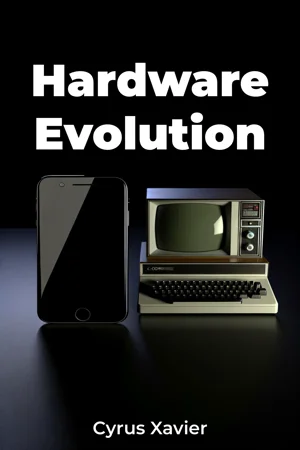
"Hardware Evolution" takes readers on a captivating journey through the Silicon Revolution, exploring how the evolution of computer hardware has fundamentally shaped our modern world. This accessible book illuminates the exponential growth of computing power, the remarkable miniaturization of electronic devices, and the democratization of technology. From the room-sized ENIAC of the 1940s to today's powerful smartphones, the book traces the rapid pace of technological change and its far-reaching consequences. The narrative is structured around three major sections: the rise of personal computing, the mobile revolution, and the Internet of Things. Each section demonstrates how hardware advancements have enabled new capabilities and transformed human behavior. For instance, the book highlights how Moore's Law has not only driven technological progress but also influenced business strategies and global economics. Readers will gain insight into how the microprocessor's invention revolutionized computing and how the evolution of digital cameras changed the way we capture and share memories. What sets this book apart is its engaging storytelling approach, which puts readers in the shoes of inventors and engineers. By weaving together technical concepts with anecdotes and real-world examples, "Hardware Evolution" makes complex topics both understandable and entertaining for a general audience interested in technology. The book concludes with a glimpse into emerging technologies like quantum computing, inviting readers to contemplate the future of hardware and its potential impact on society.
Book Details
ISBN
9788233931766
Publisher
Publifye AS
Your Licenses
You don't own any licenses for this book
Purchase a license below to unlock this book and download the EPUB.
Purchase License
Select a tier to unlock this book
Need bulk licensing?
Contact us for enterprise agreements.